Online Reporter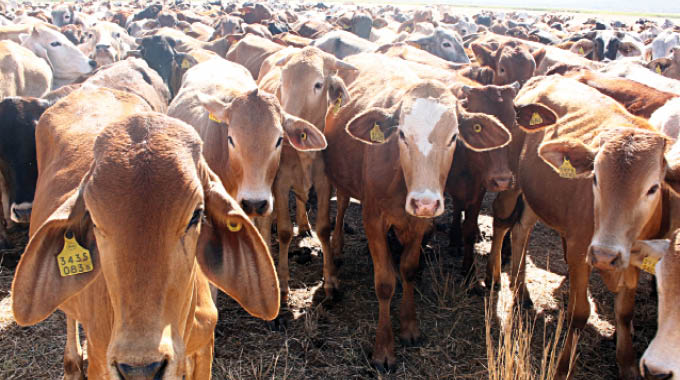
Obert Chifamba-Agri-Insight
EACH season, we seem to be witnessing a predictable pattern: the frantic scramble to climate-proof crop production while there appears to be less noises made about the apparent silent struggles of our livestock.
Livestock enthusiasts may easily be forgiven for feeling that there is some kind of disconnect between the urgency accorded to crop production issues and the equally vital, yet overlooked needs of their animals.
It is therefore crucial for stakeholders in the agriculture sector to reconfigure their mind sets and make some visible efforts to recognise that the health and welfare of livestock is equally important.
The livestock sub-sector is not merely a bystander in the agricultural narrative but a critical player in food security and economic resilience.
And as the skies fill with uncertainty and weather forecasts dominating the headlines, livestock welfare should also take the front row and not, appear to come as an afterthought for stakeholders, as they hurriedly train their sights on salvaging crop farming.
It is a fact that rain-fed agriculture currently faces the most trying times of its existence with droughts bombarding it left, right and centre.
Usually, a season’s success is gauged through crop yields while the livestock sector comes into the matrix if there is something stemming from the outcome of the season and affecting it negatively.
Otherwise, in the absence of such an eventuality, there is a deafening silent about the sector.
My offering is not there to belittle the numerous efforts being invested in improving livestock production but only highlighting the general impression livestock farmers seem to be creating from what they observe every season.
The farmers that I talked to did not seem convinced that enough is being done towards boosting livestock production given that most of them have lost whole herds to drought and diseases in recent times.
Suffice it to say therefore that it is time many other players, especially from the private sector converge on the sector just like they do for crop farming and start rolling out various programmes to revamp it.
The mere fact that each time there is a discussion on food security, crop farming comes to the fore, yet most of the farmers rely on livestock for tillage services.
Some of them even sell off a beast or two to support crop farming, which kind of demonstrates the crucial role this farming category also plays.
The livestock sector surely deserves some concerted effort to reclaim its yesteryear status.
Domesticated animals play an equally crucial role in the national food and nutrition matrix and must therefore be accorded the appropriate attention they deserve.
And for a season like the current 2025/26 that is projected to experience a delayed start, all farmers, including those doing livestock only, need to adopt several strategies to mitigate risks and prepare for the anticipated bountiful rains later in the season.
Such farmers’ preparations may need to start with a properly scheduled supplementary feeding programme in which the animals get both water and feed from the farmer.
This is important given that with delayed rains, pastures may also not be ready to sustain livestock effectively.
The long and short of my argument is that farmers should stock sufficient feed, including hay and grains to sustain their animals during the early dry period.
There should be reliable sources of water, which is clean.
To achieve this, farmers or even development partners should come up with programmes to help establish reliable water sources like boreholes or even install water tanks to capture and store rainwater when it arrives.
Millions of cubic metres of run-off go to waste every season, yet they pass through regions where there are farmers doing livestock farming and a few months down the line, there will be no reservoirs with water to nourish livestock.
Besides this, there is also need to manage the health of livestock. On this one, Government through the Department of Veterinary Services (DVS), has been doing a lot.
Manufacturing of vaccines for the infamous January disease problem is also being done in earnest, as the country moves to rebuild the national herd, which had taken a severe battering from diseases and poverty deaths in recent seasons.
The efforts of Government alone will not be sufficient if the farmers and other concerned stakeholders do not come to the party too. It is important for farmers’ organisations working with Government, to seek collaborations with private sector players to ensure there are livestock programmes running religiously every year.
Vaccination programmes and other veterinary care should be undertaken to ensure the country has a healthy herd. It is interesting to note that communal farmers have the bigger number of cattle, for instance, yet they are the most vulnerable in the event of disease outbreaks or poverty deaths inspired mortalities.
This is the group that needs to be cushioned from these setbacks each time seasons are predicted to be characterised by abnormalities.
Preventive health measures should be prioritised with scheduled vaccination programmes and regular health checks to prevent outbreaks of diseases, especially when stress levels are higher due to food or water scarcity.
This should also include concerted focus on practices such as deworming and controlling external parasites given that stressed animals are more susceptible to infections.
While this is happening, it is also prudent for farmers to adopt and practice rotational grazing to allow overgrazed pastures to recover.
This ensures that when rains come, pastures can regenerate effectively. The other important strategy would through investing in drought-resistant grass species and leguminous plants that will help enhance soil fertility and improve pasture quality.
These strategies should not only zero-in on the nutrition and health side but must incorporate measures that ensure livestock have adequate shelter for protection against cold and wet conditions that may arise unexpectedly.
This will minimise stress and health issues.
On the one hand, it is also crucial to take into account the financial component when crafting strategies to protect livestock from unruly seasons.
Naturally, slow beginnings to seasons come with increased expenses since farmers have to run about securing supplements for different livestock management requirements.
This requires farmers to do their budgeting carefully and possibly adjust cash flow strategies to maintain operations without major disruptions.
The farmers may also need to consider getting livestock insurance to hedge against losses due to drought or other adverse conditions while they also start identifying possible markets for livestock or livestock products early to ensure that they can sell when the rains favour growth.
Those with the capacity may even consider value-adding processes (like processing milk or meat) to enhance profitability when resources become more abundant.
For the communal farmer, one of the most reliable weapons for this fight is resource-sharing, which is possible through collaborating with neighbours to share resources, knowledge, and equipment.
This helps minimise individual costs while maximising resource use.
It is also important for farmers to stay updated with reliable weather forecasts, which helps them to make informed decisions regarding planting, grazing, and resource allocation.