

 admin
admin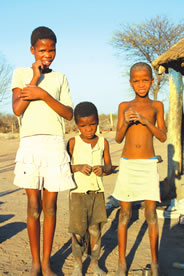
sun carrying a bucket of water on her small head, she is clueless of the ways her ancestors lived and might never know.
All she knows is that they are all different from the other people staying in that area, but no one has had time to tell her why.
Since her ancestor’s switch from being nomads to join other tribes in the area many years ago, life has never been the same for the Khoi San.
The oral history of these people, which for long has been a binding force, is highly fractured and their ancestral language, the abatwa, is extinct.
Both the elderly and young now speak Ndebele.
Only one woman, Gogo Margaret Sibanda (74), still speaks abatwa fluently.
But soon, she will be gone.
The language will go, too.
With no one except a few other old timers who even lack her fluency, to talk to, Gogo Sibanda only shares the language with the wind, in moments of drunken bliss.
There, one sad day, the language will repose.
“How do I teach my grandchildren abatwa when their mother is not interested to learn it?
“I tried to teach my daughter and her siblings the language long back but she is thick headed.
“You can only teach someone if they are interested in learning. These children behave as if they are not interested in learning. It is disheartening to watch language vanish,” she said.
She added: “We still have songs that we sing when we get drunk but the youths laugh at us. We only sing and dance when the sun goes down as we used to in the olden days. I could have danced for you if the time was right and if I was a little bit tipsy.”
Gogo Sibanda says Government officials should visit their area and record the language so that future generations know of its existence.
“We have strong oral culture and it is important to use it, preserve it and try to solve problems like HIV and Aids that face us today by referring to it.
“We even call upon the Government to allow us to teach youngsters attending schools in our area this language,” says the woman whose wit and wisdom is striking.
Modernisation
There are many other things, chief among them their diet, she blames for the switch to modernisation.
She reckons that although modernisation is good – and she loves tea and cooked meat – the people should retain their culture.
She reminisces her days as a young girl when her grandfather, father and uncles would go hunting and bring back game meat.
But now, her voice cracks whenever she speaks of those good old days.
She says if her husband goes hunting, he will be shot by National Parks and Wildlife Management rangers as the law does not allow them to hunt.
“They now call it poaching and will shoot you if they find you. I crave for meat,” she says.
If man would survive on meat alone, Gogo Sibanda could have died years back as the way she explains how she misses meat shows its close link to their culture, so she claims.
Even if she misses the taste of tenderly fire-roasted meat so much, there is nothing her husband can do to provide it.
“I miss all the meat my grandfather and father would bring home. We are now surviving on okra and sadza.
“I was a full figured beautiful woman before all the changes came. You could have seen how good I looked if we had cameras back then. Now I am just a thin old woman watching time pass by. We are living in poverty,” said the old woman.
Children, birth control and education
Her womb bore 13 children. She says most of the children are all not working but sometimes look for work in Bulawayo.
Most of her female children are not married but always bring back babies for her to look after.
The sight of the many grandchildren makes her wish that their culture was not eroded.
She says back in their days, when they still religiously followed their culture, girls would marry men in their community and there were no such problems.
“We would help girls choose husbands and hold traditional wedding ceremonies. We would only demand lobola after our child bore two children for her husband.
“This is how we would measure our son-in-laws’ commitment to our daughters.
“We were also afraid that our daughters would run away from their husbands before their marriages blossomed.
“No man would abandon a woman and children. They would hunt and ensure they are well kept.
“But today, the girls just go and bring you many children to look after. Look at all these children I am looking after. I do not even know some of their fathers,” she said.
Most of the Khoi San people in the area still do not use family planning methods and the large number of children each family has tell the story.
The Ministry of Health and Child Welfare is doing all it can to convince them to use contraception.
Officials even travel to village head’s homesteads and invite them to collect contraceptives, but there are always gaps, some are just not interested.
Out of the 27 Khoi San families living in the area, most couples have children exceeding 10 with the highest having 17.
Village head Mr Amos Sibanda said this is because of various reasons.
He explained that a few use family planning methods, others traditional ones while others like him opt to stay away from such and ensure that their kind does not disappear.
Even if his wife is given family planning pills, she simply does not use them.
He reveals he is a macho man and has 13 children.
“Is it not a bad thing to use contraceptives? Would I be here if my parents had used contraceptives?
“I do not use contraceptives and I have 13 children,” he said.
He notes that to say that most families are living in poverty is an understatement.
Most of the families do not have cattle with some like Gogo Sibanda saying they do not own even a chicken in this dry part of the country.
He says for various reasons, notably the establishment of Hwange National Park in 1928 as a game reserve, and as a national park in 1930, the majority of their people were forced to give up their hunting and gathering lifestyle and merged with other cultures in the district.
“The way we were brought up could have played a big role in our failure to keep our own livestock.
“We are bushmen and our forefathers used to hunt.
“I think not keeping animals runs in our blood, though some have a few cattle,” he added.
Mr Sibanda added that most of the primary school going age children are not attending school.
He said the major reason is because they are poor and do not have money to meet the day-to-day needs of the school.
He claims that the Government-funded Basic Education Assistance Module (BEAM) has failed to shine on them.
And in some cases where it has, the children are turned away from school because their parents cannot afford to buy exercise books.
The same schools have textbooks with a ratio of one to one donated by the United Nations Children’s Fund (Unicef) under the Education Transitional Fund.
Most of the parents seem to care that their children are not getting an education, but they have done less to confront the responsible authorities.
History
According to southafrica.net Khoisan is a term used by physical anthropologists to distinguish the aboriginal people of Southern Africa from their black African farming neighbours.
The original San hunter-gatherer groups lived on this land for approximately 100 000 years before the arrival of other black people and European settlers. When the pastoral Khoikhoi appeared 2 000 years ago they saw people similar to them in physical appearance, but with a different culture. They called these elders of the land “the San”, which means “people different from ourselves”.
The San men usually hunted antelope using bows and arrows smeared with poison. Before a hunt, a shaman would conduct a religious ceremony.
He would enter a trance and his vision was recorded on a rock by way of painting. This rock art is now a central feature of national heritages of countries the Khoisan exist.
The Khoi brought pastoralism to the San – with their sheep and cattle contributing to a balanced diet. Unlike the San, who did not live in a hierarchical society, the Khoi had a complex social structure.
These two cultures would later merge and become known as the Khoisan people.
The Khoisan can be found in Namibia, Botswana, South Africa and Zimbabwe.
Preservation of culture through languages
Lawyer and executive director of the Centre for Minority Rights Development (CEMIRIDE) Mr Innocent Maja during the constitution-making process advocated and spoke of the importance and the need to include minority languages in the Zimbabwean Constitution.
He said the inclusion of minority languages in the country’s constitution would save them from extinction.
He said there is no universally acceptable definition of minority languages both at national and international levels.
“This is not uncommon because the term minority itself defies a precise definition,” he said.
He also said language is a means of expression and allows a person to participate in community activities. It can be used as a medium for fostering a democratic culture.
“Thirdly, languages are also valuable as collective human accomplishments and ongoing manifestations of human creativity and originality.
“Fourthly, languages can be a source of power social mobility and opportunities,” he says.
Expo Times Africa editor Kofi Akosah-Sarpong , who was named Fellow to the Institute of African Renaissance at the University of Botswana, in an essay noted that African culture is part of the remaining 15 000 cultures worldwide.
He says today as Africa increasingly gets absorbed into the global system, its 2 000 ethnic groups are gradually dying or being sucked into modern civilisation as they disappear so does the irreplaceable knowledge and values.
This is a sad part of Southern African history that these two vibrant and culturally-rich tribes are now almost extinct; with Khoisan culture pushed to the periphery of most societies.



 Online Reporter