Online Reporter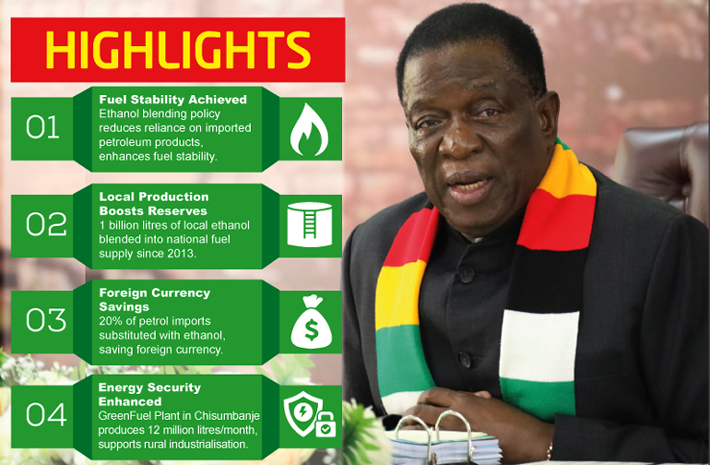
Ray Bande
Senior Reporter
DOMESTIC fuel supply has achieved greater resilience and pricing stability, thanks to reduced reliance on imported petroleum products through the ethanol blending policy introduced in 2013.
This strategic intervention has become one of the country’s most important economic and energy safeguards amid global market volatility and supply chain disruptions caused by the ongoing Middle East conflict.
Just last week, Government cushioned citizens by cutting certain taxes and levies on fuel to avert runaway price increases triggered by surging global oil costs.
Zimbabwe Energy Regulatory Authority (ZERA) announced new fuel prices effective March 4, 2026, with petrol set at US$1,71 per litre and diesel at US$1,77.
Initially designed to ease shortages and reduce the import bill, the ethanol blending policy has evolved into a cornerstone of Zimbabwe’s energy strategy—preserving foreign currency, strengthening energy security, driving rural industrialisation, and advancing environmental sustainability.
More than a decade later, the results are tangible: over one billion litres of locally produced ethanol have been blended into the national fuel supply, making Zimbabwe’s programme one of the largest renewable fuel substitution initiatives in the SADC region.
Production at the GreenFuel Plant in Chisumbanje has placed Manicaland Province at the heart of national energy security.
By substituting up to 20 percent of imported petrol with ethanol, the country has saved significant foreign currency, cushioned consumers from global price shocks, and boosted GDP while protecting household spending power.
Responding to a parliamentary question from Headlands legislator, Honourable Farai Mapfumo, Information, Publicity and Broadcasting Services Minister Dr. Zhemu Soda—acting as Energy Minister—confirmed that Zimbabwe currently holds up to three months of fuel reserves.
“In my interactions with the Minister of Energy and Power Development, (Honourable July Moyo), he indicated that we have two to three months’ fuel in stock, both petrol and diesel as well as Jet A1 for the aviation industry. This includes fuel that has arrived and ships that are docking at the Port of Beira. We are sure that we will be able to maintain affordable prices of the commodity as we keep following events in the Middle East conflict,” said Minister Soda.
In an interview, GreenFuel community relations manager, Ms Merit Rumema said ethanol blending has long been promoted as a way to reduce reliance on imported petroleum products.
“Renewable energy forms a central pillar of GreenFuel’s strategy through both renewable fuel production and renewable electricity generation. The production of ethanol from sugarcane provides a locally sourced renewable fuel that is blended with petrol as part of Zimbabwe’s National Biofuel Policy.
“Ethanol blending has long been promoted in Zimbabwe as a way to reduce reliance on imported petroleum products, while supporting domestic agricultural value chains. At a time when global energy markets are experiencing instability and supply chain disruptions, initiatives such as these strengthen domestic fuel resilience by reducing reliance on imported petroleum products and increasing the proportion of locally produced fuel available in the national supply chain,” said Ms Rumema.
Currently, GreenFuel’s operations maintain an installed capacity of 12 million litres per month.
“Key technical and operational milestones include large-scale feedstock production. The company manages over 14 000 hectares of high-yield sugarcane across two primary estates, supported by a sophisticated large-scale irrigation network. Following recent facility upgrades, the distillation plant now achieves a daily output of 700 kilolitres, producing ethanol at a 99,6 percent purity level – exceeding standard requirements for national petrol blending. In terms of industrial capacity, current operations maintain an installed capacity of 12 million litres per month, positioning the company as a cornerstone of Zimbabwe’s domestic fuel security,” said Ms Rumema.
The Chisumbanje ethanol producer is scaling up operations and production.
“GreenFuel plans to scale operations through continued agricultural expansion and improvements to storage and logistics infrastructure. Immediate plans include increasing the sugarcane cultivation area at the Chisumbanje Estate to 15 000 hectares, underpinned by enhanced pumping and irrigation infrastructure to support long-term increased agricultural output. The company is also investing in additional fuel storage facilities to ensure that ethanol supplies remain stable across seasons and can support blending requirements throughout the year. By supplying locally produced ethanol for blending with imported petrol, GreenFuel contributes to reducing the overall import requirement for finished fuel. This helps moderate foreign currency outflows and provides some stability to domestic fuel pricing in periods of global supply uncertainty,” she said.
Apart from ethanol, GreenFuel is also active in power generation.
“In addition, the company operates a “zero-waste” energy model within its production facilities, utilising bagasse (sugarcane fibre residue) to power a high-pressure boiler producing 120 tonnes of steam per hour. Beyond achieving total energy self-sufficiency for its own operations, the plant has the potential to generate up to 18MW of power, with surplus electricity exported to supplement the national grid. This integrated renewable energy approach reduces reliance on imported fossil fuels while simultaneously contributing to Zimbabwe’s broader energy security strategy,” said Ms Rumema.