admin
admin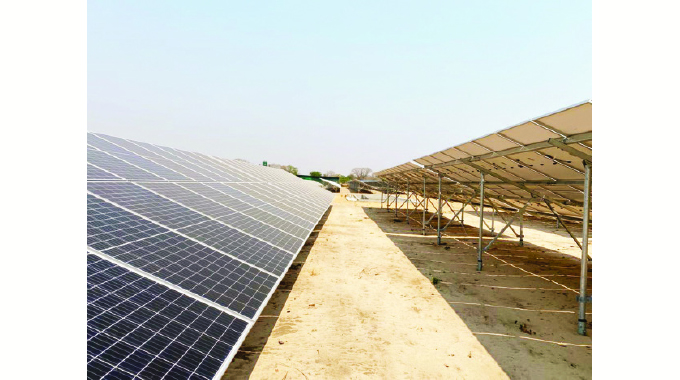
Sam Matema Correspondent
In the wake of global warming and climate change shocks and all attendant challenges, transition to green societies, economies and environments, is seriously threatened by the same.
It is therefore incumbent upon every one of us to be a responsible steward of the environment around us in managing the carbon footprint which is the primary driver of global warming, alive to the direct and indirect anthropogenic contributions.
We need a collective approach to fight climate change and to provide escape routes to green energy alternative sources and solutions. We also need to be very scientific and strategic with respect to the generation, storage, transmission, distribution and retailing of power in order that we give the best possible utility to the final consumer predicated on efficiencies.
Energy Demand
With an installed capacity of 2 800 megawatts (MW), 1 050MW coming from hydro, the rest coming from fossil fuels, and Independent Power Producers (IPPs) contributing less than 2 percent, but chasing a target contribution of 2 000MW, the mining sector and agriculture which are on a serious rebound, uses more than 50 percent of the total energy requirements.
There is therefore the urgency for investment in clean sources in sympathy to the commitments that we made since the Paris Agreement on climate change.
In light of the increase in energy demand, emphasis must be on three aspects, that is energy security, supply and capacity utilisation, of course alive to the urgency of mitigation and adaptation to climate change causes and impacts respectively.
Carbon footprint
Our carbon footprint as a country is comparatively insignificant but we are disproportionately affected by the vagaries of climate change occasioned largely by the actions and activities of the global north.
In view of the aforesaid, and in light of the Kyoto Protocol, the COP28 deliberations, and the obligations and commitments thereto, the global North led by the USA must come to the party and make good their commitments. Without proper and adequate climate financing, our efforts will be akin to building a bridge to nowhere. Zimbabwe as a country contributes insignificantly to the obtaining world carbon footprint, but feels the disproportionate weight of climate change impacts.
Energy and Climate Change
As we work towards realising the following Sustainable Development Goals (SDGs), Clean and Affordable Energy, Innovation and Economic growth, and Sustainable cities and communities via a sound and bankable Climate Action through Partnerships with many actors, state and non-state actors alike, energy availability becomes very critical and important.
As we chase an Upper Middle Income Economy status by 2030 converging with Agenda 2030, there is an upsurge in energy demand that should be matched with ramping up the generation and supply side of the energy equation. ZESA targets to get all households to be accessing electricity and modern energy by 2030 growing from the current 52,29 percent accessibility rate.
The transport sector growth means an increase in demand for carbon fuels for land and aero space, and the attendant pollution from our motor vehicles and aeroplanes.
Independent Power Producers (IPPs) are expected to contribute 2 000MW of clean energy from solar, hydro and wind sources by 2030. We also need to transition from vehicles that run on carbon fuels.
The Electric Vehicles (EVs) have been celebrated elsewhere as a panacea to the pollution occasioned by the many vehicles on our roads. However, many have been lost on the fact of the processes preceding the physical batteries, the mining of the battery ore and the processing that follows which pollute the atmosphere.
We run the risk of contradicting ourselves in terms of policy pronouncements, global commitments and what is obtaining on the ground. We have 26 billion tonnes of coal reserves and 46 trillion cubic feet of coal bed methane (CBM) gas reserves. These are huge reserves that can spur the economy to greater heights, but this solution may become tomorrow’s problem from the perspective of Green House Gas (GHG) emissions and global warming.
There is destruction of 35 000 hectares of vegetation per year related to woodfire with much of that going to tobacco curing against a reafforestation capacity of 5 000 hectares. Decline in vegetation cover change speaks to a decline in carbon sinks exacerbating global warming.
Policy position and policy direction should be in sync with the big idea and the bigger picture. As we transition, we should see more resources being allocated to green alternatives as opposed to carbon fuels.
How do we locate the huge investment in the Hwange 7 and 8 units as well as the oil and gas discoveries in Muzarabani and the investments thereof, in light of carbon emissions and global warming and all attendant challenges?
Just like Poland which is sitting on coal deposits that will deplete in 150 years with 75 percent of its total energy requirements coming from coal, we have huge coal deposits and CBM in Zimbabwe. The opportunity cost of dumping such an important resource is huge.
We find ourselves at a crossroads in light of the potential contradictions, the need to transition to green alternatives vis-a-vis the available not-so-clean discoveries that have a huge and transformative potential financially. How do we strike a balance between social costs (negative externalities) and social benefits (positive externalities)? It is that potential contradiction that is problematic and a cause for concern.
Available Options and a Just Transition
A just transition speaks to “ensuring that no one is left behind or pushed behind in the transition to low-carbon and environmentally sustainable economies and societies through inclusive dialogue that reflect the needs, realities and priorities of their societies” (UN Committee for Development Policy, 2023).
It speaks to a regenerative low carbon economy predicated on energy justice, equity and energy democracy from both the perspective of generation and distribution. It speaks to the ethics of interventions around mitigation and adaptation.
The available clean alternatives are hydro, solar and wind. With respect to hydropower, it is threatened in a very big way by climate variabilities in cases where there are droughts which reduce generation capacity on account of decline in water availability and generation levels.
The Zambezi and Kafue rivers present huge hydropower potential through the 10 gorges (Batoka Gorge, Devils Gorge, Cahora North Gorge, Cahora South Gorge, Kafue Gorge, Lower Kafue Gorge, Mupata Gorge, Lupata Gorge, Boroma Gorge and Mpanda Nkuwa Gorge) power project as part of the ZIZABONA (Zimbabwe, Zambia, Botswana and Namibia) programme expected to generate 15 565MW. There are vast opportunities for harnessing solar and wind energy via some solar and wind farms.
Challenges to a Just Transition
It admits of no debate that green alternatives need huge capital outlays, and in light of the sanctions imposed on Zimbabwe, major sources of funding are not available to Zimbabwe.
When they are available, the funding comes at a premium on account of the high risk index of the economy occasioned by sanctions and the vilification from the west and the negative messages amplified by Uncle Tom surrogates here at home. It is those funding gaps that are an albatross on the green transition neck.
Climate change makes hydropower vulnerable to climate variabilities. The generation capacity of Kariba Dam was significantly compromised by droughts, to the extent that Kariba was decommissioned during the 2019 drought which saw the water level declining to record lows, getting to the 475m minimum level which makes power generation impossible.
In view of the foregoing, even the 10 gorges project which is expected to generate 15 565MW for ZIZABONA, should be seen in the context of the El Nino phenomena in the SADC region.
Power storage is a major challenge. We are currently relying on intermittent energy sources. Investment in storage involves huge capital outlay, and this becomes prohibitive to many countries and private sector players in the global south.
With respect to the transport industry, where there has been hope around EVs and solar aeroplanes, there is serious biodiversity loss, CO2 emissions, air contamination, and water loss from lithium ore mining and processing of the ore and subsequent manufacturing of lithium batteries and solar panels.
An analysis of the value chain and the disproportionate climate change impacts may leave smaller economies and companies in worse off situations because of technological differentials. According to the IPCC assessments there are only two negative emission technologies which relate to carbon capture and storage as well as reforestation and afforestation (IPCC, 2018).
Domestication of Solutions
As we transition, it is imperative that we look inwards and domesticate and localise our interventions and solutions.
We need to leverage on the natural resources that we have in abundance as we provide energy security of supply and efficient capacity utilisation occasioned by plant refurbishments, upgrading of equipment capacity and general expansion of generation capacity with respect to transmission, distribution and retailing of the same.
Through the Innovation Hubs resident in our Institutions of Higher learning, we should invest more in green alternatives via Research and Development in our efforts towards net-zero pollution through conventional mitigation that seeks to decarbonise via renewable energy, nuclear power, carbon capture, fuel switch to low carbon fuels like natural gas. Thermal storage via thermal batteries is one escape route to green energy sources.
Domestication of solutions should also be seen from ethical considerations of human rights and a consequentialist perspective. Ethical considerations predicated on what is right and what is considered to be wrong. It could be argued from a utilitarian consideration as well as welfarism which speaks to greater satisfaction and general welfare of those affected.
The consequentialist consideration looks at the mist benefit to the greatest number. The Turow coal mine (Poland) supplies a nearby power plant with installed capacity of 1,5GW, meets 5 percent of Poland’s energy production and provides electricity to 2,3 million households. The mine and power plant are a source of income to between 60 and the 80 thousand people (Mikulska & Kosinski, 2021). How do we balance such a benefit against the social cost?
The Sustainable Future
This is rooted in sustainable development according to the Brundtland Report – development that meets the needs of the present without compromising the ability of future generations to meet their own needs (Todd Reubold, 2014).
It is an attempt to balance intra and inter-generational equity in the context of climate change, climate justice, welfarism, utilitarism, stewardship, consequentialism, energy and the net-zero transition. We all have an role to play, duty-bound and obligated to save mother earth through mitigation as well as planned and anticipatory adaptation.
Hon. Sam Matema is the MP for Buhera Central constituency and ZANU PF Manicaland Provincial Spokesperson and writes here in his personal capacity.



 Online Reporter