Chronicle Editor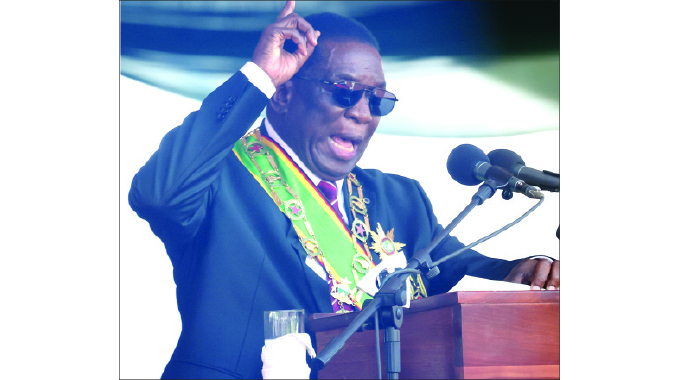
Fungi Kwaramba,Zimpapers Elections Desk
AN INDEFATIGABLE man, respected for his pragmatism over rhetoric, and whose works reflect his words, the President told a state banquet after his inauguration that he will fulfil all the promises that he made when he took over the reins in 2018.
In his inauguration speech, the President promised to consolidate the development programmes that characterised his first term and to be a leader of all Zimbabweans whatever their background.
Starting with the Transitional Stabilisation Programme, of 2018-2020 which laid a robust base for economic growth for the period 2021-2030, the President in his term was implementing the National Development Strategy 1 (NDS1).
This led to unprecedented economic growth, with the country’s economy being the fastest growing in the region, never mind the deleterious effects of the illegal economic sanctions whose primary motive is to stunt growth.
Key areas of the NDS1 include economic growth and stabilisation, food security and nutrition, governance, moving the economy up the value chain, structural transformation, human capital development, environmental protection, climate resilience and natural resources management, and housing delivery.
A bellyful for everyone
A sneak view into recent history will show that Zimbabwe has been able to achieve food security and is now moving towards food sovereignty which is defined as “the right of people to healthy and culturally appropriate food produced through ecologically sound and sustainable methods, and their right to define their own food and agriculture systems”.
This is, as outlined in the President’s inauguration speech, already in motion with the country’s 35 000 villages, each getting solar-powered boreholes that will be used to provide water to irrigate nutritional gardens.
The NDS1 places particular focus on rural urbanisation and modernisation, and towards that end, the 2,7 million communal families will benefit from 35 000 two-wheel tractors that are replacing the traditional hoe and plough system in a transformative move by the Government set to change lives and livelihoods across the country.
“The ongoing success milestones in the agriculture sector will be consolidated during this new term under my leadership. To date, we are food secure in both maize and wheat. All the agriculture sub-sectors have realised unprecedented growth. I commend our farmers as well as stakeholders in the agriculture sector for these achievements. This is indisputable evidence of the success of our Land Reform Programme and the responsive pro-people policies of the Second Republic.
“Going forward, my new Government will prioritise guaranteeing this momentum through household and national food security.
“The construction of dams, accelerated irrigation development, coupled with the ongoing borehole drilling programme, in every village and school, is set to insulate our agriculture sector from climate change-induced weather fluctuations. Vulnerable districts and areas are now the critical focus,” the President said.
Turning mining ores into solar panels and batteries
Apart from the consolidating gains in the agriculture sector, the President also outlined his vision for the equally crucial mining sector, placing particular emphasis on beneficiation and value addition.
In the NDS1, the mining sector has an ambitious US$12 billion target, cynics were doubtful that
Government would transform that sector which was US$2,8 billion when President Mnangagwa came to power in 2018, but that target will be met because apart from just exploiting minerals for raw exports, there is now beneficiation and value addition.
The mining sector is now heading towards a US$20 billion sector with other signature projects on the cards such as the Mapinga Industrial Energy Hub investment worth over US$13 billion. Zimbabwe is set to manufacture lithium batteries and solar panels, resultantly more than 25 000 jobs directly and indirectly will be created in the Great Dyke area.
In yet another masterstroke President Mnangagwa set up measures that compelled gems and precious metals miners to pay half of their mining royalties to the Government through minerals as the country builds its mineral reserves.
Previously, they were paying a portion in forex, but mineral reserves serve as a source of trust in a country given that they carry no credit or counter-party risks. “Our economy must realise maximum benefits from increased beneficiation and value addition. As such, my new Administration, through the
Responsible Mining Initiative, will ensure greater stewardship over our finite natural resources. These must benefit both present and future generations. Riding on our abundant resources, as well as skilled and hard-working people, Zimbabwe is poised to take its place as a competitive manufacturing jurisdiction,” the President said.
Love your country, love your currency
But in the journey to prosperity, President Mnangagwa reckons, no country has ever prospered using an alien currency, whose printing and distribution it cannot control. By using the United States dollar for instance, Zimbabwe will be relinquishing any possibility of having an autonomous monetary and exchange rate policy, including the use of central bank credit to provide liquidity support to its banking system in emergencies.
Without control of the economy, how then can a Government develop its economy and in the case of Zimbabwe, which once used the US dollar, how can it be fully functional economically when it is under sanctions from the US, the source of the dollar, and ironically its misery?
“The past five years have delivered valuable lessons on our intricate economy, especially the fact that a national currency that is supported by a vibrant productive sector is indispensable to sustainable development. No country has ever developed without its own currency. Further, we can only develop and grow the economy based on our own internal resources.
“I urge us all to believe in ourselves and our abilities, as Zimbabweans and Africans. Development and national prosperity based on what we have is more sustainable and durable. We must take pride in who we are and what we can do for ourselves,” said the President. To achieve this, stakeholders from industry to consumers must have a sense of patriotism, with businesses in particular expected to strike a balance between profits and the blight of the people. The ultimate goal is to grow the country’s manufacturing base, to use, consume and wear what the nation produces.
Roads and dams everywhere
With regards to “Made in Zimbabwe” the country has witnessed a new crop of companies that emerged during the dark cloud of Covid-19 to spearhead massive infrastructure development projects, of course with support from the Second Republic.
There was a time when the Harare-Beitbridge Road was like a deadly serpent, many lives were lost on the narrow road that connects Zimbabwe and South Africa, its major trading partner, but with the advent of the Second Republic, the road is among many of President Mnangagwa’s signature projects with only a fraction now left before it is wholly surfaced.
Rehabilitation of the Harare-Beitbridge highway by local companies, that has created thousands of jobs, and the modernisation of the Beitbridge Border Post to bring in efficiency and eliminate delays, the construction of Hwange Thermal Power Station Unit 7 and 8, the completion of major dams across provinces and the Robert Mugabe International Airport are some of the signpost projects of the Second Republic and going ahead, the President promised to deliver even more.
“The modernisation of our national infrastructure, utilities and amenities will continue unabated. Transport inter-connectivity within provinces and further linking us to the rest of the Sadc region and the Continent are a priority.
The internal capacities and local skills in road construction that have been developed over the last five years will be deployed to further modernise our road network.
“Agreements and investments to modernise, repair and expand our rail system will be consummated to allow urgent revitalisation of the sector”.
Everyone needs shelter, everyone needs water
One of the most distressing aspects of urban life in Zimbabwe is the absence of running water. Some have dug wells to plug the gaps left by inept opposition councils, but President Mnangagwa is promising to bring water to urbanites, especially Bulawayo and Harare, the most affected urban centres where population expansion has outpaced infrastructure development,.
This is why a century-old programme, the Gwayi-Shangani Dam commenced under his first term and will be completed during his second term.
“Water is life and a solution not only to sustainable food security and sovereignty but also for the water and sanitation needs of our fast growing urban populations. Gwayi-Shangani and Kunzvi Dams, which are set to meet the needs of Bulawayo and Harare Metropolitan Provinces, are scheduled to be completed soon.”
The President promised to continue delivering quality education and health to his people as that is key to achieving a prosperous Zimbabwe.
“Matters related to housing delivery, water and sanitation, among other social amenities remain key to the modern, empowered, and prosperous Zimbabwe we all want and deserve. I call upon those elected at the local government levels to wholeheartedly serve the people of our great country.
“Our citizens, especially those in urban areas have endured poor service delivery for far too long. Ratepayers deserve hard working and competent local authorities who will ensure that our towns and cities regain their long-lost pride and lustre, through world class service delivery.”
Entrenching democracy and constitutionalism
Zimbabwe’s recent elections were carried in accordance with the country’s laws; they were held in a peaceful environment and the outcome was a true reflection of the aspirations of Zimbabweans.
Now that the elections are over, elected officials are expected to push for their political party interests and use their time in the legislative arm of Government for meaningful debate.
“Under my leadership and the new ZANU PF Government, democracy, good governance, the rule of law and the politics of tolerance will be entrenched, in line with the spirit and letter of our sacred national Constitution and laws.
“We make no apologies for entrenching and protecting our unique Zimbabwean values, cultures and norms. In this regard, I challenge us all to remain Zimbabwean and African, in both thoughts and deeds.”
It is now common cause that President Mnangagwa will form the next Government, and by the same measures those in the opposition should have the grace to accept defeat, because no histrionics, prophecies or fantasies can reverse that outcome.
Maybe focus for the whiny opposition can be trained towards improving areas that were outlined by the various Election Observer Missions that were in the country last month, but for many, focus is on consolidation and continuation of the development projects witnessed during the first term of President Mnangagwa.



 Online Reporter