Chronicle Editor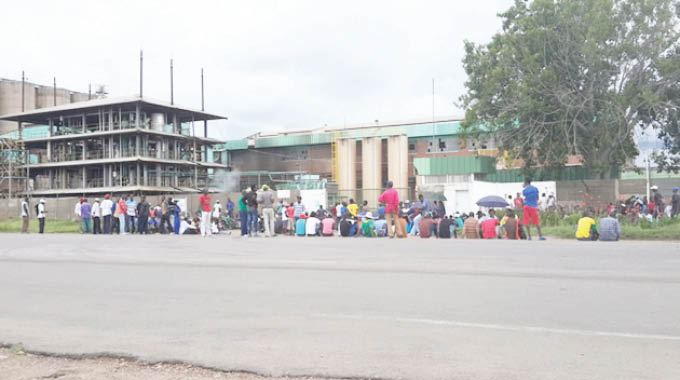
Dumisani Nsingo, Senior Business Reporter
LOW production capacity is haunting one of the country’s leading cooking oil and soap manufacturers, United Refineries Limited (URL)’s prospects of generating foreign currency through exports.
URL chief executive officer Mr Busisa Moyo said the Bulawayo-headquartered company’s production capacity has plunged to below 25 percent largely due to lack of adequate raw materials culminating into poor export performance.
“Our exports have been constrained due to low production capacity which is now below 25 percent from 70 percent in 2016,” he said.
The company resumed exports late last year after it had halted for close to two decades due to a myriad of challenges, including the downturn of the economy. It exports cooking oil, stock feeds and its wide range of soaps to Botswana, Namibia, Zambia, Mozambique and Malawi.
Four years ago as part of its efforts of penetrating the Portuguese speaking nations of Mozambique and Angola, the company inscribed its re-introduced three range of bathing soaps namely Image, Vogue and Fresh Health Joy in Portuguese. Prior to resumption of exports, URL had sustained its operations through processing cooking oil and laundry bar soap.
Mr Moyo said the re-introduction of the Zimbabwean dollar was likely to stimulate exports whose growth was under threat from a strong United States dollar, which rendered local goods uncompetitive on foreign markets.
“Our challenge was competitiveness because of a strong United States dollar, the depreciated Zimbabwean dollar means our goods are landing cheaper in foreign markets,” he said.
However, Mr Moyo said there was a need for the country to improve on the ease of doing exports citing the existence of numerous permits as red tape.
“We, however, need to improve on ease of doing exports, by removing permits and working on a return system, which is easy to work with,” he said.
Mr Moyo said the company’s performance for the first half of the year 2019 had hit a low. “Capacity utilisation has hit a low point in H1, but we are looking forward to a better H2, once our incomes-prices find a new balance demand picks up and exports gain ground,” he said.
Mr Moyo said continued low soya bean output means the country would once again have to rely on imports for crude oil, refined cooking oil and soya bean meal.
“Low soya output will put pressure on imports and further demand on foreign currency,” he said.
According to the Confederation of Zimbabwe Industries (CZI), Zimbabwe in 2016 imported 9 300 tonnes of soya beans and seed, approximately 119 000 tonnes of crude oil and 78 900 tonnes of soya meal. Between 2000 and 2015 production of the crop declined from 135 415 tonnes to 41 768 tonnes.
The decline in soya bean production is attributable to low yields and high production costs. Local production is just enough to meet five percent of the country’s oil needs with soya crude oil import bill standing at US$119m in 2016, an amount which is enough to produce 550 000 tonnes of soya beans.


 Online Reporter