Chronicle Editor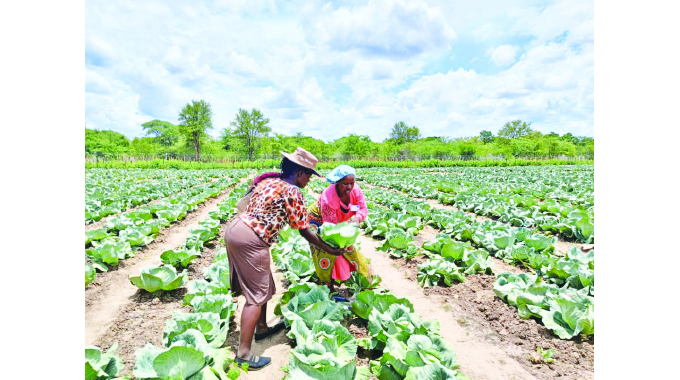
Rutendo Nyeve, Sunday News Reporter
MR Nkosilathi Ncube of Lupaka Village in Ward 10, Lupane District, Matabeleland North Province vividly remembers the day he and other villagers braved the sweltering October temperatures as they embarked on a land clearing exercise to set up an irrigation scheme.
Although they may have been used to the high temperatures that punctuate the summer season in the district, the scorching sun’s rays on their backs made work a little more difficult but hope carried the day for them.
It was the hope of their area being turned from the brown seemingly barren earth that it was into a lush green that would not only solve their dietary needs but empower them in the process and give them easy access to water through a piped scheme.
It was community anticipation of the promised Biblical Canaan and their Joshua was an organisation called Amalima Loko. Three months down the line, Lupaka Irrigation Scheme was born and is promising to transform the lives of more than 75 beneficiaries who have cultivated more than 12 000 cabbage plants, tomatoes, butternut among other vegetables courtesy of Amalima Loko.
The organisation has set up the highly equipped irrigation scheme complementing Government as part of a sustainable agriculture initiative that seeks to increase the resilience of rural communities and strengthen the capacity of those within dry regions to cope with shocks.
The scheme draws water from the nearby Shangani River through ground abstraction and a field day was held on Thursday to celebrate the scheme where various stakeholders spoke glowingly about it.
“We started this scheme under Amalima Loko. It is three hectares and has 75 members. We expect this scheme to transform our lives through money and food security. Looking back, we had food challenges especially nutritious food like vegetables. We also had water challenges but the irrigation has provided us with piped water which is not only used for watering purposes but domestic uses as well. As I speak we started selling on Monday and about 600 cabbages were delivered to our market sources.

“We are in ecological region four which means that our area is dry. However, the coming in of the scheme has helped us a lot. Cabbages are very rare in this area even during the wet season. In terms of soil fertility, it is very poor but the methods we are now using are adding nutrients to the soil.
“We were a bit held up but next week we expect to be supplying as far as Victoria Falls and our tomatoes would be ripe and already we have a market because the whole of Lupane does not have tomatoes at the moment. This is a great opportunity for us to have markets locally as it cuts on the costs,” said Mr Nkosilathi Ncube the chairperson of the scheme.
Mr Robert Dube said he was so happy for the development as it would provide food security and enhance their livelihoods.
“It has helped us the elderly, the young as well as our children. It is also a platform where we all learn new things about farming while hunger will be a thing of the past as we will now get food from this irrigation scheme. It was difficult for us to get fresh vegetables. We were just idle at home doing nothing. As I said, we are learning a lot, I did not know for example that we could dig fertility trenches and put manure in order to make our soil nutritious and get a good yield,” said Mr Dube.
Mr Oliver Mashiri who represented the Agricultural Rural Development and Advisory Service (Ardas) Matabeleland North provincial director said he was happy that the scheme was a community-owned asset and there was evidence that the members were very much committed as they had purchased all the inputs and the healthy state of the crop.
“I am happy that some of your prospective customers are here and they will be able to buy your produce. An irrigation scheme is only as vibrant as its off takers. My piece of advice to the irrigators is that your production should be market-driven. I challenge the marketing subcommittee to continuously engage your customers to find out what they want and when.
“I also implore the local business community to support the irrigation scheme by not only buying their produce but also stocking the inputs that they use, so that these become easily accessible at the local business centre.
“As we start to receive cash from our sales, please let us remember to build our resilience by investing the money into other productive assets that we can use to rely on during those hard times. Let the cash also be spent wisely through joint decision-making.
“It should promote strong family bonds and not tear the families apart. I also encourage the asset management committee to make sure that the maintenance fund is always up and running,” said Mr Mashiri. — @nyeve14



 Online Reporter