admin
admin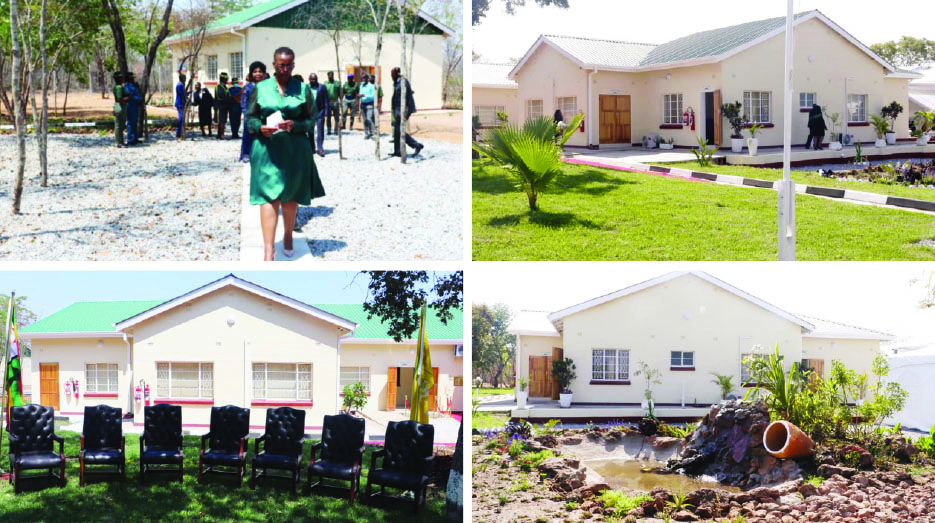
Speech by Chief Justice Luke Malaba at the opening of Lupane Magistrates Court
rtToday’s event is significant in various ways. It is part of the implementation matrix of the Judicial Service Commission’s Strategic Plan, in which it undertook, consistent with its constitutional obligation, to enhance access to justice by ensuring that courts are as close to the people as possible and that justice is dispensed in courthouses equipped with modern facilities.
The event comes a few months after the Judicial Service Commission celebrated the official opening of the first paperless court in Zimbabwe in the form of the Commercial Court on 6 May 2022.
As many of you may be aware, there has been a magistrates’ court sitting at Lupane.
It was housed in three offices belonging to the District Administrator’s Office.
The resident magistrate had a small office which could hardly accommodate a desk; the rest of the support staff used one office; while court proceedings were conducted in a room that was not suitable for the purpose of dispensing justice in an environment that inspired public confidence in the justice delivery system.
The Judicial Service Commission had to provide a court that met the expectations of the public as a symbol of the fountain of justice located in the provincial capital of Matabeleland North.
The Judicial Service Commission commenced the construction of the new courthouse two years ago.
A number of challenges were encountered but were overcome by the resolve and determination to succeed, resulting happily in today’s event. All the justice sector stakeholders represented here celebrate the milestone achievement, which also attests to the realisation of the constitutional value and principle of devolution. In compliance with the constitutional principle of devolution of essential services and infrastructural development provided by the State, the Judicial Service Commission has adopted a policy of ensuring that courts are fairly distributed in all Provinces and that there is a courthouse where the consideration of factors such as data, distance and devolution justify the decision to construct such a courthouse. The objective is to ensure easy access to justice for the people where they live. Courts are places where justice must not only be done and seen to be done; they must be symbols of peace in the community which are easily accessible for the resolution of disputes. A community without an accessible court within reasonable distance is denied the protection of a fundamental human right.
The court complex being commissioned today is spacious and has new furniture befitting the standard of a modern courthouse of its size.
There are twelve offices and two courtrooms. The majority of the offices will be used by members of staff. Two offices have been reserved for the National Prosecuting Authority.
There is also an office for use by legal practitioners who attend court to represent clients. A witness shed and prison cells also form part of the court complex.
At the prison cells there is an office reserved for use by legal practitioners for purposes of consulting with the clients who are in cells. This, by any standard, is an ideal courthouse, suitable for the smooth dispensation of justice.
The Judicial Service Commission is aware of the fact that currently there are only four magistrates’ court stations in Matabeleland North, situated in Victoria Falls, Hwange, Binga and Lupane. The province has the least number of courthouses compared to the other Provinces in the country.
This is so notwithstanding the fact that it is a big Province, meaning that people have to travel long distances to access the nearest courthouse. One needs only to note that from Hwange to Binga one travels 209 km; from Hwange to Lupane is a distance of 165 km; and Hwange and Victoria Falls are 102km apart.
The Judicial Service Commission is disturbed by such long distances between the courthouses because they signify the distances that litigants may have to travel to access the courts. This is a situation that calls for the intervention of the Judicial Service Commission, which should consider having a resident magistrate’s court at Dete, where a circuit court is currently operating.
There is also need to have a court opened at Kamativi. In the fullness of time, I expect Matabeleland North to have at least six courthouses.
Whilst celebrating the official opening of this courthouse, the Judicial Service Commission is conscious of the need to do more in the Province so that there are courts as close as possible to the people they serve.
After all, judicial authority is derived from the people. The infrastructural development envisaged for Matabeleland North is part of the aggressive decentralisation agenda pursued by the Judicial Service Commission throughout the country.
The expansion and decentralisation drive has been an integral part of the policy of a constitutionally based transformation of the Judiciary adopted and being implemented by the Judicial Service Commission with full Government support for the past five years to ensure access to quality justice to all the people of Zimbabwe regardless of where they live.
The Constitution guarantees to every person in Zimbabwe a right to an efficient and effective system of delivery of justice. One cannot speak of efficient and effective administration of justice where courts are far for the people to access justice.
Every person wants to be treated fairly by fellow human beings, either in their individual capacities or as public officers in the execution of the duties of the offices of the institutions charged under the Constitution with the responsibility of the administration of justice.
He or she expects to be treated in the same manner as is applied to any other person in circumstances similar to his or her own.
Courts are not built to satisfy the interests of court staff and legal practitioners. They are built so that those who work in them and administer justice are in a position to discharge the call of the duty of public office to serve members of the public conscientiously, diligently, fairly and equally without favour.
Every person who seeks service in pursuit of justice at the courts must be served with the utmost respect for his or her inherent dignity as a human being.
The marginalised and vulnerable people, such as children, women, the disabled and the illiterate, must receive the same service to their satisfaction like any other court user.
In other words, court users must all be accorded friendly and respectful attention from court staff. They must always be made to feel welcome, no matter the cause of their visiting a courthouse.
Allow me to share with you and the nation at large some of the expansion and access to justice programs being undertaken by the Judicial Service Commission –
Previously the High Court used to sit at Harare and Bulawayo only. As a result of the Judicial Service Commission’s decentralisation program, the High Court now sits at Mutare in Manicaland Province, Masvingo in Masvingo Province and Chinhoyi in Mashonaland West Province. If everything goes according to plan, there shall be a High Court sitting at Gwanda in Matabeleland South Province, where the Judicial Service Commission is in the process of building a state-of-the-art court complex.
The plan is to have the court complex house the High Court, the Magistrates Court and the Office of the Sheriff.
The court complex at Gwanda would come after the opening of the beautiful Chinhoyi court complex on 03 September 2021. Upon its completion, the Gwanda court complex will be a source of pride for the people of Matabeleland South. The goal is to have a High Court in every Province, starting of course with those Provinces that already have the High Court sitting as a circuit court. The Judicial Service Commission may therefore be back in Matabeleland North with a High Court after the construction of the High Court in the Midlands Province.
The Judicial Service Commission is currently undertaking a construction project at Chiredzi where there will be a bigger and better equipped courthouse than the prefabricated court, which is no longer suitable for the district. Construction of Mutawatawa courthouse has also commenced. Currently the Mutawatawa Magistrate’s Court is housed in the District Administrator’s offices, the same scenario that prevailed at Lupane.
The Judicial Service Commission will soon be converting the circuit court at Chimanimani in Manicaland Province into a resident magistrate’s court. Inyathi circuit court in Bulawayo Province has already been converted into a resident magistrate’s court. The Judicial Service Commission hopes to commence constructing bigger and better equipped courthouses at Kwekwe and Murehwa in the near future so that the needs of the population in those areas are met.
The Judicial Service Commission recently commenced the novel and far-reaching initiative of constructing courthouses in townships in the big cities such as Harare, Bulawayo, Mutare and Gweru. The initiative has been informed by the need to reduce the number of people who visit the courts which are traditionally located in the city centres. The litigants should be able to access justice in the townships without the need to travel all the way to the city centre.
As the population continues to grow, the courts’ facilities in areas such as Tredgold in Bulawayo, Rotten Row and Mbare in Harare have been over-stretched. Under the initiative, the Judicial Service Commission is constructing a courthouse at Epworth, which will serve the people of that township. It is hoped that the Epworth Magistrates Court will be opened this year, as the building is at its finishing stages. In Bulawayo, the Judicial Service Commission has secured stands from the City Council to build magistrates courts in Cowdry Park and Emganwini to serve the people of those townships. The Judicial Service Commission is grateful to Epworth Town Council and Bulawayo City Council for responding positively to its requests for land on which to build courts for residents to ensure the protection of their constitutional right of access to the courts.
Harare City Council has reacted positively to the Judicial Service Commission’s request for land on which to build courts and a process is currently underway to identify suitable land or buildings the Harare City Council can provide for the erection of, or conversion into, courthouses. The engagements with Gweru City Council, however, met with no success as the request for land on which to build a court in Mkoba was rejected by the City Council. The need to locate courts close to the people is a constitutional imperative, binding on all institutions of Government including those responsible for local governance. It is hoped that Gweru City Council will soon appreciate its constitutional responsibility and respond positively by cooperating with the Judicial Service Commission in the endeavour to provide courthouses close to the people.
In addition to these construction projects, the Judicial Service Commission has carried out rehabilitation and refurbishment of old courthouses to meet world class standards. The work was successfully carried out at Harare Magistrates Court, the High Court at Harare and Bulawayo, Mutare Civil Court, Tredgold Magistrates Court, the Supreme Court and the Constitutional Court, amongst others. The Judicial Service Commission furnished the courthouses with new furniture and equipment and attended to repairs, such as painting, to improve the ambience of the court premises. Litigants and members of the public who have visited the courts will attest to the conducive environment for the attainment of justice obtaining in these courts.
Hwange Provincial Magistrate’s Court had been an eye-sore over the years, as the building had become old.
The roof tiles were falling off; the floor tiles peeling off; and the building generally had degenerated into an appalling state of disrepair.
The Judicial Service Commission carried out extensive rehabilitation works at the court, including redoing of the roof and the ceiling, painting, retiling the floor of the entire courthouse, replacing all the furniture, and creating an additional courtroom. It was a major face-lift of the courthouse.
The exercise was very successful and the courthouse is now a source of pride for the Judicial Service Commission. The court now looks beautiful and modernised.
I share with you all these institutional and operational measures the Judicial Service Commission has adopted and implemented so that you appreciate that what has been done at Lupane is not an isolated development but an integral part of a well-planned process in the execution of a national development strategy based on constitutional values and principles of good governance. The Judicial Service Commission undertakes these projects on the basis of the formula it has termed the three Ds principles; that is, DATA — there should be collection and analysis of data on the population of an area and case statistics available to the Judicial Service Commission to assess need, DISTANCE — there should be taken into account the distance people have to travel to access the nearest courthouse, and DEVOLUTION — there should be compliance with the Government policy and the constitutional requirement on devolution. The Judicial Service Commission is an institution created by the Constitution.
Its constitutional mandate is stated in sections 190 and 191 of the Constitution. In the execution of its mandate, the Judicial Service Commission is mindful of the requirement that it must have a national outlook and that the services provided in the form of provision of centres for the administration of justice must reflect the necessary equitable national distribution.
Lupane Magistrate’s Court will benefit from the national program of the Integrated Electronic Case Management System (IECMS). The IECMS is a system in which the filing of documents, including pleadings from the beginning up to the finalisation of a court case, will be done electronically and the hearing of matters will, where practical, be conducted virtually.
The system is already operational under Phase One of the program in the Constitutional Court, the Supreme Court and the Commercial Court. The already digitised courts have been functioning well under the IECMS.
The system is now being moved to Phase Two of its implementation, which will involve the High Court, the Labour Court, the Administrative Court, the Magistrates Courts and the Office of the Sheriff. The system will make the courts more efficient and effective by ensuring that matters are disposed of without delay.
Although the Judicial Service Commission will continue to build more courts in Matabeleland North, the implementation of the IECMS under Phase Two of the program will go a long way towards mitigating the effects of barriers to access to justice faced by the people in the Province and elsewhere in the country due to long distances they have to travel to be able to be physically present at the courthouse. Litigants will be able to access courts from the comfort of their own homes and offices, particularly where they are not accused persons who may in some cases have to be physically present in court during trial.
At each court the Judicial Service Commission has deployed e-filing officers who will assist litigants who may have problems using the system or who do not have the enabling gadgets.
The measures were devised with the interests of the poor, the marginalised and the vulnerable people who use the courts, such as children, women, the disabled, the illiterate and generally those who need the assistance to navigate the technology based system in mind. This has been done so that technology itself does not become a barrier to litigants accessing the courts and justice.
The Magistrates’ Courts will not be embracing digitisation for the first time when Phase Two of the implementation of the IECMS commences. In February 2022 the Judicial Service Commission officially launched the virtual courts system at Harare Magistrates Court. The virtual courts system electronically connects the physical courts with remand prisons to enable routine remand and bail applications to be made, heard and determined through the virtual platform.
Virtual courts have been set up at all provincial stations in the country. Taking into account its location, Lupane Magistrates Court will soon have the virtual court system installed.
The introduction of the IECMS in the courts is in line with the trajectory adopted by the Government on the Ease of Doing Business principle, as this will no doubt enhance business interactions for both local and foreign investors.
The system will ensure that investors have access to the courts from anywhere in the world and the courts will be more efficient and transparent.
The IECMS also resonates with the thrust of the Government vision of ensuring that Zimbabwe becomes a Prosperous Upper Middle-Income Nation by 2030 in accordance with the policy document and the National Development Strategy 1 (NDS1). The objectives of the NDS1 are consistent with the national aspiration of constitutional transformation of the lives of the people in line with the demands of social justice. Establishing the IECMS is one of the documented strategies to improve justice service delivery in the NDS1.
It is part of the broader aspiration of establishing an integrated e-government system. The Judicial Service Commission is grateful to its sister departments and Ministries, including Treasury, for the necessary support provided by them to pioneer the implementation of the IECMS in the Judiciary to promote access to justice for all citizens.
The justice delivery system was never intended to allow for and tolerate obstructions to access to justice. The rivers of justice must be allowed to flow smoothly according to the law until they reach their destination of delivery of justice.
By demanding an efficient and effective justice delivery system, the Constitution calls upon all stakeholders, such as the police, lawyers, prosecutors, magistrates and Judges, to apply themselves in a manner that guarantees the efficiency and effectiveness of the justice delivery system.
All the measures adopted and implemented by the Judicial Service Commission mark the process of transformation of the Judiciary from presiding over an inefficient system of delivery of justice, characterised by huge backlogs of cases, long delays in the delivery of judgments and over-prolonged partly heard cases, to a system that gives priority to expeditious delivery of quality justice.
As I conclude my remarks, allow me to thank the Ministry of Finance for the financial support it provided towards the construction project that was carried out here.
I would also like to thank the Ministry of Local Government and Public Works, which was in charge of the technical side of the project, for the successful implementation and finalisation of the project.
I also extend the Judicial Service Commission’s gratitude to the Ministry of Justice, Legal and Parliamentary Affairs for the continued support and co-operation.
The Judicial Service Commission has progressed to where it is able to have developmental changes that speak to progress in the process of ensuring efficiency and effectiveness in the administration of justice because it long heeded the constitutional requirement to co-operate with other organs of Government without losing its independence.
I also wish to express my appreciation to the members of the Judicial Service Commission Secretariat for the hard work and dedication to duty that made today’s event possible.
The planning, the execution and the successful completion of the project would not have happened without the passion and dedication to duty by members of staff.
Finally, I thank all of you for gracing today’s occasion. Your support gives the Judicial Service Commission the basis of the conviction that the reforms it has embarked upon to improve the justice delivery system will have the desired outcomes to build public confidence in the justice delivery system.
With these remarks, I now declare the new Lupane court complex officially commissioned.
I THANK YOU.



 Online Reporter