tawandamusarurwa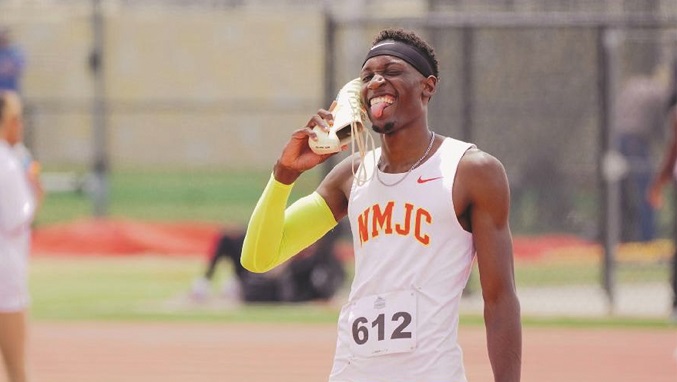
Petros Kausiyo
Sports Editor
FOR Tapiwanashe Makarawu, his debut at the just-ended World Athletics Championships was about “coming, seeing and learning”.
And at the end of it all, he left Budapest, Hungary, as inspired as he was confident that he could match some of the world’s best athletes.
It was probably the biggest stage of his fledging career so far.
He ran alongside eventual gold medallist and defending champion Noah Lyles in Heat 2 of the 200- metre event, clocking 20.64 seconds.
He, however, failed to qualify for the semi-finals.
Lyles, who had earlier won the 100m race, looked comfortable, coasting home in 20.05sec to win his qualifying Heat.
He later claimed his third straight 200m World Championships title.
But more importantly for Makarawu, competing against the first man since Usain Bolt in 2015 to win double gold in 100m and 200m events left him more inspired than overawed.
The Zimbabwean speed merchant is now targeting to qualify for the 2024 Olympics.
There were plenty of positives to take back to his base at New Mexico Junior College in the United States, from the World Championships.
“From my perspective, I think my Heat was not that fast and I didn’t manage to make it to the semis, but it was a learning curve for me,” Makarawu said.
“Going back home, I have to work on some areas like my start, consistency throughout the race and all that, and I hope my coach will help me with those aspects.
“Watching the final (men’s 200m), I noticed that consistency is just the key to these competitions. You have to be strong emotionally and mentally, even physically. Everything has to apply if you are going to run well and give it your best performance in these kinds of competitions . . .
“I am going to work on my mental and physical areas so that I can improve on my performance in the coming season, as I prepare for qualification for the Olympics, my college outdoor season and the All-Africa Games.”
And he has enough time during the Olympics qualification window to punch his ticket to the Paris Games.
There are a number of platforms on which he can run the qualification time of 20.24sec.
He, however, wants to seal that qualification at the earliest possible time.
“Basically, I just want to qualify as early as possible, but my challenge is that back in the United States, during my school season, we will start with the indoor competitions, then we move to outdoor.
“But my target is just to qualify for the Olympics from the first outdoor competition that I get so that it reduces the pressure on me.
“If I qualify early, then it means I can use more races to prepare for the Olympics.”
With National Athletics Association of Zimbabwe (NAAZ) director of development and talent identification Lisimati Phakamile indicating that they would help Makarawu race outside of the US, opportunities for the 23-year-old to fulfil his Olympic dream may come much earlier.
The athlete has just spent his first year in the US, after having secured a scholarship from Bindura University of Science Education’s sports academy.
“Back home (in Zimbabwe), I didn’t have much time in the gym and now in the United States, I have that opportunity . . .
“And now I can spend more time with my coach . . . getting all the help I can,” he said.
“I can also always access my physiotherapist anytime that I want, and it is something that helped my performance and helped me with breaking the national record and own personal records.”
After picking up an injury during the outdoor nationals in the US, Makarawu feels he has fully recovered and ready to use the World Championships as a springboard for success.
NAAZ president Tendayi Tagara has already noted something special in Makarawu.
He believes barring a serious injury, he will be Zimbabwe’s flag-bearer in the sprint events, given that he also competes in the 100m race.
“If you look at Makarawu, he has the qualities of a modern sprinter. Look at the Botswana guy (Letsile Tebogo), look at Bolt (Usain) and the American sprinters and you look at his shoulders and height, not bulky . . . it is all about the strength to run a good time,” said Tagara.
Phakamile considers him a medal hopeful.
“In less than a year, Tapiwa managed to compete with the defending world champion, Lyles, indicating that, with more training and more races at such a level of the competition, he can do even better,” he said.
“Tapiwa has got the body, the mind (and) he has got the zeal and a very stable mind, and my appeal to the association is to give him more platforms to compete at such levels.”



 Online Reporter