admin
admin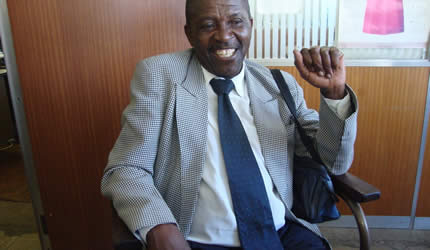
work and worrying about improving their grades, Pius Makokowe, then 15, was already crossing the length and breadth of the country, recording music and holding live shows.
Now nearing 60, the long forgotten musician, famed for the 1969 hit single “Anopenga Ane Waya”, is now retracing his footsteps and wants to re-record the yesteryear hits that earned him fame and a little fortune more than four decades ago.
Makokowe has since teamed up with Hwange-based Chimurenga musician, Blessed Chari to revive his waning fortunes in music. He is doubling up as the band manager as well as the lead guitarist for Chari, on their “Bhora Mugedhi” project.
“I am working with Blessed to improve our music, which we call the genuine Chimurenga music. I have, however, not abandoned the type of music that brought me fame. Right now we are in the process of reproducing all the yesteryear music that we did back in the 1970s. We also want to produce videos for some of the songs,” he enthused.
Reminiscing over his career, Makokowe, a retired staff sergeant in the army and farmer, says he played his part in entertaining Zimbabweans, who then were faced with a lot of challenges as a result of colonialism.
He ventured into music when he was only 15 after being spotted by Elias Banda, who was already a practising artiste and had just formed a band.
Makokowe and Elias Banda then teamed up with the likes of the late Jethro Shasha, and Elias Chimwala to form the Great Sounds, the band that earned them accolades for releasing the yesteryear hit song “Anopenga Anewaya”.
With yet another song “Connie” on the flip side of “Anopenga Ane Waya” the single went gold, just a few weeks after its release.
It was a shocking development for Makokowe and his peers, who had wanted nothing more than just to enjoy themselves and get attention from the women in the neighbourhood.
“Before we knew it we were already lining our pockets with money, because the single was well received.
“I remember getting about £200 as royalties, and back then with £500 you could actually buy a house in the high- density suburbs.
“Since I was still in school, the money was given to my father, who bought me a few shirts and trousers for my uniform, while he used the rest for family upkeep and other needs,” he recalled.
Spurred by the few dollars and the realisation that they could make more, in the event that they played their cards right, the group worked hard and released a few more sizzling hits that were also well received.
“Some of the songs included “Wakandisiyisa Mbatya”, “Mupfuwhira”, which has stood the test of time and is used as the signature tune for the radio programme “Chakafukidza Dzimba Matenga”.
Having made a name for themselves, the group’s popularity grew and they could now hold live shows in the high-density bars like Mutanga in Highfield.
On a few occasions they would also play at upmarket venues like Elizabeth Hotel, because of their ability to play copyrights from Elvis Presley, the Beatles and Cliff Richard.
However, as is often the case, when fame and fortune outweighs integrity, the centre could not hold, resulting in the disbandment of the Great Sounds.
“While others abandoned music completely my brother and I formed the Acid Band in 1975, and released a number of hit songs that included ‘Basa’, ‘Wakandisiya Zvisina Notice’ and ‘Shanje’.
“During the same year I took a break and went to the UK to see my wife, and that’s when Chimurenga musician Thomas Mapfumo joined the band to fill in the void,” he said.
When he came back, Makokowe did not retrace his footsteps with the Acid Band, but joined the rhumba outfit Real Sounds who had just arrived in the country from the Democratic Republic of Congo and operating from Mutare. That was in 1979.
At the peak of the liberation struggle, he joined the army, where he served for more than two decades until his retirement in 1997.
“Even when I was in the army my passion for music never died. Although I had taken up nursing in the army I still loved music.
“My passion was later recognised by my superiors who asked me to assist in grooming youngsters within the army.
“I then enrolled at the Academy of Music in Bulawayo and did music theory. It therefore did not come as a surprise to those who knew me when they saw me getting back into music, after I had retired from the army,” he said.
Soon after hanging his military fatigues, he joined Jabavu Drive in 2011, having spent some few years tilling the land at the family plot in Nyanga.
However, his romance with the jazz outfit did not last long and he left Jabavu in August last year.


 Online Reporter