

 admin
admin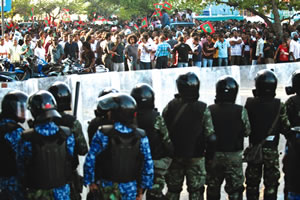
Tuesday’s turmoil in the island nation of Maldives again showed a collection of unhappy neighbours – unhappy with each other and unhappy among themselves.
Grappling with internal crisis and as a result hampering economic development is a chronical problem for South Asian countries, according to political analysts here.
After decades of civil war, Sri Lanka has regained stability and is seeking economic recovery and rehabilitation of war-torn areas in the north.
Pakistan is fighting with Islamic extremism for nearly two decades with a prolonged war waged by NATO in its western neighbour Afghanistan. Rumours of military taking over again gained front pages of Indian newspapers last month, against the background of a renewed Pakistan-US tension of relations.
“Pakistan has a democratic government but it’s also tackling with Taliban and al-Qaida militants causing blasts – almost on a regular basis – in the country. Besides, it is faced with Nato operation on its border on a daily basis, while Islamic militant groups from outside the country are active there,” said Professor Ajay Singh, a Delhi-based political analyst.
After a space of nearly two years when its capital saw violent fighting between the army and dissident soldiers, Bangladesh army last month claimed to have foiled a coup planned against the government of Hasina, saying the attempt by some fanatic military officers had been thwarted by the “whole-hearted efforts of army soldiers.”
“In recent years, certain government policies, such as its attempts to push Bangladesh in a more secular direction and its closeness to neighbouring India, have proved divisive. Islamist groups openly challenged the government and it seems the discord spread to elements of the army,” said Professor SK Gupta, a South Asia analyst.
Nepal, another India’s close neighbour, is also troubled by political uncertainty but it is trying its best to return from the edge by experimenting with a democratic system, according to the experts.
“The decade long civil war transformed Nepal from a monarchy into a republic in 2008. But internal political crisis has grappled the Himalayan nation, though India is playing the role of a big brother to stabilise the country.
“India wants Prime Minister Baburam Bhattarai’s government stays on even though there are some vocal Maoist factions stridently opposed to any agreement with ‘hegemonic’ New Delhi,” said Professor Singh.
In fact, late last year, India agreed to provide US$250 million in credit for developing Nepal’s infrastructure.
“New Delhi’s ‘generosity’ is intended to free Indo-Nepal relations from political nettles and ground it in economic realities that make Nepal an attractive investment destination for countries. Nepal’s economic partnership with India augurs well for both the neighbouring nations” said Professor Singh.
The Indian Ocean nation’s first democratically elected President Mohamed Nasheed Tuesday resigned bowing to pressure following police mutiny and weeks of protest over his controversial decision to sack a criminal judge he had accused of favouring the opposition.
“Though it can’t be called a military coup of sorts, trouble in Maldives is trouble in the Indian subcontinent.
“More or less a peaceful nation, Maldives is strategically important to India’s security being in the backyard.
“For India, which has close security and trade links with Maldives and is now poised to provide greater developmental assistance after Prime Minister Manmohan Singh’s visit during the South Asian Association for Regional Cooperation summit, negatives have emerged from the sudden turn of events Tuesday,” said Basab Sen Sharma, a former Mumbai University political teacher.
“As I have always said, we live in perhaps the most troubled neighbourhood in the world. In this neighbourhood there are countries with governments that are extremely fragile and all this increases the level of threat to our security and our defence,” Indian Home Minister P. Chidambaram once said. – Xinhua.



 Online Reporter