admin
admin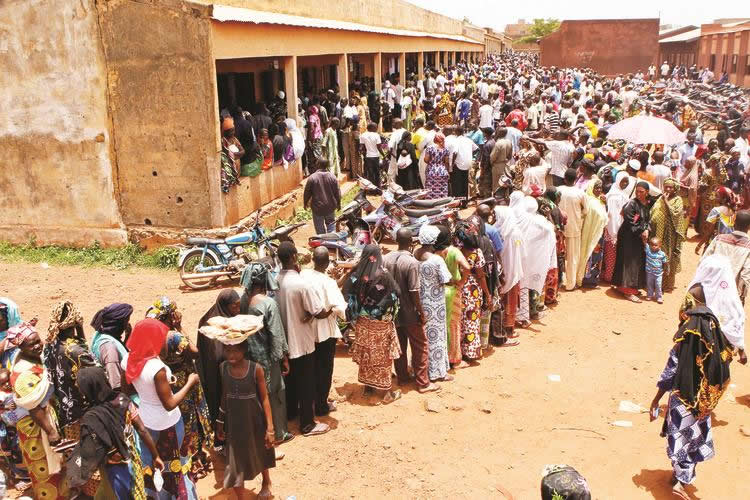

BAMAKO. — Voters in Mali headed to the polls yesterday for a second round of presidential elections, officials said. The leading candidate, 68-year-old former prime minister Ibrahim Boubacar Keita or IBK as Malians call him, cast his vote at the centre of Sebeninkoro Ecole AB, in the 4th district of Bamako, where a heavy deployment of security measures were visible.
Shortly after the voting, IBK told press at his residence that if he is elected, he will form a government which will “make sure that our whole country gets back onto the base of unity.”
“Our parents are in hope,” said IBK, “this country needs all his sons and daughters.”
IBK garnered 39,97 percent of the votes in the first round held on July 28, largely ahead of his rival Soumaila Cisse who got 19,70 percent. Since no single candidate gained 50 percent of the total vote, the poll had to go to a second round.
IBK had his favourable position consolidated following the announcement of results of the first round, as 20 of the 25 eliminated candidates of the first round chose to support him in the second round.
His long-term rival, 63-year-old former finance minister Soumaila Cisse voted at the Fundamental school of Mamadou Gondo, Badalabougou, also in Bamako.
In other stations visited by Xinhua in the capital, the voting operations continued smoothly. Police and armed forces deployment was visible around the city.
Louis Michel, head of the European Union observer mission and Edem Kodjo, former prime minister of Togo and head of the African Union observer mission, assisted the opening of the centre at Mamadou Sarr High School in Lafiabougou, Bamako.
In all, around 21 000 polling stations were to stay open till 6pm local time the same day to receive Mali’s 6,8 million registered voters. The definitive results will come out within five days.
The poll was being watched by some 2 100 observers deployed by Mali’s Poll of Electoral Observation which groups 60 civil society associations, in addition to 50 AU observers, 100 more from the EU, 150 from the Economic Community of Western African States and delegations from other international organisations.
A large majority of the observers stay in five of the eight administrative regions in the south and central part of the country and in the district of Bamako, the capital.
In this part of territory live 90 percent of the country’s population.
In the fragile and sparsely populated north, no observation was reachable.
However, during the first round, notably in Kidal, 1 500 kilometres from Bamako, the turnout was low because of absence of polling cards, and attempts of intimidation by radical separatist of the Azawad Liberation Movement.
The region of Kidal counts 35 000 voters, a tiny part compared to the national total of 6,8 million. But vote in this area of recent conflicts is important for the credibility of the election.
A new president is believed to be a marking point for the west African country in political and economic stagnation to turn over the page of months of unrest.
Hit by a military coup in March last year, the country witnessed rebels uprising in the desert north seeking for an independent state. As the conflicts pushed towards the south, the transitional government led by Dioncounda was forced to ask for French military intervention to fight them back.
Mali, with a territory of 1,24 million square kilometres and a population of 15,8 millions, is one of the world’s poorest country.
The country is rich in resources such as gold (Africa’s third largest producer), kaolin, salt, phosphate and limestone. About 90 percent of the Malians are Muslim and nearly two thirds of the population are illiterate.
Following the election, Mali will receive nearly US$4 billion in promised international aid that had been suspended after a military coup threw Mali into chaos last year, Voice of America reported.
The United Nations Stabilisation Mission in Mali, made up of 12 000 troops, is currently being deployed to Mali as France begins to withdraw its 3 000 troops that were sent to the West African nation earlier this year to fight militant Islamists that took control of cities in Mali’s northern desert region. — Xinhua/upi.com.



 Online Reporter