Chronicle Editor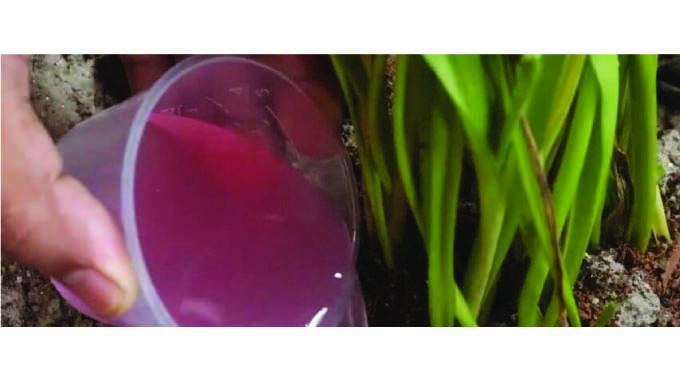
Canditar Chapanduka, Chronicle Reporter
MR Thandolwenkosi Moyo (23) from Richmond suburb in Bulawayo is making a killing from selling liquid fertilisers manufactured through the fermentation of waste products such as chicken manure and comfrey plant.
Since the introduction of liquid organic fertilisers, he said, farmers prefer them as they improve crop production.
Mr Moyo has introduced his product onto the market at an affordable price.
“I sell them at US$15 per five litres, which is used with 50 litres of water. The fertilisers are very effective on horticultural crops such as green leafy vegetables, cabbage, tomatoes and many other crops. It also works well on lawn,” he said.
The product, BioMass Liquid Fertilisers was born after he studied a certain module at university.
Mr Moyo is a Bioscience student at the Bindura University of Science Education.
He said he was keen to be innovative and started experimenting with chicken manure and plants that are able to produce liquid fertilisers after being fermented.
“I took chicken manure and fermented it inside a drum for two weeks and after that, I carried out some tests to see if it works before I took it to the market. I made a testing sample on tomatoes and it was very effective. The tomatoes were big and they were plentiful,” he said.
“Organic fertilisers are now a modern way of protecting our agricultural environment from being damaged. The fertiliser is now applied as a liquid and it spreads through a dilution with water so it spreads into the plants through the stomata into the plant leaves.
“So, it is more efficient than the fertiliser which is applied in the soil underneath the plant because there are so many factors that reduce the efficiency there. The fertiliser will leach with water and goes underground so at the end, the plant absorbs about 30 percent of the fertiliser, which affects the growth of the plant and consequently production,” said Mr Moyo
He said a significant number of farmers are not yet familiar with liquid fertilisers since they are still new on the market.
Mr Moyo said liquid fertilisers don’t destroy the soil unlike synthetic fertilisers.
He said organic fertilisers help farmers maintain the structure and texture of the soil thereby farming becomes effective while the environment is protected.
Resorting to organic fertilisers, he said, would help farmers use the same piece of land for more than 20 years without the soil structure and texture changing.
“When I started the business, I gave a couple of samples to a few farmers for free so that they could try them out and the farmers seemed to like the product.
“Currently, the business is doing very well and the product is promising. I supply farmers in Bulawayo, Matobo, Nyamandlovu and some in Botswana,” he said.
He said the business requires little capital but has high returns.
“The profits help me to cater for my needs but I save most of the money I get because my vision is to expand the project. I want to register my company this month so that I can start taking my product to big companies like Farm and City. I have plans to create a hub where farmers will be getting free training lessons on producing different agricultural products,” said Mr Moyo.
Besides making liquid fertilisers, Mr Moyo is an innovative youth who also recycles wheat straw into mushroom compost.
Wheat straw is leftover stalk from the grain harvesting process that people treat as waste.
He mixes the wheat straw that people burn with poultry manure, horse manure, and water as well as urea.
Mr Moyo turns the mixture every day for a period of three weeks after which it will be ready compost for mushroom production.
“I encourage people to venture into such businesses because they require little capital but have high-profit margins. Also, there is no competition on the market. People need to be focused and have goals in order for the business to do well,” said Mr Moyo. — @NomqheleC



 Online Reporter