admin
admin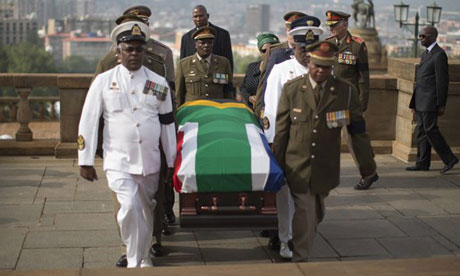

Pretoria — Nelson Mandela’s family gathered around his open coffin yesterday, marking the beginning of three days in which the former president will lie in state.
Mandela’s coffin was placed inside the cavernous amphitheatre of Union Buildings — South Africa’s seat of government — on a cubic platform.
Two military officers clad in white dress uniform stood guard at each entrance with swords pointing downward.
Earlier Mandela’s funeral cortege had rolled through Pretoria to cheers from flag waving crowds.
His coffin was carried up the steps toward the towering acropolis of beige freestone, trailed by Mandela’s oldest grandson, Mandla Mandela.
His manifest grief was a poignant reminder that while the nation lost a hero, Mandela’s family lost a father, grandfather and husband.
After the family had paid their respects, Mandla sat inside ready to receive presidents, celebrities and other dignitaries.
A winding queue formed outside Union Buildings as people gathered to view the body of former president.
The queue was growing rapidly as members of the Tshwane metro police directed it.
Some people used umbrellas to shield themselves from the sun.
Political party T-shirts of the African National Congress and Agang SA were in evidence.
Tshepiso Matema said she had travelled from Soweto “to see history being made”.
“There is no other place to be besides the Union Buildings today, in the whole South Africa. We want to see our old man,” said Matema.
Before midday, some people were complaining about the slow movement of the queue into the Union Buildings. “I don’t know how our government plans, but this queueing arrangement is bound to become chaotic. The buses are not very frequent and very soon thousands of people will become restless,” said Irvin Lesetja from Mamelodi.
Hundreds of police officers were standing near the long queue.
The procession, which will be repeated today and tomorrow morning, passes the one-time home of Paul Kruger, who was the president of the Transvaal and led a resistance movement against British rule during the first Anglo-Boer War, which began in 1880, and will pass the central prison where Mandela was jailed in 1962 for incitement and leaving the country illegally.
His conviction and subsequent life sentence marked the beginning of a 27-year jail stint, from which he finally emerged in 1990 as the structure of apartheid crumbled around its white minority supporters.
Mandela died at home in Houghton, Johannesburg, on Thursday, at the age of 95. He will be buried in Qunu in the Eastern Cape on Sunday. — Al Jazeera.



 derick.khumalo