Online Reporter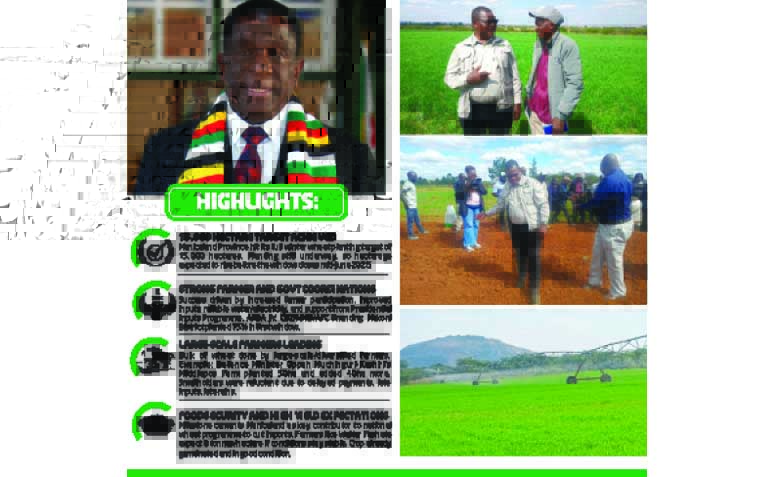
Lovemore Kadzura
Post Reporter
MANICALAND Province has successfully achieved its winter wheat planting target of 15 000 hectares, with planting still underway in several irrigation schemes and commercial farming areas following the Government’s extension of the deadline.
This milestone cements Manicaland’s role as one of the country’s leading contributors to the national winter wheat programme, which is designed to boost food security and cut reliance on imports.
Provincial Director for Agricultural and Rural Development Advisory Services (ARDS), Mr Nhamo Mudada, said the province had exceeded expectations, thanks to increased farmer participation, improved access to inputs, and reliable water supplies in key wheat-producing zones.
Mr Mudada noted that the strong performance reflects coordinated efforts between farmers, Government, and stakeholders, positioning Manicaland to play a pivotal role in meeting national wheat demand.
“We want to appreciate our farmers in the province for heeding the call by President Emmerson Mnangagwa to produce food for the country. We are very happy that this year farmers responded well, and we are looking to produce enough wheat for the province.
“We are pleased to report that Manicaland has already attained its target of 15 000 hectares under winter wheat. Planting is still underway in some areas, and we expect the hectarage to increase further before the planting window closes. Most of the wheat has since germinated, while some farmers are still planting.
“By mid-June 2026, we hope to have finished all the planting, and we look forward to surpass our target by a bigger percentage. Farmers are being urged to continue planting.
“Bulk of the wheat was planted in Makoni District. 75 percent was planted within the first window, and the rest before June 5, 2026. The crop is being grown under different schemes such as the Presidential Inputs Programme, Food Crop Contractors Association, ARDA Joint Venture, self-sponsorship and bank financing by CBZ, NMB and AFC and other facilities. So far there is no challenged of water and electricity, and we are focusing on good agronomy practices to achieve good yields,” said Mr Mudada.
This year’s wheat was mainly done by large-scale farmers with diversified operations, as smallholder farmers were reluctant to take up the crop, citing delayed payments, late delivery of inputs and late rains that delayed summer crop harvesting to pave the way for winter farming.
Middlepos Farm on the outskirts of Rusape, owned by Defence Minister and ZANU PF national chairman, Cde Oppah Muchinguri-Kashiri, planted 50 hectares during the first window, and this week added another 40 hectares after heeding the Government’s call to continue planting.
Farm manager, Mr Walter Feshete, said their crop is in good condition, and if the situation remains stable, they expect to achieve eight tonnes per hectare.
“We have so far planted 50 hectares of wheat under contract from ARDA. Following the announcement of extended planting, we are going to put up an additional 40 hectares under wheat. The wheat we have planted is doing very well despite us being on sandy soils. We first tested the soil and this informed us which type of seed, fertilisers and chemicals to apply. Our wheat is of high quality, and we are expecting a good yield of not less than eight tonnes per hectare. So far everything is going on well according to the plans save for some power cuts which are disrupting irrigation schedule,” said Mr Feshete.
Mr Hebron Taguta, of Taguta Farm in Nyazura, recently revealed they had planted 10 hectares, and would add another 10 hectares in the extended planting period.
“The season is progressing on very well. There is reliable electricity and enough water to irrigate the crop. We faced challenges of late delivery of seed which delayed our planting schedule. We are grateful for the support we are receiving from the Government, and we are doing our best to produce high grade wheat,” said Mr Taguta, whose family owns another farm where they have planted 50 hectares of winter wheat.