Online Reporter
Rutendo Nyeve [email protected]
MANUFACTURING has emerged as Zimbabwe’s largest contributor to Gross Domestic Product (GDP), accounting for 16.2 percent in the second quarter of 2026, as the sector continues to recover and expand productive capacity.

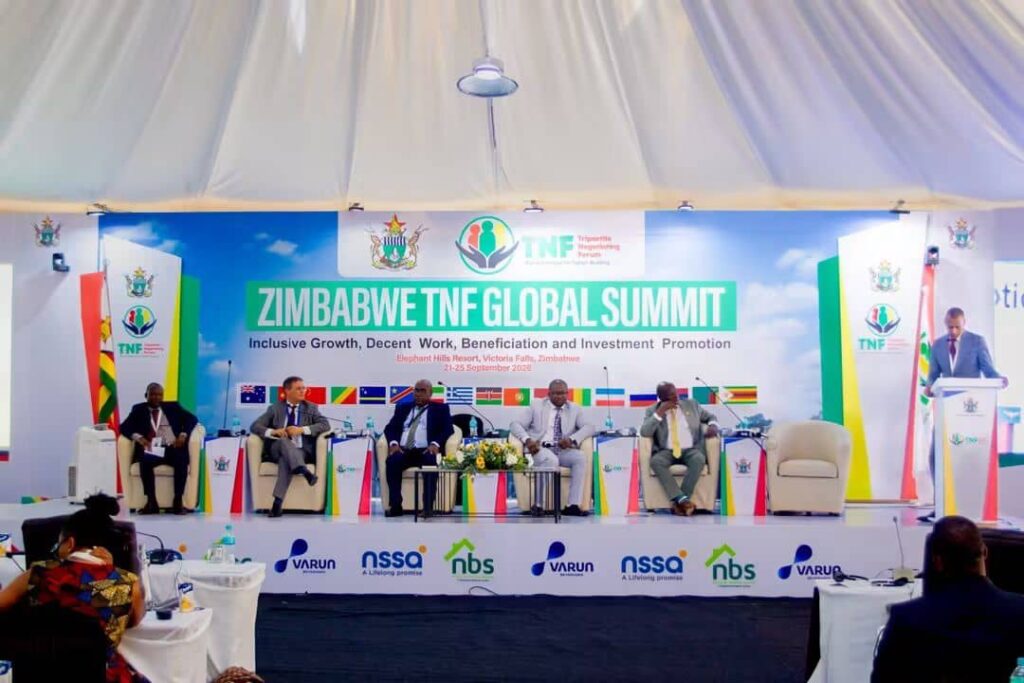
Speaking at the Zimbabwe Tripartite Negotiating Forum (TNF) Global Summit in Victoria Falls on Wednesday, Minister of Industry and Commerce Mangaliso Ndlovu said capacity utilisation had risen to 61.2 percent, reflecting increased activity in the sector.
“Manufacturing has now emerged as the largest contributor to Zimbabwe’s GDP,” Minister Ndlovu said, attributing the growth to renewed investment across a broad range of industries, including cement, fertiliser, food and beverages, fast-moving consumer goods, metals and metal products, and chemicals.
The growth has been accompanied by increased exports, with manufactured exports rising to approximately US$584.8 million in 2025, from US$437.6 million in 2024.
At the centre of the industrial expansion is the US$1.5 billion Dinson Iron and Steel Company (DISCO) investment at Manhize, which Minister Ndlovu cited as an example of the shift towards industrial production and higher-value exports.
The plant produces pig iron, steel billets, reinforcing bars and wire rods for domestic and regional markets.
National steel exports reached 146 314 tonnes valued at US$92.1 million in 2025, while value-added steel exports rose to US$68.22 million in the first quarter of 2026, compared with US$19.25 million during the same period last year.
Minister Ndlovu said the transformation extended beyond steel, citing local processing in the lithium value chain through lithium sulphate production at Prospect Lithium Zimbabwe (Arcadia).
Government is also strengthening manufacturing-agriculture linkages, with 15 priority agro-value chains identified, while the Local Content Strategy 2026-2035 aims to reduce the import bill by approximately US$3 billion.
“Our task now is to change that structure and ensure that our resource endowments become the foundation for productive industries, competitive enterprises, skilled employment and sustainable economic growth,” he said.
The TNF Global Summit provides a platform for Government, business and labour to discuss policies aimed at attracting investment, promoting beneficiation and strengthening industrial development.
As Zimbabwe pursues its upper-middle-income development ambitions, the focus remains on building competitive industries capable of supplying local markets, participating in African value chains and competing globally.
Ends//…