Online Reporter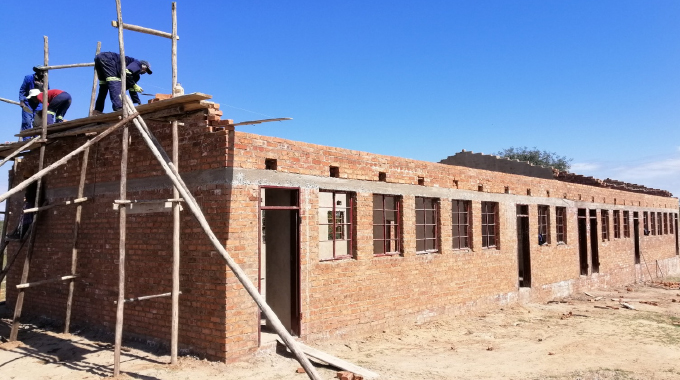
Tapera Gwezhira, [email protected]
A new science laboratory under construction at Mapane Secondary School is expected to improve access to practical science lessons for pupils in Gwanda district, many of whom have never had such facilities at their school.
The laboratory is part of the Government’s 2026 Independence Legacy Projects being rolled out across Matabeleland South province, aimed at strengthening science education in rural areas.
Construction is progressing steadily, with builders having reached gable level. Work has now moved to plastering the walls while the project awaits the delivery of roofing materials.
The project is being implemented by the Rural Infrastructure Development Agency (RIDA), formerly known as the District Development Fund (DDF).
Mapane Secondary School was established in 2015 by the local community after villagers identified the need for a nearby secondary school. Before its construction, learners had to travel long distances to access education, often under difficult conditions.
The school currently has an enrolment of 115 pupils and is staffed by eight teachers.
During a site visit this week, School Development Committee (SDC) chairperson Mr Special Ndlovu described the construction of the laboratory as a major development for both the school and the surrounding community.
“This science laboratory is a welcome development for our school and community. We are very thankful to the Government for this infrastructure development,” said Mr Ndlovu.
He said the community had taken an active role in supporting the project, with some villagers donating food to workers, while others provided tractors and donkey-drawn scotch carts to transport building materials such as river sand and pit sand.
However, the project has not been without challenges. Mr Ndlovu noted that persistent rains had slowed progress and made it difficult to deliver materials to the site.
“Some trucks delivering bricks and cement could not reach the school because of muddy roads. Materials had to be offloaded at the nearby primary school before being transported here using donkey pulled scotch carts,” he said.
Despite these setbacks, the community remains optimistic about the long-term benefits of the facility. Mr Ndlovu said the laboratory is expected to play a key role in shaping the future of learners in the area.
“We are hoping that doctors, engineers and other professionals will emerge from Mapane in the near future. We want to see learners from Matabeleland South enrolling at Gwanda State University, NUST in Bulawayo and Joshua Mqabuko Nkomo Polytechnic,” he added.
He also pointed out that the absence of a science laboratory has placed a burden on pupils, particularly girls, who have had to travel long distances for practical lessons.
“The nearest school offering science practical lessons is 10km away at Simbumbumbu Secondary School. This laboratory is going to improve access to science education within our own community,” he said.
Mr Ndlovu further commended RIDA for prioritising local employment during construction.
“We are very grateful to RIDA for employing us, the owners of the school. The community is very happy because this is our school,” he said.
School headmaster Mr Butholezwe Mabhena said the completion of the laboratory would address long-standing challenges faced by pupils, especially during examination periods.
“Every year our Form Four pupils travel to Simbumbumbu for science practical examinations. So, having a laboratory here means learners will now be able to sit for practical examinations at our own school,” said Mr Mabhena.
He said the facility would also allow the school to broaden its science curriculum, which is currently limited.
“At the moment, we only have a small Chemistry class, but once the laboratory is complete, we intend to introduce Biology,” he said.
Mr Mabhena added that the school already has a qualified science teacher in place, ready to support improved academic performance once the laboratory becomes operational.
He also highlighted ongoing infrastructure challenges at the school, noting that some teachers are currently accommodated at Mapane Primary School due to a shortage of staff housing.
The school has only two classroom blocks and one staff house.
Across Matabeleland South province, RIDA has been tasked with constructing 40 science laboratories under the Independence Legacy Projects programme, which supports the Government’s Science, Technology, Engineering and Mathematics (STEM) policy.
All 40 laboratory structures have now reached gable level, with 10 already at the roofing stage.
In Gwanda district, similar projects are underway at Simbumbumbu, Lushonkwe and Halisupi secondary schools.
Other districts benefiting from the programme include Umzingwane, Matobo, Mangwe, Insiza, Bulilima and Beitbridge.
In addition to the laboratories, RIDA is drilling boreholes at each school to ensure reliable water supply. At Mapane, however, water yield has been low, forcing the school to rely on sand abstraction for its water needs.
The infrastructure programme has also created employment opportunities for local communities, with 1 693 youths and women engaged as builders and assistants across the province.