admin
admin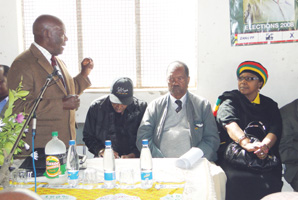
The party’s leadership in the province said the move marked the rebirth of the party as it signified its constant evolution to maintain relevance to the electorate.
They said it was a necessary step in gearing up for the forthcoming harmonised elections as it brought the revolutionary party’s leadership closer to the people at grassroots level.
A high powered delegation led by Secretary for Administration Cde Didymus Mutasa, mandated by the party’s First Secretary, President Mugabe to explain the decision to the provinces, met Matabeleland South leaders at the party’s headquarters in Gwanda Town.
Addressing the leaders, Cde Mutasa said all the structures that had been reporting to the DCCs as affiliates had also been dissolved.
“This means all the affiliate organs to the DCCs, which include war vets, ex-detainees and war collaborators are no longer there at district level because there is no longer a DCC for them to report to,” said Cde Mutasa.
He said the party’s Politburo and Central Committee had resolved to do away with the DCCs after they realised that they were slowly cutting the party off from the electorate as some leaders abused the structure.
“The DCCs had become an impediment. Messages from the people to the party’s leaders were no longer being conveyed faithfully as some unruly elements sought to fulfil selfish agendas. Conversely messages from leaders were no longer filtering to the most important people, who are the electorate at grassroots level,” said Cde Mutasa.
He said provincial leaders would have to take over the role of the disbanded DCCs and mobilise people on the ground.
“It is not a mammoth task. Remember the party district is the next structure after the province. It has 102 officials who include secretaries and chairpersons. If done properly, there should be seven districts, each with 102 officials, meaning all branches in a district should have 714 officials. Each of the officials would be working with 50 cells and each cell would have 21 members. With all these working together, we cannot fail to reach all the people at grassroots,” said Cde Mutasa.
The Zanu-PF provincial chairperson for Matabeleland South, Cde Andrew Langa, said the province accepted the dissolution of DCCs.
“It is a collective Politburo and Central Committee decision, which we accept without reservations or conditions. We thank the leadership for realising that we need to go to the people and transfer power to them,” said Cde Langa.
He said he was happy to declare that the unity in the province had always shut out factionalism and would ensure success of the resolution.
Cde Langa said the new system would help the province improve on its four seats in the House of Assembly and three in the Senate, in the forthcoming elections.
Giving a vote of thanks, Politburo member Cde Naison Khutshwekhaya Ndlovu, said it was up to the province to make the most of the new dispensation, which would open up avenues of communication between the Zanu-PF leadership and the people.
Cde Mutasa was accompanied by the Secretary for Women Affairs, Cde Opah Muchinguri, the Secretary for Youth, Cde Absalom Sikhosana, Political Commissar Cde Webster Shamu and Cde Rugare Gumbo, the Secretary for Information and Publicity.
The delegation will be in Masvingo today before visiting Manicaland and Mashonaland East tomorrow.
It will visit Mashonaland Central on Saturday and Mashonaland West on Sunday and concludes the tour in Harare on Monday.
Bulawayo, the Midlands, Matabeleland North and South Provinces have already been visited and have endorsed the dissolution.



 Online Reporter