Chronicle Editor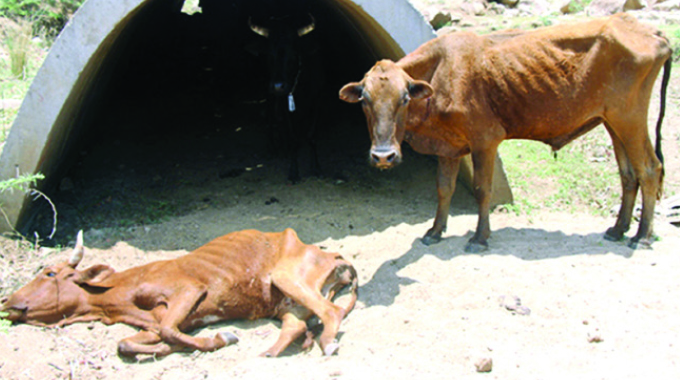
Vusumuzi Dube, Online News Editor
THIRTY percent of households in Matabeleland South reported livestock deaths this year as the province continues to feel the impact of the El Niño dry weather phenomenon.
The dry spell experienced in the country had a huge impact on the national herd, with some districts in the Matabeleland region being the worst affected with livestock farmers losing animals to poverty deaths.
That saw the Government stepping up its drought response programme to mitigate loss of livestock by ensuring the availability of feed, water and vaccines.
The authorities established village-based troughs at community boreholes to ensure access to drinking water for the livestock.
According to the 2024 Zimbabwe Livelihoods Assessment Committee (ZimLAC) Rural Livelihoods Assessment, while the country recorded 20 percent of rural households losing their livestock, Matabeleland South topped the provinces, with 30 percent of its households recording livestock deaths.
“Livestock deaths (20 percent) were the most reported agriculture-related shock nationally. Matabeleland South (30 percent) had the highest proportion of households that reported livestock deaths as a shock.
“Chirumhanzu (53 percent) and Zaka (46 percent) had the highest proportions of households that reported livestock diseases as a shock. Chirumhanzu (49 percent), Zaka (45 percent) and Bulilima (42 percent) had the highest proportions of households that reported livestock deaths as a shock,” reads the report.
On livestock deaths, Matabeleland South was followed by Masvingo Province where 28 percent of its rural households were affected, followed by Midlands (27 percent) and Manicaland had 18 percent of its households recording livestock deaths.
Mashonaland West Province, at 12 percent had the lowest number of livestock deaths recorded. Households in Matabeleland South and Masvingo provinces — both at 49 percent — indicated that their livestock were in poor condition.
“In terms of sharp drops in livestock prices, Gwanda (64 percent) and Nkayi (60 percent) had the highest proportions of households that reported sharp drops in livestock prices as a shock. Cattle prices ranged from US$119 to US$430 per average beast.
The highest prices were reported in Mutasa (US$430), Goromonzi (US$428), Zvimba (US$422) and Seke (US$410) whilst the lowest prices were reported in Gokwe South (US$119) and Gokwe North (US$137).
“Goat prices ranged from US$11 to US$70. The highest prices were reported in Goromonzi (US$70) and the lowest prices were reported in Gokwe North (US$11) and Gokwe South (US$14),” reads the report.
On performance of crops, countrywide the ZimLAC report revealed that Hwedza (65 percent), Chivi (50 percent) and Gutu (49 percent) had the highest proportions of households that reported crop pests as a shock.
“About 52,3 percent of households practised Pfumvudza/Intwasa in 2024, an increase from 47,1 percent reported in 2023. There was a decrease in the use of quality certified seeds from 2023 (47,3 percent) to 2024 (34,1 percent).
“Mashonaland East (50,2 percent) had the highest proportion of households that reported using quality certified seeds, while Matabeleland South had the least (20,5 percent).
Mashonaland East (60,4 percent), Midlands (59,1 percent), Mashonaland West (56,4 percent) and Matabeleland North (55,7 percent) were the provinces that reported high practice of Pfumvudza/ Intwasa,” reads the report.
It was further discovered that about 27,7 percent households accessed agriculture inputs through agro-dealers or agriculture cooperatives, contract farming, Government input schemes and loans in kind.
“At least 30,2 percent of the households were practising drying, packaging and storage and two percent of the households branded and labelled products. About 33,2 percent of the households were practicing minimum tillage followed by 21,1 percent which practised contour ridging as water and soil conservative strategies.
“The proportion of households which grew crops decreased across all crops, except for sorghum which had an increase from 19 percent in 2022/23 to 23 percent in the 2023/24 season. Nationally, 75,1 percent of the households grew maize, 33,1 percent grew groundnuts, 23 percent grew sorghum and 18,7 percent grew African Peas,” reads the report.
ZimLAC is a consortium of Government, UN agencies, Non-Governmental Organisations and other international organisations led and regulated by Government.
It is chaired by the Food and Nutrition Council (FNC), a department in the Office of the President and Cabinet.
ZimLAC has the mandate to generate information on livelihoods and other related socio-economic factors.
Last year the Government removed the term “vulnerability” from ZimVAC, replacing it with “livelihood” after noting that the country’s continued use of the term shifts focus away from assessing the impact of the developmental, empowerment and livelihood upliftment programmes that are underway.



 Online Reporter