Chronicle Editor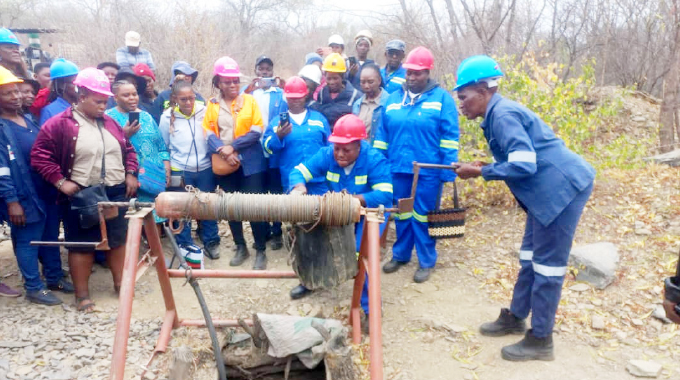
Sukulwenkosi Dube-Matutu, Matabeleland South Bureau Chief
WOMEN from Matabeleland South Province that have formed co-operatives to penetrate the once male-dominated mining sector are adamant to take a leading role in developing the sector. Through forming co-operatives, women and youths in small scale mining have realised that they stand a better chance at development and growth.
One such cooperative is the Killarney-Filabusi mining cluster which is working on upscaling production at its claims.
The group, through its cluster, has been able to secure five claims in the Amazon area which has around 100 members. The Government has made significant strides in mainstreaming the involvement of women in mining. It is pushing for legislation of the Mines and Minerals Bill as it will provide mining title ownership and support for female miners.
In April, female miners pleaded with Government and banks to allow them to use mining titles as collateral when applying for loans as they were facing challenges in accessing working capital.
Speaking during a recent tour of Mike A Mine in Insiza District, which is among their claims, Killarney-Filabusi mining cluster chairlady Ms Sibongile Ndlovu said they are working on creating linkages to help grow their enterprise.
“At first we were operating as individuals but we then decided to form mining clusters. We realised that if we formed clusters, we could stand a better chance of getting working space and our capacity would improve. We formed the Killarney-Filabusi mining cluster which started off with 12 members and went on to mobilise more women and now we have about 100 registered members.
“We then collectively looked for mining space through engaging with one of the large scale miners in the area. We got space where we are working in five groups, with each group working on a 200 by 500 metre space,” she said.
Ms Ndlovu said when they started off in 2022, they were searching for gold in the surface rubble as they could not afford to hire manpower or equipment. She said after some time, they were able to open shafts and they managed to hire young men to assist them in their mining activities.
Ms Ndlovu said they have managed to secure a hammer mill but they still need to buy more equipment as hiring equipment limits their production and is costly.
She said they were in need of capital which could help boost their production.

“We are still trying to grow our mining enterprise but we are glad that we have started. Our wish is to secure our own equipment including an excavator, compressor, tractor and more hammer mills so that we can produce more in order to increase our income. If our business grows, then we will be able to incorporate even more women. With the necessary equipment we will be able to do most of the processes ourselves. “We are still growing and are doing our best to secure the necessary equipment. Our target as women is to become a force to reckon with in the mining sector,” she said.
The tour was organised by the Zimbabwe Association of Women in Mining Associations (Zawima) as part of an engagement exercise to bring together women in mining and various stakeholders and regulating authorities to promote formalisation of operations.
Ms Sikhanyisiwe Nkomo who is the chairlady of Shangani Cluster said forming clusters has helped to ensure that more women are involved in mining. She said there is, however, a need for women to be educated more on mining and its significance to the economy. Ms Nkomo said there is also a need for the protection of women in mining as they remain at risk.
“Mining is one of the major sectors in the country and it’s one of the key economic drivers. It is of great importance for women to be involved in the sector for their empowerment. There are a number of challenges we are facing in our operation ranging from financial to security threats. This has discouraged some women from participating in mining.
“We sometimes face threats from machete gangs after hitting a big score and they rob us. The mining environment can sometimes be harsh for women. Some service providers take advantage of our need for equipment and they inflate their charges,” she said.
Ms Nkomo said being involved in mining has helped to empower them as women.
She said they have formed money saving and lending groups which have helped them to secure assets such as houses and stands.
Zawima national chairperson Ms Kundai Chikonzo said the country has recorded significant progress in the involvement of women in the mining sector. She said women and the youth have to contribute to the realisation of Vision 2030. Ms Chikonzo said women are now responding well to programmes that seek to empower them in mining.
She said women need to be conscientised more about these opportunities and educated on formalisation of operations. Despite making in-roads in the mining sector, there are some barriers which continue to constrain women.
Women in mining are facing challenges in accessing capital as well as obtaining licences which affect their participation in the sector. The financial challenges have made it difficult for women to secure the necessary equipment and machinery for their operations.
Women also face verbal abuse and labelling from male counterparts. They also face a higher risk of sexual abuse and gender-based violence. Safety concerns such as hazardous environments, physical demands, and harmful substances are also a barrier. – @DubeMatutu.



 Online Reporter