Online Reporter
Kudzanai Sharara in Port Louis, Mauritius
PORT LOUIS – Mauritius is facing a skills shortage in its financial services sector and sees Zimbabwe as a key partner in addressing this gap, Mrs Dovina Pillay-Naiken, Acting Director of the Financial Services Unit at Mauritius’ Ministry of Financial Services and Economic Planning, told delegates at the Mauritius-Zimbabwe Business Forum on Wednesday morning.
“I think this is one area where there could be very close collaboration between Mauritius and Zimbabwe,” Mrs Pillay-Naiken said, noting that there are already Zimbabweans working in Mauritius. “We are having a skill shortage because this is a sector that we want to grow.”
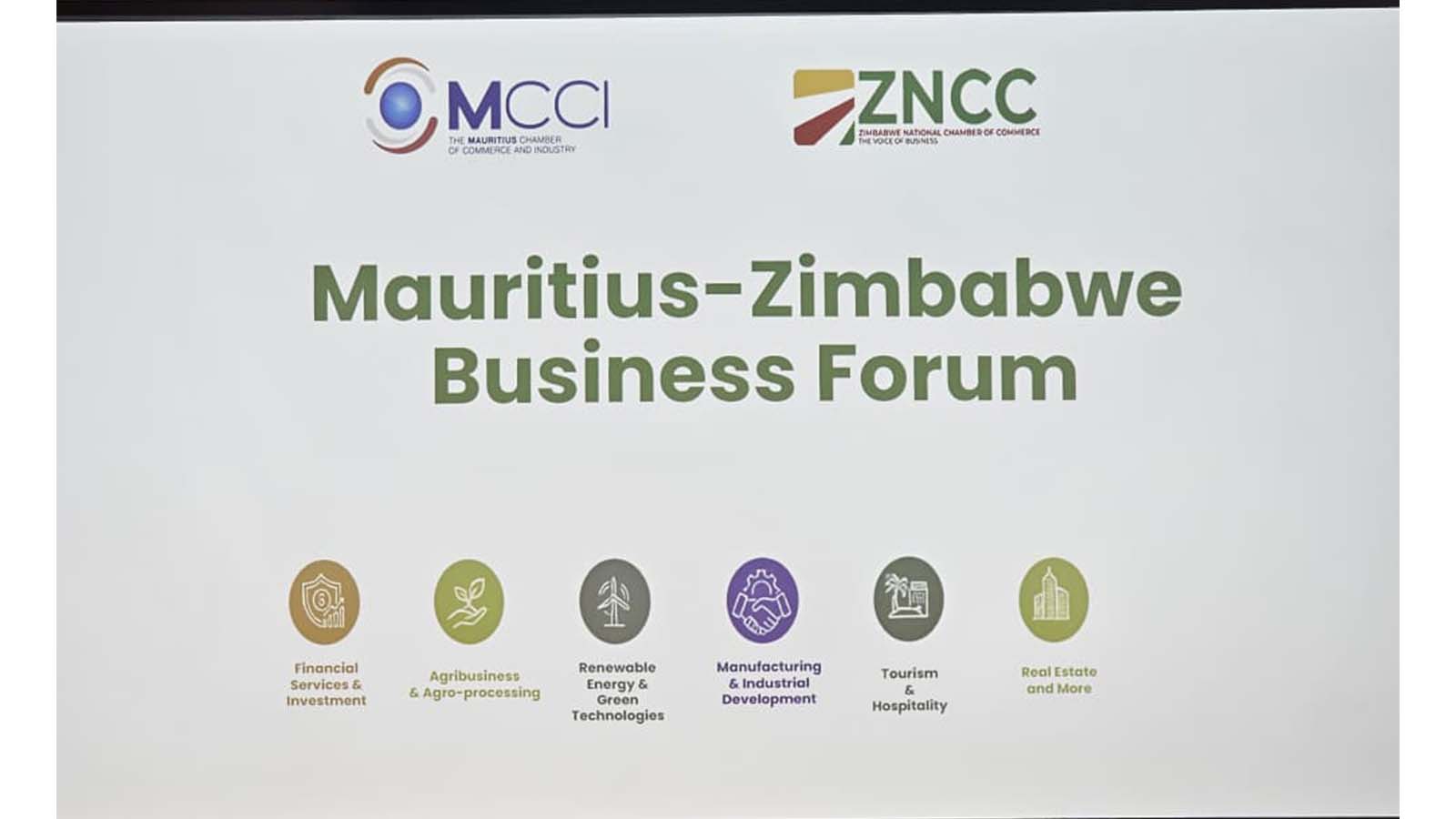
Speaking at the Caudan Arts Centre during the five-day Mauritius-Zimbabwe Investment and Trade Mission, jointly organised by the Zimbabwe National Chamber of Commerce (ZNCC) and the Mauritius Chamber of Commerce and Industry (MCCI), Mrs Pillay-Naiken also revealed that foreign direct investment (FDI) injected into Zimbabwe through Mauritius amounted to US$1,4 billion as of June 2025. The total FDI stock stood at US$8,5 billion, meaning a significant portion of investment value in Zimbabwe is channelled through Mauritius.

“When they actually approached us to work on this business forum together, we looked at the FDI,” she said. “I think we already have a very close collaboration in terms of FDI invested in Zimbabwe through Mauritius. If we continue working together, this is something which can be enhanced.”
Tracing the evolution of Mauritius’ financial services sector, Mrs Pillay-Naiken explained that it began with a single bank in 1967 before a group of experts came together in 1992 to create a completely new sector under the Mauritius Offshore Business Authority Act. That initiative created what was then known as the offshore sector, now regulated by the Financial Services Commission (FSC), which oversees the non-banking financial services sector alongside the Bank of Mauritius, which regulates banking.
“The financial services sector is the first pillar of the economy,” she said. “It was an initiative taken 30 years ago and today it is bearing the fruits.”
Related Stories:
Zim offers investment opportunities in mining, energy, manufacturing, Govt official tells Mauritius Forum
She revealed that the global business sector, a major component of the financial services industry, contributes 8 percent to Mauritius’ GDP, with a growth rate of 5 percent. Mauritius is ranked 50th among 180 countries in the Global Financial Centres Index and is among the top five countries on the African continent.
Mrs Pillay-Naiken emphasised that Mauritius offers tax certainty and predictability, with a progressive income tax system ranging from 0 to 20 percent and a flat corporate tax rate of 15 percent. However, an 80 percent partial exemption on qualifying income categories – including foreign dividends, non-banking interest income, and specific leasing or digital services – reduces the effective tax rate to as low as 3 percent. She also highlighted Mauritius’ network of approximately 46 Double Taxation Avoidance Agreements, including one with India and around 25 with African countries, noting that only companies resident in Mauritius are eligible to benefit from these agreements.
Outlining the vision for Mauritius’ International Financial Centre, she said the focus is on rethinking the financial services industry through five strategic directions: improving the ease of doing business, diversifying and modernising product offerings, enhancing visibility of the Mauritius IFC through promotion and branding, diversifying target markets, and addressing skills shortages. Key initiatives include streamlining client onboarding, digitalising regulatory processes, and integrating artificial intelligence into operations.
Earlier, Mr Sachin Mohabeer, Deputy Chief Executive Officer of the Economic Development Board (EDB), addressed delegates on ten reasons why investors choose Mauritius, including its geostrategic location bridging Europe, Asia, and Africa, political and economic stability, a modern judiciary blending French and British legal traditions, and exceptional quality of life.
The forum continues with a panel discussion on agro-processing and export development, followed by B2B matchmaking sessions later today.