Innocent Madonko in BEIJING, China
A TEAM of medical specialists from Zimbabwe say they have drawn valuable lessons from China’s vastly superior and technically advanced health sector and will implement most of the innovative ideas they learnt during a two-week seminar on Public Health Management which closes tomorrow (Thursday).
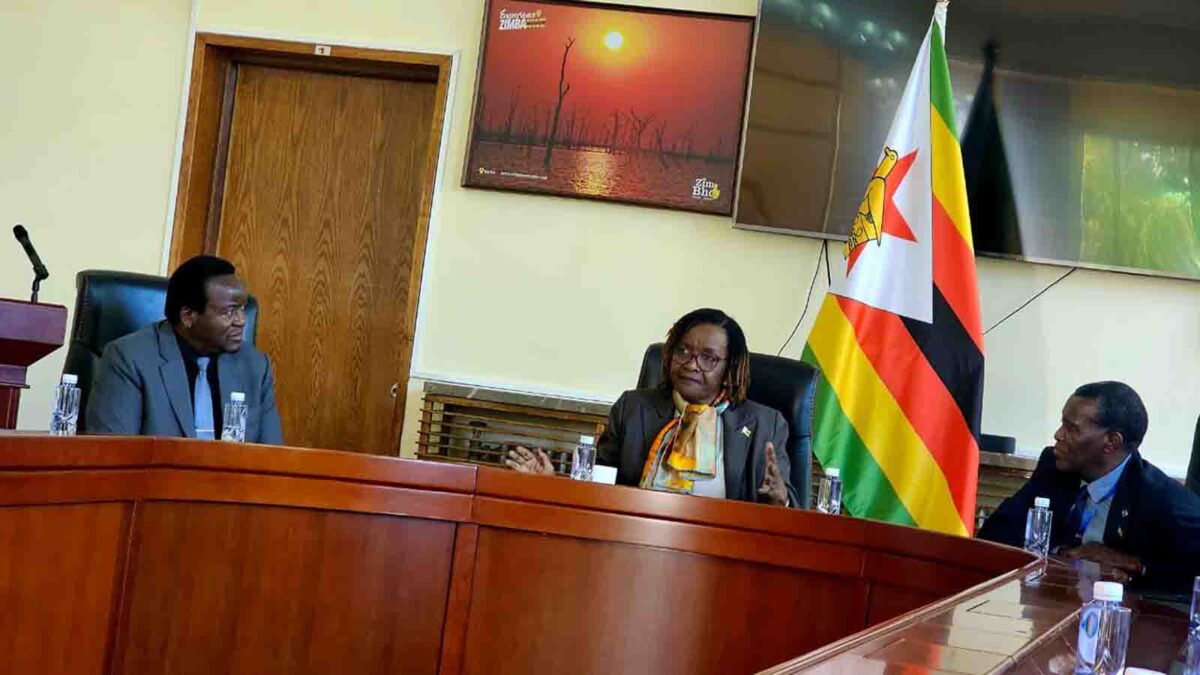
Briefing Zimbabwe’s Ambassador to China, Mrs Abigail Shonhiwa, during an interactive meeting at the country’s mission here today, the delegation, comprising Provincial Medical Directors, epidemiologists, maternal and child care officers, pharmacists, hospital administrators, Health Service Commission members, Government and District Medical Officers from all the country’s 10 provinces, said the seminar was an eye opener as it exposed them to the world Artificial Intelligence and other modern tools used in the industry.
The seminar, organised by the Academy for International Business Officials (AIBO) under China’s Ministry of Commerce, saw the team visiting health care facilities including major hospitals, drug and medical sundries manufacturing companies, laboratory diagnostic plants, and other health related firms in Beijing, Hangzhou and Shaoxing in Zhejiang Province.
The Zimbabwean health care professionals also received lectures from senior Chinese experts in the fields of disease control, epidemiology, infant and maternal mortality and other key sectors of their industry.
The Provincial Medical Director for Mashonaland East Province, Dr Paul Farai Matsvimbo, said they learnt a lot not only about the Chinese health sector but also the foundation of modern China and how the country attained unprecedented milestones in all facets of society.
“We had lectures in various aspects of the Chinese health sector but the introductory sessions focused on the foundation and establishment of the People’s Republic of China, its evolution and the modernisation process that is happening generally in China and particularly in terms of the health sector.
“We also had a chance to have field visits to health care facilities and industrial sites. Broadly, we learnt about the journey of the Chinese people even from ancient civilization up to now and how this journey has contributed the advancement of the country and its health sector. We learnt about disease control initiatives.
“Most importantly, we also learnt about the cooperation between Zimbabwe and China, that is not limited to trade or economic cooperation. We were surprised that some of the projects that we see at home are actually an investment from the Chinese people in terms of agriculture, the health sector and I am happy to say that I come from Mashonaland East province where we have a Chinese Friendly Hospital, Mahusekwa. We have been having multiple engagements, multiple teams that are coming in, so it was a realization of a commitment of the Chinese people to the advancement of the Zimbabwean people,” he said.
Harare Provincial Maternal and Child Health Officer, Dr Farai Josphus Chitiyo, said he was impressed by the low maternal and infant mortality rate in China.
“China’s maternal mortality is quite low, its 13 per 100 000 live births, ours is at 212 per 100 000 live births. So the difference is quite vast and even their infant mortality is at 3 per 1 000 live births, ours is still at 56 so there really is a big gap. They (China) are even not happy with such low numbers but for us it’s a challenge. The road that they have adopted to reduce this mortality is a multi-sectoral approach such that the Ministry of Health is not alone but there are other ministries, the Ministry of Transport gets also to construct the roads so that women can be transported, Finance are involved, Education are also involved.
“So this was a good learning curve for us. We have also seen that when the mothers wait for ante-natal care, they have pre-conception screening. So because of their (low) birth rate, they are trying to increase births…moving from the one child policy. In our country, we have a problem of teenage pregnancies, so it was quite different here where people choose when to get pregnant,” he said.
Dr Chitiyo said in China, expectant mothers are screened for any birth defects and when children are growing they are screened for myopia (short sightedness), obesity and hearing impairments.
“These are things that we are not doing properly, we are doing them but at a smaller scale. This is something that we want to improve when we get home. They also have a paired up hospital system where the bigger hospitals get to assist the smaller ones. They also use telemedicine and AI assisted decision making,” he said.
Mashonaland Central Provincial Epidemiology and Disease Control Officer, Dr Sheila Chanji, said she learnt that timely detection and reporting disease outbreaks in real time was crucial to curbing the spread of infectious diseases.
“We had an exchange in term of surveillance and infection prevention and control. So we learnt that timely detection and reporting disease outbreaks in real time is crucial to combating diseases. The use of data in a coordinated and planned manner is also important to make informed decisions.
“The laboratories are well advanced in use of technology to achieve a robust response to the outbreak of infectious diseases. Their operations are also integrated and there is adherence to international quality standards,” she said.
In the pharmaceutical sector, officials from the National Pharmaceutical Company of Zimbabwe said the deployment of AI and other innovative tools in China’s pharmaceutical industry was very impressive.
Ms Tanyaradzwa Everjoyce Satande, the Regional Stores Manager for NatPharm in Bulawayo said the visit to the Full Care Group in Shaoxing, Zhejiang Province, was particularly instructive as they saw first-hand, a fully automated, AI powered plant that produces medical and surgical sundries.
“Our visit to the manufacturer of surgical sundries left us impressed and overwhelmed due to the different range of products they had. They have really mastered the adoption of AI technology and we were awestruck by the smooth flow of operations,” she said.
In response, Ambassador Shonhiwa said China’s model of development was worth emulating and hoped the medical team would adopt some of the concepts they learnt during their seminar.
“I heard you speak about the pairing of bigger and smaller hospitals. They also do that for the general development of their provinces. They will go to a province which is well to do and link it up with one which is less to do or even a district where they want to do certain things. So that this province, if you are producing stuff, the other one can help you market your products, in the process help uplift you. Companies in the richer province can actually invest in the poorer one, so it’s a good model,” she said.