Online Reporter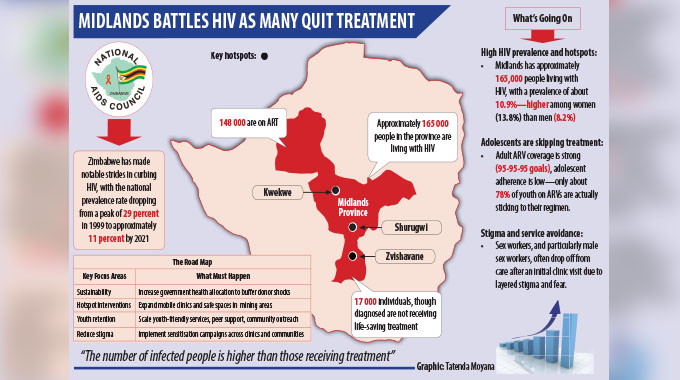
Patrick Chitumba, Zimpapers Writer
DESPITE commendable progress in the fight against HIV and Aids in Zimbabwe, authorities in the Midlands Province are grappling with a persistent challenge where many people living with HIV are not accessing antiretroviral therapy (ART) even though they are aware of their status.
Stigma remains a major barrier to treatment uptake.
According to Midlands provincial manager for the National Aids Council (NAC), Mr Mambeu Shumba, approximately 165 000 people in the province are living with HIV, yet 148 000 are on ART.
This means 17 000 individuals, though diagnosed are not receiving life-saving treatment.
“The number of infected people is higher than those receiving treatment and there are a lot of factors involved. Some people know their status through HIV testing, but delay getting initiated or simply abscond from taking ART.

“Stigma remains a major issue and many choose to remain in hiding rather than seek treatment,” Mr Shumba said.
The ART programme has been instrumental in helping those affected suppress their viral loads, thereby reducing transmission risks, slowing disease progression and significantly improving quality of life.
Among those receiving ART, 6 000 are children based on 2024 estimates.
Mr Shumba urged all individuals who test positive to begin ART immediately.
“We’re now implementing the test-and-treat model and as a province we have adequate ART in stock.
“The good thing is that we’ve seen a steady decline in new infections over the years. While new cases are still being recorded, the situation is nowhere near as alarming as it was in the 1990s.”
Zimbabwe has made notable strides in curbing HIV, with the national prevalence rate dropping from a peak of 29 percent in 1999 to approximately 11 percent by 2021, thanks to efforts from the Government, civil society and international partners. But that progress is now threatened by both treatment gaps and new public health risks.
Mr Shumba said NAC is scaling up its outreach to address these gaps, particularly among those reluctant to begin ART.
The organisation is now engaging state enterprises, the media and other stakeholders to promote workplace wellness and combat misinformation especially on social media.
“We’ve made gains in the fight against HIV, but changing lifestyles and poor information are eroding some of those achievements. We’re working with parastatals to push wellness at work and we’ve engaged journalists to help us counter the misinformation that often spreads faster than the truth,” he said.
He explained that these stakeholder engagements form part of NAC’s broader strategy to promote early testing, timely ART initiation and long-term adherence, while breaking the silence around HIV and ending the stigma that deters people from accessing care.
As part of this strategy, NAC is also focusing on addressing non-communicable diseases, which now present a secondary threat to the health of people living with HIV. These efforts are designed to ensure that as treatment access expands the overall well-being of affected individuals is also prioritised.
“As the dynamics of the HIV pandemic evolve, our response must evolve too and that means supporting people not just with medication, but with comprehensive wellness and education,” Mr Shumba said.
As NAC intensifies its campaign, the focus remains on closing the gap between diagnosis and treatment, ensuring no one is left behind and preserving the hard-won gains Zimbabwe has made in the fight against HIV and Aids.