Online Reporter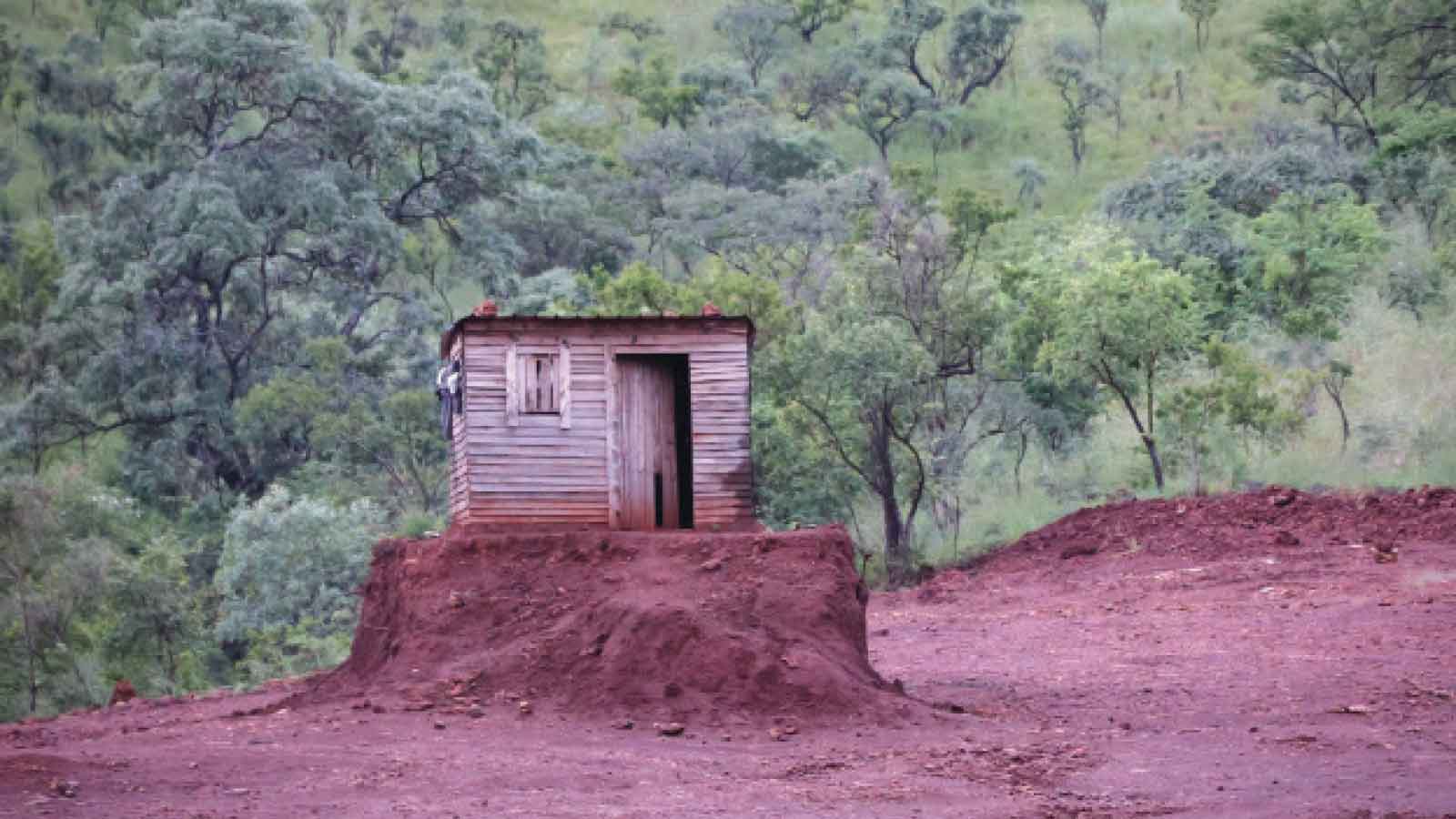
Theseus Shambare
Features Writer
A LONE wooden cabin rises from a mound of freshly disturbed soil along the once-tarred Bigdale Road to Keltson in Guruve, Mashonaland Central Province—fragile, exposed and quietly defiant.
From a distance, it looks temporary, almost incidental.
Up close, it tells a different story.
The ground beneath it is loose and uneven, freshly turned by chrome extraction.
Around it, the land is scarred — a patchwork of shallow pits, mounds of soil and fading vegetation.
What used to be grazing land now struggles to sustain even the hardiest livestock.
And the road that leads here, once a smooth strip of tar connecting rural lives to opportunity, has been reduced to dust, ground down by the weight of heavy trucks ferrying ore out of the district.
Each passing truck lifts a cloud that lingers long after it is gone.
For the people who live here, that dust has become part of life.
“We used to graze our cattle freely,” said Mr Tawanda Murozvi, a local farmer, standing at the edge of what was once open rangeland.
He pauses, scanning the ground carefully before taking a step — wary of the pits that now dot the landscape.
According to researchers Yan Feng, Peng Wang, Wen Li, Qian Zhang, Wei‑Qiang Chen and Danyi Fengin in Environmental Research Letters published in 2021, communities adjacent to unregulated lithium mining often face diminished livelihoods and increased health risks from dust and water contamination.
This mirrors what farmers in Guruve experience daily.
“Now there are holes everywhere. Even the grass is no longer enough,” said Ms Rumbidzai Nyamupfukudza.
“Some are hidden by grass and you only realise when it is too late. We fear our cattle will fall in or break their legs.”
In a rural economy where cattle represent both wealth and security, such risks are not small.
Ms Nyamupfukudza tends to a small herd, guiding it carefully across shrinking grazing patches.
“Even the grass is no longer enough. The soil has been disturbed, and during the dry season it becomes worse. Our livestock are getting thinner,” she said.
For families here, the land is more than just a resource; it is survival.
And when it is degraded, the impact ripples through everything: food, income, dignity.
Dreams amid dust
A few kilometres away, near Kelston 1 Primary School and Mudhindo Growth Point, a small tuckshop stands quietly by the roadside.
Its name is bold, almost out of place: “Joina City”.
Borrowed from Harare’s towering commercial landmark, the name speaks of ambition — of a vision far removed from the dusty surroundings in which it sits.
But the shop itself tells a humbler story.
Often understocked, it comes alive only during the tobacco marketing season, when farmers briefly have money to spend.
Outside that period, it returns to stillness. Yet the name endures — a quiet assertion that even here, people still dream. The irony is unmistakable.
Beneath the soil lies mineral wealth feeding global industries, from steel to the clean energy technologies powering the future.
Above ground, development remains uneven.
Extraction without transformation
Zimbabwe’s mining sector is the backbone of the economy, contributing about 70 percent of export earnings.
Across districts like Guruve, Bikita, Hwange and Mutoko, mining activity has intensified, driven by global demand and domestic priorities. But alongside this growth, a pattern has persisted: extraction without transformation.
In 2024 alone, Zimbabwe produced approximately 2,4 million tonnes of lithium concentrate, marking a surge in output as global demand accelerated.
Exports have continued to rise sharply.
In the first half of 2025, the country shipped out 586 197 tonnes of spodumene concentrate, up from 451 824 tonnes during the same period in 2024.
Yet much of this leaves the country in raw or minimally processed form.
Minerals Marketing Corporation of Zimbabwe (MMCZ) general manager, Nomsa Moyo, described the situation as a missed opportunity.
“When minerals are exported in raw form, we are effectively exporting potential jobs, revenue and industrial growth,” she said. “Beneficiation is what converts natural resources into real economic development.”
Her words reflect a broader reality: the country exports value but retains only a fraction of it.
Policy meets reality
Ministry of Mines and Mining Development Permanent Secretary, Mr Pfungwa Kunaka, said Zimbabwe is repositioning its mining sector to align with global trends.
“Zimbabwe has rapidly emerged as a significant player in energy minerals, particularly lithium,” he said.
The country holds about 10 percent of the global lithium market and is targeting 20 percent by 2030. But, Mr Kunaka, said, resource abundance alone is not enough.
“The key issue is ensuring that these resources translate into meaningful economic development through value addition and beneficiation,” he said.
The issue took centre stage recently during a stakeholder workshop on energy minerals, convened by the Parliament Portfolio Committee on Mines and Mining Development in partnership with ActionAid Zimbabwe in Kadoma.
What is unfolding in Guruve is not unique.
Across Zimbabwe, artisanal and small-scale mining has expanded rapidly, often outpacing environmental safeguards.
Parliamentary Portfolio Committee on Mines chairperson, Honourable Remigio Matangira, said communities must no longer remain on the margins.
“Mining must not be an extractive exercise that leaves communities worse off,” he said.
Environmental strain meets global demand
Lithium has become one of the world’s most strategic minerals — central to electric vehicles and renewable energy storage. However, its extraction comes with trade-offs.
ActionAid Zimbabwe director, Dr Selina Pasirayi, warned that without proper governance, the consequences could be severe.
“These resources present opportunity,” she said. “But they also carry serious environmental and social risks. Open pits and tailings can contaminate water sources, heavy machinery compacts the soil, and dust clouds degrade local air quality.
“Surrounding ecosystems, from grazing lands to forests, are often disrupted, affecting both biodiversity and livelihoods.”
Peer‑reviewed research in Journal of Cleaner Production (2022) by Alejandro González and others, done in lithium-rich regions in South America, shows that different lithium extraction processes, including brine and hard rock spodumene mining, have significant environmental footprints, especially in terms of water use and waste generation.
“Open-pit extraction can reduce local water availability by up to 30 percent while tailings ponds risk contaminating nearby rivers with heavy metals and salts,” the study revealed.
In Guruve, farmers report shrinking grazing lands and degraded water points, echoing these global findings.
These risks, Dr Pasirayi said, are magnified when artisanal and small-scale mining outpaces regulation.
“Without robust monitoring and community safeguards, the very wealth beneath the soil can undermine the health and survival of those living on it,” she said.
The turning point
For years, trucks carrying lithium ore streamed across borders, particularly along the Zimbabwe-Mozambique corridor.
But what appeared to be lithium exports masked a deeper issue.
“When we talk about lithium, we are not just talking about a single mineral,” Mr Kunaka said. “These ores carry other valuable by-products, including tantalum, rubidium, caesium and rare earth minerals.”
Without proper testing and local processing capacity, much of this value left the country undetected.
“We cannot continue exporting potential,” he said.
Government responded with a ban on raw lithium exports, even recalling shipments already in transit.
A 2023 World Bank study highlights that countries exporting raw lithium capture less than 10 percent of the potential value, while processing domestically into battery-grade chemicals can increase national benefits fivefold.
This underscores the government’s rationale behind banning raw exports and promoting local processing.
Mr Kunaka explained: “If we stop exporting concentrates, it compels producers to invest in processing.”
The goal: force a shift from raw exports to processing.
A further ban on lithium concentrate exports is scheduled for 2027, aimed at compelling producers to move towards battery-grade production.
Processing plants are already emerging in Arcadia, Goromonzi, Bikita and Kamativi.
The ambition is to build an entire value chain from mine to battery. Yet, as the landscape changes and communities grapple with the pressures of mining, it is not only the land and livestock that bear the costs, but youngest members of these communities are also at risk.
Director for Child Protection in the Ministry of Public Service, Labour and Social Welfare, Mr Timothy Mudakureva, stressed the importance of safeguarding children in mining communities.
“Mining must not compromise the rights of children,” he said. “Every child has the right to grow, learn, and be raised safely, free from exploitative labour. We cannot allow economic activity to come at the cost of their development.”
Mr Mudakureva said children in rural and mining districts are particularly vulnerable, often drawn into hazardous tasks alongside family members or informal mining operations.
“Exposure to mining hazards, from open pits to chemical processing, not only endangers their health, but also interrupts education and infringes on their right to a normal childhood,” he said.
The Government, he said, is aligning its policies with the Sustainable Development Goals and international labour standards, reinforcing monitoring systems and strengthening community awareness.
“Our approach is twofold: enforcement and empowerment. We work to prevent child labour while educating communities about the long-term benefits of keeping children safe and in school,” Mr Mudakureva said.
He concluded with a call for integrated action.
“Economic development is important, but it must be balanced with social protection. The children of mining communities are not just observers of change — they are the inheritors of this land and its resources. Our duty is to ensure they can claim that future fully and safely,” he said.
Ensuring social and environmental safeguards; from protecting children to restoring degraded lands, is part of a broader strategy to make Zimbabwe’s mining sector not only profitable, but responsible and sustainable.
A delicate balance
Even as Zimbabwe pushes for beneficiation, another challenge is emerging, how to tax the sector without stifling it.
The Chamber of Mines of Zimbabwe says the balance between revenue collection and investment remains delicate.
For lithium producers, royalties and levies, including a 10 percent beneficiation tax, push the effective burden to nearly 20 percent. Industry players warn this could constrain the capital needed to build processing plants.
However, the Government sees taxation as a tool to plug leakages and ensure fair value.
For communities like Guruve, the question is more immediate: Will any of this translate into better lives?
Even as policy evolves, the realities on the ground remain complex.
In Guruve, the loss of grazing land and degraded infrastructure are daily reminders of mining’s cost. The challenge is clear: balancing economic growth with environmental stewardship and social equity.
Towards a real “Joina City”
Back along Bigdale Road, another truck roars past, leaving a cloud of dust in its wake. The wooden cabin still stands.
Nearby, “Joina City” remains a symbol of ambition in a place still waiting for transformation.
“We are not saying mining should stop. We just want it to improve our lives, not destroy what we already have,” said Mr Murozvi.
Across Zimbabwe, that sentiment echoes. A new conversation is emerging; one that seeks to move beyond extraction towards shared value.
Only then will the dust that rises along Bigdale Road begin to settle — not as a symbol of loss, but as the foundation of a future where the wealth beneath the soil is finally reflected in the lives above it.