Chronicle Editor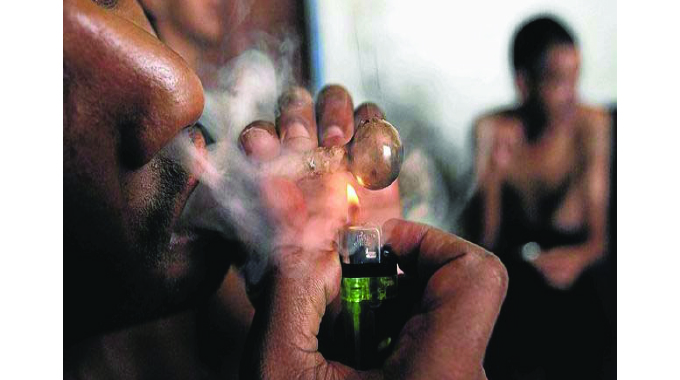
Sione Amidu, Gwanda Correspondent
A cloud of smoke bellows into the air behind the Vubachikwe shops in Gwanda District, Matabeleland South province.
As one approaches, a pungent and distinctive sweet and sour smell hits the back of the nose as 15-year-old *Chris Moyo and his friends engage in a puff and pass of marijuana they commonly refer to as “skunk”.
Chris dropped out of school early this year after his father lost his job.
With all hope of getting back to school lost, the young man has turned to illegal gold panning and uses the little he gets to buy drugs and other intoxicants.
“This sachet costs R10. Unlike beer, it’s cheaper and you get high faster than when you are drinking beer. My friends and I meet every day and each one of us brings something to share,” he said.
Chris is among the hundreds of young people who have turned to drugs and alcohol in the sprawling Vubachikwe Mine compound and surrounding areas.
Besides marijuana, the youths are also into Broncleer, njengu, mutoriro and other concoctions made using diapers and orange juice. A recent study showed that drug and illegal substance abusers in Zimbabwe spend an average of US$5 per day to feed their addictions. The study also found that urban dwellers constitute the highest number of drug users in the country compared to those in the rural areas.

To understand the root causes of drug consumption and substance abuse among Zimbabwean adolescents and youths, United Nations Children’s Fund (Unicef), in collaboration with the Government of Zimbabwe, Muthengo Development Studies (MDS), Zimbabwe Civil Liberties and Drug Network (ZCLDN), and Youth Advocates Zimbabwe (YAZ) undertook a qualitative behavioural analysis in 2022. The study aimed to identify the factors that contribute to drug use among young people in Zimbabwe and develop strategies to address the problem.
The study also identified the root drivers of alcohol, drugs, and other substance abuse as the death of parent(s), poverty and idleness, absent parents, broken homes, inadequate parenting practices, deviant behaviour and experimentation.
Mr James Ngwenya, a shopkeeper, said there are a lot of “unholy” incidents that happen when youths consume drugs. He said they become violent and young girls start behaving like commercial sex workers.
“We once encountered an incident where three young boys fought each other using dangerous weapons to the extent that one of them was severely injured, all under the influence of drugs. They are not ashamed of smoking weed or drinking njengu, broncho and mutoriro in front of us. When they are high, they become very wild.
“Young girls are also into substance abuse and they start behaving like old women. After taking the drugs, they indulge in sexual intercourse with older married men. They become characterless moving around the community half-naked looking for men,” said Mr Ngwenya.
Local churches have continuously been called upon to invite the youths to their churches and offer various activities as a means of keeping them away from drugs.
Various organisations have also undertaken to provide sporting activities and income-generating projects as a means of keeping the youths busy.
A local miner who spoke on condition of anonymity said the young drug users can go up to a week without food, surviving on water alone while underground panning for gold.
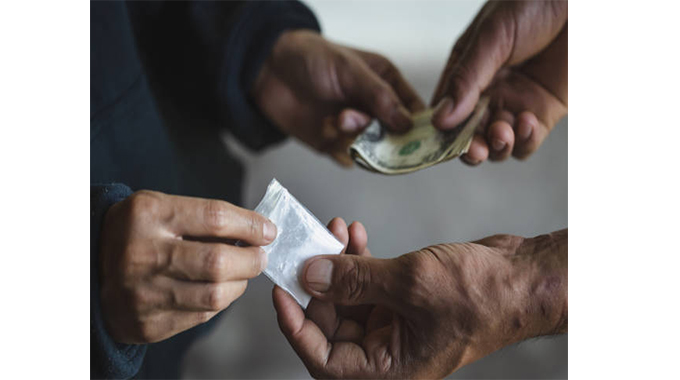
“We have a hard time working with these young men. They put some white substance on a R100 note and sniff it. Within a few minutes, they change behaviours and become like zombies, remaining still. They work tirelessly day and night without eating any food for a week or so.
“At times, they become very violent at work and drive us out of the mine using dangerous weapons like machetes and okapi knives. When they run out of the substances, they become so remorseful and we end up feeling pity for them,” he said.
The miner said there is hope for rehabilitation if families offer support.
However, the Second Republic is seized with the drug and substance abuse scourge prevailing in the country with a National Committee on Drug and Substance Abuse having been put in place to fight the pandemic.
Information, Publicity and Broadcasting Services Minister Dr Jenfan Muswere said the National Committee is determined to achieve the mandate given by Cabinet and will leave no stone unturned in its fight against drug and substance abuse.
He said drug and substance abuse is now one of the top-ranking disasters wreaking havoc in many societies across the world and Zimbabwe is not spared.
Recent studies done in Zimbabwe revealed that an estimated 7,1 percent of young people abuse drugs, with the most prevalent drugs being cannabis, crystal meth, broncleer, skin lighteners, illicit beverages and body enlargement products.
“Children as young as 10-years-old are now engaging in drug and substance abuse. Just like Covid-19, drug and substance abuse has affected our nation and in particular the mental health of our most productive age group. It is against this background that in April 2022, His Excellency, President Mnangagwa established the Inter-Ministerial Taskforce to address this menace.
“Due to the severity of the matter, the Inter-Ministerial Taskforce was elevated to the National Committee, chaired by Defence Minister and national chairman of our ruling party, Zanu-PF, Honourable Oppah Muchinguri-Kashiri, with a clear mandate to curtail the supply of illicit drugs and substances, reduce demand and harm of the same in people, ensuring access to treatment and rehabilitation services and promote the successful reintegration of people who use drugs into society,” said Minister Muswere.
The National Committee is diverse, he said, and includes Government ministries, departments and agencies, traditional leadership, religious organisations, development partners, private sector, donor agencies and academia among other stakeholders.
Church of Central African Presbyterian leader Reverend Jared Mwale said they were engaging in sporting activities to teach youths on the importance of life without drugs.
“We engage into sporting activities from assembly, provincial level to national level and also invite experts like teachers and the police who will be counselling the youths during Sunday school and sport galas. We need partnerships to build playgrounds to keep the children busy. In old mining set-ups, they used to provide youths with entertainment and have playgrounds that are specifically meant for children,” said Rev Mwale.
Ward 5 Councillor in Gwanda, Simbarashe Lismat said there were a number of push factors leading to drug and substance abuse including unemployment and ignorance.
“The issue of drugs is a serious one in this community because we see people buying electrical bulbs, diaper jelly, skunk, njengu and mbanje which are being consumed by youths. This problem is giving rise to a lot of criminal activities like house breaking, hooliganism and machete gangs because there is no longer respect for each other in the society, anyone can do anything,” he said.
Addressing the provincial drug and substance elimination committee recently, Matabeleland South Provincial Affairs and Devolution Minister Dr Evelyn Ndlovu said the province has equally been affected by drug and substance abuse particularly among youths.
“This is a very alarming and serious concern for all of us that we are losing our future leaders and our future families in this drug abuse menace. One of the mitigation measures that Matabeleland South is going to use is employment to make sure that we capacitate the youths so that during the day, they do not spend their time abusing drugs but spend their time working. We will also monitor that they are not using the same salary on drugs.
*Not his real name


 Online Reporter