Online Reporter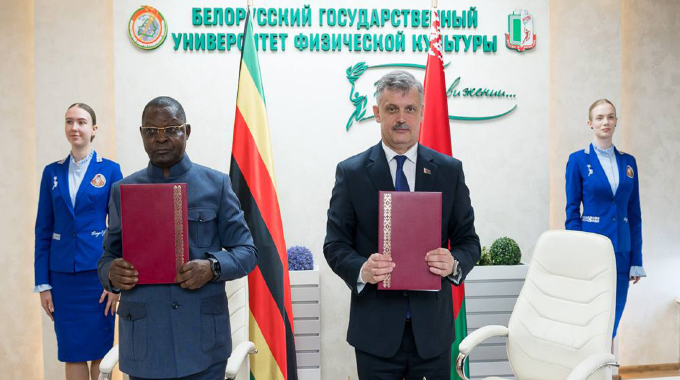
Lovemore Dube, [email protected]
THE Minister of Sport, Recreation, Arts and Culture, Anselem Sanyatwe, has set his sights on reshaping Zimbabwe’s sporting future, with his ongoing visit to Belarus already pointing towards a shift in how sport science is understood and applied back home.
Currently in Minsk, the Minister is engaged in high-level discussions at the Republican Scientific and Practical Centre of Sports — an institution that stands as a clear example of how modern sport is built not only on talent, but on knowledge, structure and precision.
What he has encountered is a system where success is not left to chance, but carefully put together through the coordinated efforts of science, medicine and education.
Inside the Belarusian institute, athletes are treated as more than competitors; they are studied, monitored and developed with a level of care that leaves little room for guesswork. Every detail matters — from heartbeat and muscle function to neurological responses — each one measured, analysed and refined. The philosophy guiding this approach is simple but firm: “No health – no results.”
It is a way of thinking that raises an important question for Zimbabwe — whether natural talent alone can still carry athletes to the top in a world where preparation has become so exact.
Walking through the institute, the Minister observed a system built around thorough medical care that goes far beyond basic checks. Athletes undergo detailed screening across various disciplines, including cardiology, neurology, endocrinology and even dental care, all working together to reduce risk and improve performance.
“Here, early detection is not a luxury, it is the foundation of victory. The message is clear, half of sporting success is secured not on the field, but in the laboratory,” said the Ministry in a statement from Belarus on Thursday.
Beyond the medical aspect, it is the use of technology that shows how far the system has advanced. Tools such as 3D imaging, body composition analysis and real-time monitoring give coaches and specialists accurate information, replacing the trial-and-error methods still common in less developed systems.
“But it is the technology that truly signals a paradigm shift. From 3D imaging and body composition analysis to real-time monitoring of physiological stress, the guesswork that often defines training in developing systems is completely absent.
“Athletes are no longer pushed blindly to their limits—they are guided there with scientific precision. Recovery, too, has been reimagined. Cryotherapy chambers, pressure therapy systems, and advanced regenerative treatments ensure that injuries no longer spell the end of a career, but merely a pause in performance”.
According to the Ministry, the visit is not simply about observing what is being done elsewhere, but about recognising what can be achieved at home if the right approach is taken. It is, in many ways, a call to move away from outdated methods and embrace a system built on science.
It said the visit was an invitation to leap from tradition into transformation.
“The implications are immense, fewer injuries, longer athletic careers and training programmes tailored to the individual rather than imposed on the masses. It is a future where some young sprinters in Harare or a footballer in Bulawayo is supported not just by a coach, but by a multi-disciplinary team of experts working behind the scenes,” said the Ministry.
Away from the machines and equipment, one of the strongest impressions left on the Minister has been the people behind the system. The Belarusian model places strong emphasis on education, continuously training professionals who specialise in different aspects of sport — from coaching and medical care to performance analysis.
This structured approach ensures that expertise is always being renewed and improved.
During his visit, the Minister has begun opening opportunities for Zimbabwean professionals to be part of this system, whether through online programmes, clinical training or practical experience in Minsk.
The aim is clear — not just to bring in equipment, but to build knowledge that will sustain long-term growth.
It is a careful and deliberate approach, centred on building capacity rather than relying on imports.
At the same time, the call for wider involvement has been made. Speaking from Belarus, Minister Sanyatwe is encouraging different sectors in Zimbabwe to play a role in shaping this new direction.
“This is not a Government project alone; it is a national challenge. The vision of a centralized Sport Science Hub in Zimbabwe which will be anchored in diagnostics, rehabilitation and performance monitoring. It requires bold partnerships and decisive investment,” said Minister Sanyatwe.
It is a message that places responsibility not just on Government, but on institutions and individuals. The medical sector is being encouraged to take sport seriously as a field of practice, while universities are being asked to align their training with modern demands.
Investors, too, are being urged to recognise that sport is no longer just leisure — it is an industry that can deliver real economic value if properly supported.
In Belarus, the strength of the system lies in how these different areas — medicine, science and education — work together. Replicating that same model in Zimbabwe could mark a significant shift in how athletes are developed.
Even before the Minister returns home, early signs of change are already being discussed. There are plans to introduce advanced diagnostic tools for national teams, to send Zimbabwean specialists for intensive training in Belarus, and to set up a smaller but effective sport science centre as a starting point.
These are practical steps aimed at turning ideas into action.
As engagements continue in Minsk, it is becoming clear that this visit could mark a turning point.
“The era of “training with hope” is giving way to “training with awareness.” The podium is no longer a distant dream—it is a calculated destination.
The Minsk Mission is not just a visit. It is a turning point.”