Online Reporter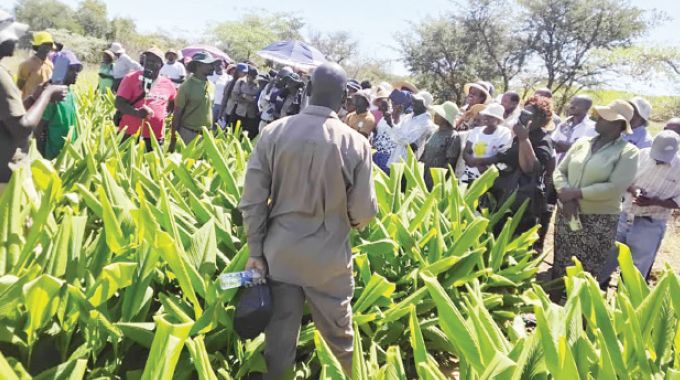
Nothando Zondo, [email protected]
FARMERS in Umzingwane District are beginning to see farming in a new light, as fresh ideas take root and quietly change what is possible on the land. In a place long known for traditional crops, there is now a growing sense of curiosity and hope, sparked by one farmer’s decision to step away from the ordinary and try something different. Instead of sticking to the usual, the focus is slowly shifting towards high-value medicinal crops such as chilli, turmeric and ginger — plants that not only survive tough conditions but also promise better returns.
At the centre of this quiet transformation is Mr Mthulisi Moyo, whose bold move into growing these crops has begun to turn heads across Matabeleland South.
What started as one man’s vision is now becoming a source of inspiration for many, as farmers begin to realise that the future of agriculture may lie in thinking differently. His work has not only introduced something new but has also opened doors to markets that stretch beyond local boundaries, reaching as far as neighbouring countries and beyond.
Although Mr Moyo is based in the United Kingdom, his heart remains firmly rooted at home, where he and his wife have built a well-organised farming operation at their homestead in Bayethe Village, Ward 14. There is a sense of order and purpose across the property, with managers carefully overseeing different parts of the enterprise — from the garden to the crop fields and even the livestock. It is a system that blends structure with vision, and it shows in the way everything runs smoothly.
Recently, the homestead became a place of learning and exchange, as scores of farmers gathered for a field day, eager to see for themselves what had been achieved. There was excitement in the air as visitors walked through the fields, observing the crops up close, touching the soil, and asking questions. For many, it was the first time they had seen turmeric and ginger being grown locally, and it sparked a sense of possibility.
The event became more than just a visit — it turned into a practical lesson. Consultant Mr Jerome Magumbe guided farmers through the important steps of production, taking time to explain everything from how to prepare the land to how to process and market the crops. His guidance helped break down what may have seemed like complex ideas into something farmers could understand and apply in their own fields.
Matabeleland South Provincial Agricultural Business Director Ms Shupikai Sibanda, who attended the event, praised the initiative and what it represents for the future of farming in the region. There was a feeling that this was not just about one farmer, but about a wider change that could benefit many.
“It is a great honour to address you at a field day that brings together innovation, resilience and practical farming solutions under one platform. Agriculture today requires us to move beyond traditional practices and embrace integrated production systems that maximise productivity, profitability and sustainability,” she said.
Her words reflected the reality that farming can no longer remain the same, especially in areas prone to difficult weather conditions. She stressed the importance of farmers learning from each other and working closely with extension services and other stakeholders, as sharing knowledge can often make the biggest difference.
She also highlighted how such gatherings help farmers adopt climate-smart practices that are better suited to their environment, ensuring that they can continue to produce even when conditions are not favourable.
Looking at the crops themselves, Ms Sibanda pointed out that turmeric, chilli and ginger are not just valuable – they are practical. They can withstand harsh weather and have strong demand in the market, offering farmers a chance to earn more.
“They are resilient to harsh climatic conditions and they present opportunities for value addition, which can enhance farmers’ incomes,” said Ms Sibanda.
However, she was quick to remind farmers that success does not come easily. These crops require proper care, from irrigation to pest control, and careful handling after harvest to make sure quality is maintained. It is this attention to detail that can turn a good idea into a successful business.
She also spoke about the importance of not putting all efforts into one type of crop. By adding other enterprises such as sweet potatoes, farmers can improve food security in their homes, especially in areas where rainfall is low.
Ms Sibanda further said that innovations like Juncao grass can help farmers take care of their livestock by providing reliable feed, while at the same time improving soil health. It is all about creating a system where crops and livestock support each other.
“It is important to integrate livestock into farming systems. You will note that cattle remain a vital asset for rural households by providing food, income and draught power.
“When supported by adequate fodder systems, livestock productivity improves, reducing feed shortages and strengthening overall farm resilience. Diversification spreads risks and stabilises income,” said Ms Sibanda.
Ward 14 Agricultural Business Advisor Mr Mkhululi Ngwenya also shared insights into the scale of the project, giving farmers a clearer picture of what is involved. He said that turmeric is grown on about 0,3 hectares, while ginger covers around 0,4 hectares — showing that even small portions of land can be used effectively.
“Mr and Mrs Moyo are the first farmers in Matabeleland South to grow these spices, especially turmeric and ginger,” he said.
Mr Ngwenya acknowledged that starting such a project requires money, which may be a challenge for some. However, he encouraged farmers not to lose hope, pointing out that the returns can be worthwhile due to strong demand, especially from export markets like South Africa.
“We want to diversify from common crops such as maize to high-value crops that can fetch more income for farmers,” he said.
As the field day came to an end, what remained was more than just knowledge — it was a shift in thinking. For many farmers, the visit planted a seed, not just in the soil, but in the mind. A seed of possibility, of change, and of a future where farming is not just about survival, but about growth and opportunity.