admin
admin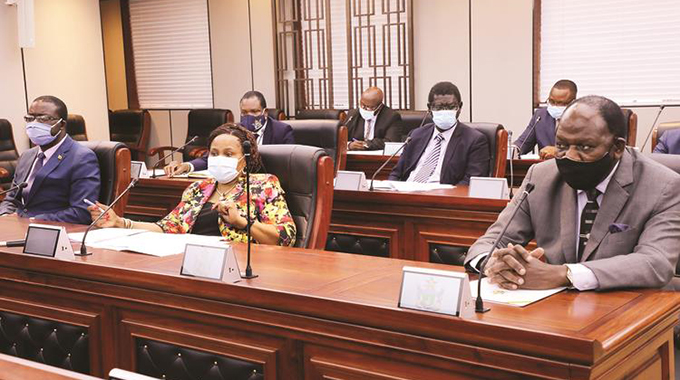
ZIMBABWE’S RESPONSE TO THE Covid-19 OUTBREAK
Cabinet received an update report on the country’s response to the Covid-19 outbreak, which the Minister of Defence and War Veterans presented as chairperson of the Ad-Hoc Inter-Ministerial Task Force.
Cabinet was informed that as of October 2, 2020, Zimbabwe’s cumulative cases of Covid-19 stood at 7 858, with 6 322 recoveries and 228 deaths. Six thousand four hundred and eighty-four of the cases are local transmissions. There were 50 new cases in week 39, compared to the 174 cases recorded in week 38.
With regard to laboratory facilities, Cabinet noted that Lancet Laboratories commissioned its laboratory at Victoria Falls International Airport, and pledges to deliver PCR results within two hours for both arriving and departing travellers.
Robert Gabriel Mugabe and Joshua Mqabuko Nkomo International airports have similar private and public testing facilities.
The task force will be dispatching teams to the country’s land and air ports of entry to assess their readiness in handling the large numbers associated with the complete opening up of the country to domestic and international flights.
With regard to the re-opening of schools the Ministry of Primary and Secondary Education is monitoring the situation and updating the Public Service Commission daily, while awaiting the outcome of the ongoing National Joint Negotiating Council talks.
Priority training of teaching and non-teaching staff on Covid-19 infection prevention and control measures for Phase 1 is underway in all the provinces, while logistical arrangements for Phase 2 staff training are being organised.
Noting the concerns and anxieties expressed by learners, their parents/guardians, as well as teachers, on the limited lesson time before public examinations, the ministry has come up with guidelines to ensure effective care and support for both teaching and learning, effective catch-up learning, remedial teaching, and preparations for examinations.
Regarding international travel, Cabinet explained that citizens can travel outside the country as long as they meet the requirements of the receiving country.
Horticulture recovery plan
Cabinet received and approved the horticulture recovery plan, which the Minister of Lands, Agriculture, Water and Rural Resettlement presented.
Cabinet was informed that the horticulture recovery and growth plan is an implementation mechanism for the Agriculture and Food Systems Transformation Strategy (2020-2025). The plans are all aimed at transforming agriculture from a US$5,2 billion to US$8,2 billion sector, contributing 20 percent of GDP by 2025 in line with the vision of making Zimbabwe an upper middle-income country by 2030.
The horticulture recovery and growth plan focuses on two broad and mutually reinforcing areas, namely: a private sector-driven recovery of the conventional horticulture sub-sector; and a robust, inclusive and sustainable and transformative rural horticulture sub-sector. While the conventional horticulture recovery plan will require US$1 047 719 284 from the private sector and partners, the Presidential Horticulture Scheme will cost US$186 920 000 and cover 1,8 million rural households.
The Presidential Horticulture Scheme will have the following components: household tree planting; village nutrition gardens; ward-based youth vegetable and horticulture gardens and orchards; schools vegetables and horticulture projects; mainstreaming indigenous vegetables and fruits; research, development and innovation in production, processing and value addition and beneficiation; and domestic and export market development.
Over 25 000 boreholes will be sunk in all villages and schools to ensure viability and anchor sustainability, and to climate-proof the Presidential Horticulture Scheme.
It is envisaged that by 2025, a vibrant rural agro-industry would have been established alongside a rejuvenated conventional horticulture sub-sector. Furthermore, it is projected that altogether a US$1,217 billion annual rural horticulture economy will be created by 2025, growing to US$3,5 billion by 2030. This will be equivalent to income amounting to US$675 and US$2 000 per household by 2025 and 2030, respectively. On the other hand, the export market from conventional horticulture growth will generate upwards of US$1,469 billion annually, from 2025 onwards, with additional exports being generated from the Presidential Horticulture Scheme.
The implementation of the plan will be championed through the Horticulture Development Council (HDC), while the Presidential Horticulture Scheme will be co-ordinated by an inter-ministerial Task Force.
Both will be aligned to the National Horticulture Working Group (NHWG). The HDC comprises horticulture commodity associations essential in the production and marketing of the respective commodities. The NHWG is a multi-stakeholder co-ordination platform that brings together all horticulture value chain players with all Government ministries involved in the sector represented. In addition, the Reserve Bank of Zimbabwe, the Bankers Association of Zimbabwe, the HDC, ARDA, ZIMTRADE, exporters, and eminent professionals drawn from the industry. The National Horticulture Working Group will oversee implementation of the plan, supported by thematic working groups.
Update on housing provision initiatives
As the Second Republic continues to explore and implement housing provision initiatives for citizens, Cabinet received an update involving Shelter Afrique, a pan-African banking institution which specialises in financing housing provision on the African continent. The institution has 44 member states.
The Minister of National Housing and Social Amenities informed Cabinet that on September 18, 2020, Zimbabwe was elected Second Vice Chair of Shelter Afrique. The country will host the 41st Annual General Meeting of Shelter Afrique, in 2022.
Cabinet agreed to the proposal by Shelter Afrique to construct its regional headquarters in Harare, to be officially opened in 2022. Cabinet noted with satisfaction that Shelter Afrique is considering to review Zimbabwe’s credit facility upwards, and negotiations on the matter will commence soon.
Memoranda of understanding between Republic of Zimbabwe and the Republic of Botswana on inter-state transfer of convicted persons, and cooperation in the field of correctional services
Cabinet considered and approved the two memoranda of understanding between the Republic of Zimbabwe and the Republic of Botswana, which the Attorney-General presented on behalf of the chairman of the Cabinet Committtee on Legislation.
The two SADC neighbours are seeking to develop bilateral co-operation in the field of the criminal justice delivery system. Through such co-operation, convicted foreigners may opt to serve their sentences within their country of origin.
The two countries are also seeking to improve the standards of services at their respective correctional institutions by enhancing co-operation on information management, human resource development, rehabilitation of offenders, and production and self-sustenance relating to agriculture and industries.
Capacitation of medical institutions: A review of Ekusileni Central hospital, Ingutsheni Central hospital, United Bulawayo hospital and Mpilo hospital
Cabinet received a report on an official visits by the Honourable CGDN Chiwenga, Vice President and Minister of Health and Child Care to the Bulawayo-based health institutions on October 2, 2020. A number of challenges were noted, and a roadmap on revamping operations of the four institutions was presented.



 Online Reporter