Chronicle Editor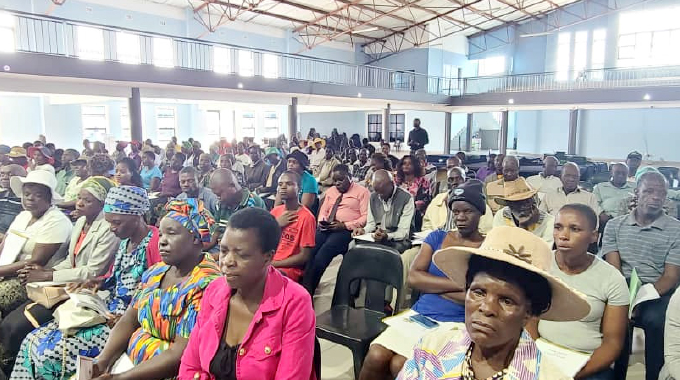
Sukulwenkosi Dube-Matutu, [email protected]
GOVERNMENT has intensified efforts to raise public awareness about the Constitution through rolling out constitutional advocacy meetings across the country targeting mainly remote and previously marginalised communities using their local languages.
This buttresses Section Seven of the Constitution, which demands that the State creates public awareness of the supreme law by translating it into all officially recognised languages and disseminate it as wide as possible to all citizens.
Under the Second Republic, the Ministry of Justice, Legal and Parliamentary Affairs, has recorded significant milestones to ensure that the public is aware of their fundamental human rights and freedoms, as enshrined in the Constitution whilst leaving no one and no place behind.
The ministry has held constitutional advocacy meetings at national level, provincial, district and institutions such as schools.
The exercise is now targeting local communities with languages, which were formally referred as minority languages with copies of the Constitution being disseminated in 16 local languages including sign language and braille versions.
On Tuesday, a Constitutional advocacy meeting was held in Beitbridge where Justice, Legal and Parliamentary Affairs Deputy Minister, Cde Nobert Mazungunye, unpacked the Constitution to stakeholders chapter by chapter with contents translated in Venda.
Local authorities, Government officials, traditional leaders, civic society organisations, special interest groups, youths, women and other key stakeholder groups attended.
“We are here in Matabeleland South to fulfil our obligation arising from the Constitution of Zimbabwe, which, among other salient issues, makes it vital for the State not only to raise awareness and knowledge of the Constitution but also to encourage all persons and organisations including civic society to disseminate awareness of the Constitution to all citizens,” said Mazungunye.
“Zimbabwe went through a historic process of crafting a new Constitution. Unlike the Lancaster House Constitution where the majority of Zimbabweans were not involved in its crafting, the 2013 Constitution is a home grown document by the people and for the people of Zimbabwe,” he added.
“As a ministry, we have done a lot to raise awareness of the Constitution from national level, provincial, district and now, we have moved to local language speaking communities.
“We want to cover every part of the country in line with Government’s philosophy of leaving no one and no place behind.”
For the Constitution to become a living and helpful document, the Deputy Minister said there is need to promote it amongst citizens.
He said the Constitution has to be taught in schools and as part of the curriculum for the training of members of security services, the civil service and members and employees of public institutions in line with Section Seven of the Constitution.
Deputy Minister, Mazungunye urged citizens and organisations, including civic organisations, to disseminate awareness and knowledge of the far and wide.
“Our Constitution begins with a preamble. This is one of the most important parts of a Constitution. The previous Lancaster House constitution does not have a preamble.
“The preamble helps to establish the context, which helps future generations to interpret and apply the Constitution in changing circumstances,” he said.
“The preamble sets out who we are, where we come from and where we are heading. The preamble articulates our shared values, norms, principles and peculiarities as a sovereign people.
“I have no doubt that my ministry’s interface with you will help to promote your sense of ownership of the Constitution and subsequently the culture of constitutionalism.”
In a speech read on her behalf by Beitbridge District Development Coordinator, Ms Sikhangezile Mafu, Minister of State for Matabeleland South Provincial Affairs and Devolution, Dr Evelyn Ndlovu, said the mandate of public promotion of the Constitution goes beyond the ministry as he invited all stakeholders to play ball.
“We consider this to be a “train the trainers” programme for us as we will be able to promote the same Constitution when we go back to our local authorities, traditional jurisdictions in the country side, political parties, civic organisations, youth and women organisations; government departments and institutions,” she said.
Chief Matibhe said the community was grateful for the Constitutional advocacy programme, which will help to bring the much needed development and empowerment to the people.
He said people in the area have in the past been left out of development initiatives because of language barriers. – @DubeMatutu.


 Online Reporter