admin
admin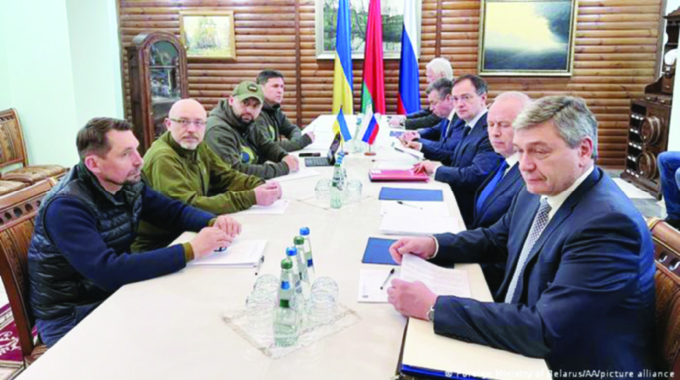
Gibson Nyikadzino Correspondent
Last week, a top diplomat stationed in Harare appeared peeved when this writer provided an alternative view to how Western media is withholding information and also inflaming events happening in Ukraine through misrepresentation of facts.
A misleading “us versus them” narrative has been created by the West against the rest, over Russia’s special military operation in Ukraine.
As usual, the goal of this space is mainly to educate and inform all, misleading none nor advocating for war.
Those who study war and politics, the Russian special military operation in Ukraine has opened broad important dimensions on the application of strategy to meet necessary objectives.
Traditionally, military force has been applied recklessly by the West without considering the consequences it would bear on civilians, whose death they labelled “collateral damage”.
As war and society have become more complicated, strategy has of necessity required increasing consideration of non-military factors, economic, psychological, moral, political and technological.
Strategies of offence, defence and coercion, for example, can all be used to achieve various strategic aims in peacekeeping operations.
The militarisation of US foreign policy has made military solutions to perceived threats the norm.
The United States has a long history of military interventionism, political and institutional developments have made it easier to choose military force as a foreign policy tool, leading to a persistent pattern of misapplication of armed force.
Since 1945, the post-war order has been characterised by the use of military force in the implementation of foreign policy, especially by the US and her European allies.
The Korean War (1950-1953) and the Vietnam War (1955-1975) exposed how successive US governments took military force as a factor that directs foreign policy.
What it means is, because the military is subordinate to politicians, when the military is deployed, it is supposed to achieve political goals.
Echoes of the 1991 disintegration of the Soviet Union were celebrated in the west with what was termed the “end of history”.
The “victorious” west, which does not pursue diplomacy as an alternative, went on rampage to bomb Yugoslavia in 1999, the US invasion of Iraq in 2003 among other endless military adventures the world over.
The 9/11 attacks on US soil changed the nature of conflict and opened more domains of conflict. Conventional wars were replaced with guerrilla wars, terror attacks and cyber warfare among other fronts.
In Ukraine today, Russia has conducted a special military operation to nip the new way of executing war that has come in the form of Western-backed neo-Nazists.
Technically, Russia has applied special strategies to curb the excesses of the west through their proxies.
Western media has cultivated mistakes that have arisen from their misperceptions of Russia’s patience and strategy.
Mediation through force
What Russia is doing in Ukraine helps the world understand the role of force in international politics and its relevance in the post-Cold War era.
The disagreement between Russia and Ukraine is being mediated through military power. This is part of a broad approach pursued by Russia under the Valery Gerasimov Doctrine.
The Gerasimov Doctrine of 2013 notes that: “The very ‘rules of war’ have changed. The role of non-military means of achieving political and strategic goals has grown, and, in many cases, they have exceeded the power of force of weapons in their effectiveness. All this is supplemented by military means of a concealed character.”
General Valery Gerasimov’s Doctrine was a result of Western threats to the Russia. When threats become sufficiently grave, soldiers themselves begin to reconsider organisationally state-serving preferences to adequately respond to the state’s immediate security problems.
No one can doubt how important military power, historically and now, is continuing to shape the trajectory of international security.
In the worst case for the US and its allies, Russia’s military operation may be the first important indicator of the dawning new world order.
An order that will be de-centred from Western values and rules.
The import of the special military operation in Ukraine, which others may term “limited war”, is that it is an operation not to defeat the enemy militarily but to force them to compromise and negotiate through calculated strikes.
Russia is not seeking to destroy Ukraine in the battlefield, but to shape its foreign policy in such a manner that it dis-aligns and mis-aligns with the US, NATO and the EU.
This is the long-term guarantee that Putin is chasing through the special military operation.
Clash of interests
When Russia President Vladimir Putin put his country’s nuclear forces on alert, ordinary people condemned him.
What is happening in Europe is a clash of foreign policy interests and ordinary people might not have the inner-eye to understand the dynamics besides condemnation of war as an eventuality.
Is Russia correct in putting nuclear forces on alert?
Yes. Nuclear forces or weapons are important not only because of their destructive capacity, but because of their deterrent effect.
The announcement by Russia was meant for NATO and the US not to contemplate interfering with the special military operation, ipso facto reminding the US and its allies that Russia is a great power whose security concerns must be taken seriously, with utmost respect.
Secondly, beyond communicating its security interests in Ukraine, Putin is also demonstrating how things could go out of hand if Russia decides to unleash the nuclear forces (brinksmanship).
Effectively, Russia is using the threat of nuclear weapons for bargaining and force US, NATO to stick to non-military action.
The final pivot of action
Since wars or military operations are usually highly costly endeavours, leaders of choose strategies that minimise losses, even when these strategies are not optimal for winning wars.
As we continue learning from the Ukraine situation, European politicians and their military officers need to find greater acceptance and understandings for each other’s domains.
Military officers in NATO or Russia need to accept that politics is part of war, and politicians need to acknowledge their need of military expertise in the balancing of ends, ways and means.
The military operation is far from a complete battlefield affair, but rather a means to get the enemy onto the negotiating table.
The conference table, and not the battlefield will soon prove to be the theatre of action.
From a strategic studies point of view, the Russo-Ukraine conflict is an emerging case study of limited war.
Reports coming through, which Western media turn a blind eye to, are that Ukraine’s President Volodymyr Zelensky is acceding to the possibility of recognising Crimea as Russia and also the sovereignty of the independent republics of Luhansk and Donetsk in the Donbass region.
All wars will end on the negotiation table.
Negotiation and not the battlefield, is the ultimate pivot of action where the theatre of peace will prevail.


 Online Reporter