Online Reporter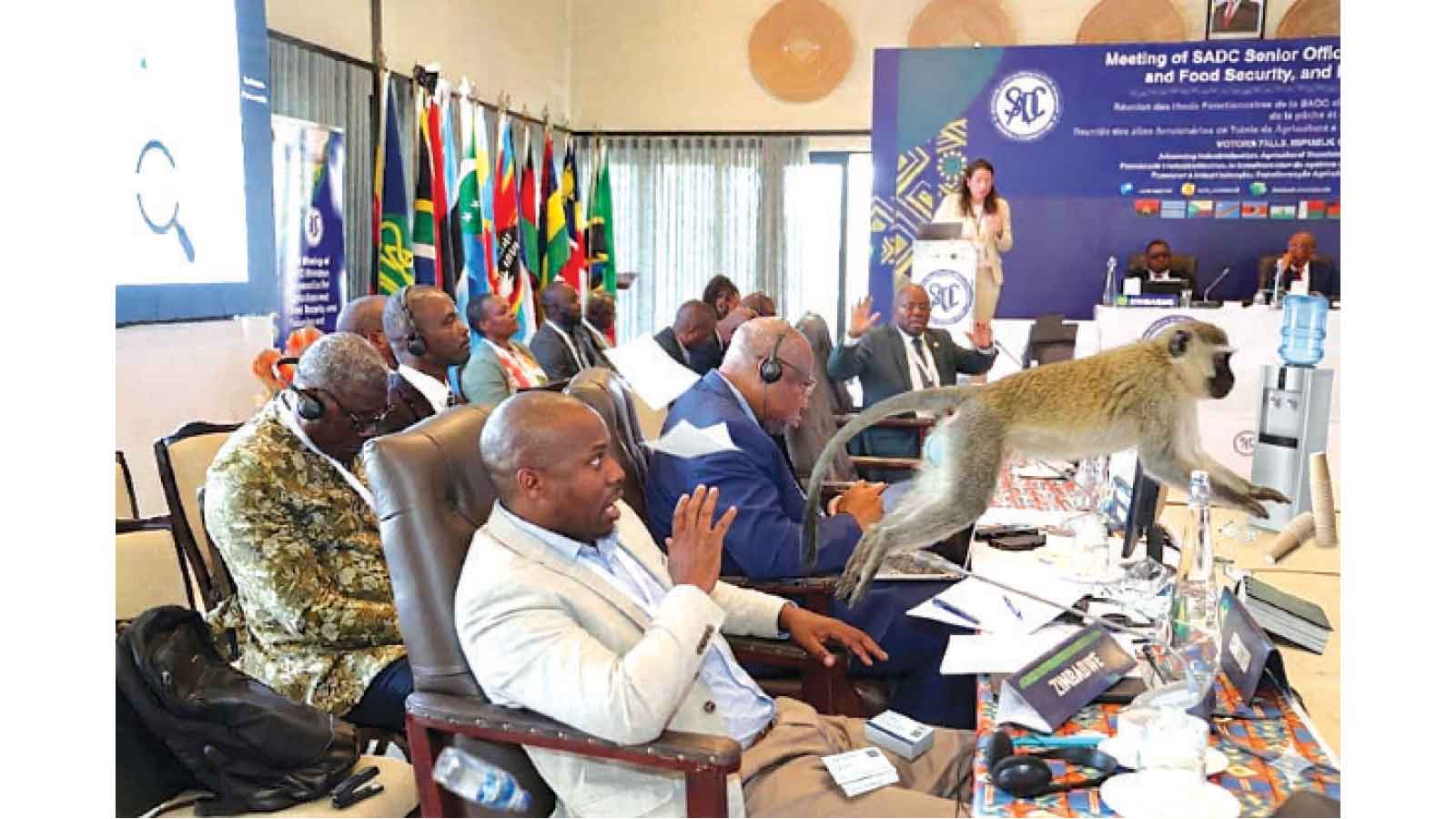
Theseus Mauruki Shambare in VICTORIA FALLS
THE conference centre in Victoria Falls does not behave like a sealed diplomatic space.
It behaves like a shared habitat.
Glass doors open onto walkways where mist from the Zambezi River drifts inland in slow waves.
The air carries both humidity and noise — the distant roar of the Falls, the rustle of trees, and the occasional sharp call of wildlife moving through the resort grounds.
And then there are the monkeys.
They are not visitors. They are not interruptions.
They are part of the landscape.
One sits on a railing near the entrance as if waiting for accreditation.
Another crosses a tiled walkway with the confidence of someone familiar with the venue. Staff barely look up anymore.
They already know the rules of engagement.
Keep doors closed. Do not leave food unattended. And never assume a corridor is empty.
Inside, Southern Africa is negotiating something far more structured.
At the entrance, security officers speak in the calm tone of people who have adjusted to unpredictability.
“They will enter if you leave the door open,” one officer says, gesturing toward the corridors.
“So we keep everything closed.”
At one point, a corridor door is left slightly ajar.
Within moments, movement outside quickens.
A few minutes later, a monkey appears briefly at the threshold, scans the room, and retreats just as quickly — as if deciding the agenda is not worth interrupting.
Staff laugh softly. Delegates smile but do not linger on it.
The meeting continues.
Step into the conference rooms and the atmosphere changes — not from chaos to order, but from natural movement to structured multilingual precision.
English dominates formal proceedings, but it is constantly filtered through interpretation headsets switching between Swahili, Portuguese and other regional languages.
A delegate from the other end speaks in Swahili, carefully outlining concerns about livestock disease spread across porous borders.
His remarks are translated into English, then into Portuguese for Lusophone Member States.
In response, another delegate raises concerns in English about climate variability affecting grazing systems, particularly in semi-arid zones, before switching briefly into a local language during a corridor discussion to clarify a point with another official.
Meaning does not collapse.
It circulates.
Beneath the linguistic flow is a clear set of pressures shaping the discussions.
Officials are working through proposals on how to stabilise Southern Africa’s food systems under increasing strain from climate variability, rising input costs, and livestock disease outbreaks.
One of the most urgent items is Foot-and-Mouth Disease, which has been repeatedly raised as a transboundary threat affecting livestock trade and rural livelihoods.
A proposal for a regional vaccine bank is tabled, alongside coordinated vaccination programmes and harmonised animal movement controls.
Zimbabwe’s Permanent Secretary for Agriculture, Mechanisation and Water Resources Development, Professor Obert Jiri, outlined the direction of travel.
“We have agreed on the need for SADC countries to coordinate vaccination programmes across borders, improve information sharing and strengthen surveillance systems because these outbreaks do not respect national boundaries,” he said.
He added that the region is now shifting from fragmented response systems to coordinated production capacity.
“We are also looking at producing vaccines within the region, establishing vaccine banks and strengthening diagnostic capacity so that Member States can quickly respond during outbreaks,” Prof Jiri said.
The discussion is not theoretical.
It is framed as a response to recurring disruptions already affecting livestock production systems across Member States.
The economic weight in the room
As discussions deepen, Chairperson of the SADC Committee of Senior Officials, Mr Mooketsa Ramasodi, anchors the debate in human and economic terms.
He noted that more than 58 million people in the region are currently food-insecure, a figure that immediately reframes the technical agenda.
“The economic and trade effects are being felt across the SADC region,” he said.
The implication is clear: livestock disease, climate stress and input instability are no longer sectoral issues — they are regional food security risks.
Around the room, the tone tightens.
Not in alarm.
But in recognition of scale.
Technical science: a virus that is changing shape
FAO experts brief delegates on evolving Foot-and-Mouth Disease strains circulating in Southern Africa, warning that virus mutation is complicating vaccination strategies.
Dr Elma Zanamwe explains that multiple SAT1 and SAT2 strains are currently in circulation, with new topotypes emerging in the region.
“We are seeing mostly SAT1 and SAT2 circulation, but what is more concerning is the emergence of new topotypes in the region,” she said.
The implication is direct: vaccine effectiveness now depends on continuous scientific adjustment.
“Vaccination cannot be static. We need epidemiologically matched vaccines and coordinated regional responses if we are to stay ahead of the disease,” she added.
The human systems behind the livestock economy
While technical debate continues, Directorate of Veterinary Services Chief Director, Dr Pious Makaya, shifts attention to the human foundation of the system.
He noted that smallholder farmers remain the backbone of regional agriculture, but also the most exposed to climate and disease shocks.
“The resilience of our livestock and food systems is ultimately dependent on the adaptive capacity of smallholder producers, who are operating at the frontline of climate variability, emerging animal disease pressures and constrained input access,” he said.
Around him, delegates nod — a quiet acknowledgement of a long-standing structural imbalance in the region’s agricultural systems.
Beyond the conference rooms, monkeys continue to move across rooftops and railings with unbothered rhythm.
One pauses opposite a meeting room window, briefly observing delegates seated inside, before turning away.
Inside, no one reacts anymore.
The outside world has become part of the background architecture of the meeting.
While livestock disease dominates discussion, broader agricultural challenges surface repeatedly.
Officials reference rising fertiliser costs, climate variability affecting rainfall patterns and water system stress across parts of the region.
Zimbabwe’s river systems, including those feeding irrigation infrastructure, are already under rehabilitation following environmental degradation, with at least 17 rivers placed under a national disaster framework.
The message is consistent: agricultural systems are already under strain.
The question now is how to stabilise them.
As evening approaches, monkeys retreat into surrounding trees, their movement fading into the softening light along the Zambezi corridor.
Inside the conference centre, lights remain on. Headsets are still in use. Interpretation continues across languages. Draft resolutions are refined.
From the outside, the building appears calm.
But calm is not silence.
It is structured activity contained within fragile stability.
Outside, nature continues without negotiation.
Inside, Southern Africa continues negotiating its own survival systems — across languages, across borders, across vulnerabilities.
And in Victoria Falls, between the roar of the river and the quiet of translation headsets, both worlds share the same air.