admin
admin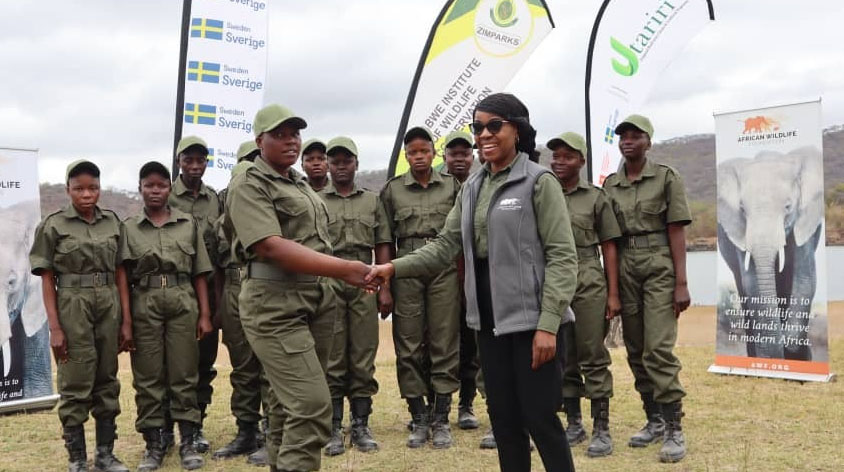
Sifelani Tsiko Agric, Environment & Innovations Editor
Zimbabwe is taking steps to increase the participation of women in wildlife conservation and creating a conducive environment to attract young girls to chart viable career paths in conservation.
Speaking at the graduation of 28 community wildlife scouts drawn from Mbire and Muzarabani districts at the Zimbabwe Institute of Wildlife Conservation (ZIWC) in Masvingo recently, Prof Never Muboko, principal of the institute said the country had made tremendous progress in opening up spaces for women and young girls in wildlife conservation.
“Witnessing such a great number of women graduating today shows gender balance in upskilling and training. I continue to advocate for the improvement of the girl child in wildlife conservation and I am happy today with the ratio that we have,” he said.
Almost half of the graduates were women and Prof Muboko said this signified the importance of gender inclusion in the conservation of natural resources and cultural heritage of two wildlife-rich regions in Zimbabwe.
A total of 28 community wildlife scouts completed a basic ranger training course facilitated by the African Wildlife Foundation (AWF) under the ongoing Swedish International Development Agency (SIDA) funded ‘UTARIRI – Integrated and Adaptive Biodiversity, Climate and Livelihoods Project in the Zambezi Valley, 2022-2025.’

The two – month basic ranger training course included both theory and practical training modules, equipping community scouts with skills in ecological monitoring, ranger-based data collection, conducting problem animal management and communicating with stakeholders in wildlife-rich areas.
It also included engaging the local community on conservation aspects using human rights-based approaches.
With funding support from the SIDA under the Utariri Project, AWF also equipped these scouts with uniforms, including patrol boots critical for their work during anti-poaching patrols.
“This historic development has come as part of efforts to support community-level human-wildlife conflict management structures under the Utariri Project,” said Dr Olivia Mufute, AWF Zimbabwe country director.
“This is in harmony with the AWF’s 10-year conservation strategy as we strive to conserve wildlife and reduce poaching and trafficking as major causes of the decline of key wildlife species in Zimbabwe.
“This would not have happened without the unwavering support from the Zimbabwe Parks and Wildlife Management Authority (Zimparks). The strong partnership that we have is indeed yielding positive results on the ground, including the upskilling of scouts that we have witnessed today.”
AWF supported a two-week refresher ranger training course offered to another 15 scouts from Mbire and Muzarabani Districts under the Utariri Project, bringing the total number of scouts trained by AWF to over 40 individuals.
For many years, men have dominated the wildlife conservation sector – safeguarding elephants as national park rangers or steering wildlife management agencies as chief officers or scientists.
Today, Zimbabwean women are making inroads and entering various fields and pursuing successful careers in diverse wildlife conservation disciplines.
The conservation sector is seeing a shift toward gender inclusivity as the country takes proactive steps to include more women and girls.
Missy Muchadei (19) won the overall Best Student Award for this basic ranger training course.


 Online Reporter