Online Reporter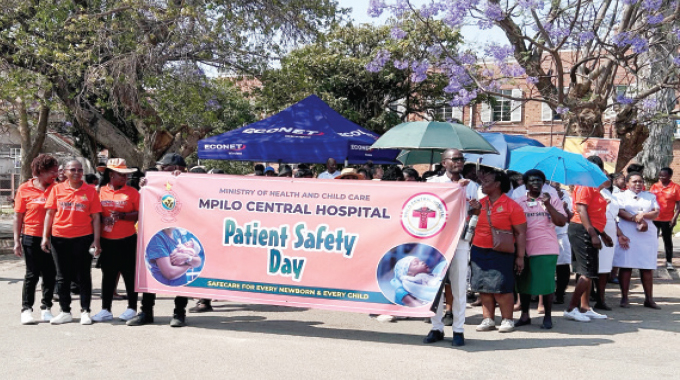
Raymond Jaravaza and Tanaka Nkala, Zimpapers Writers
HEALTH workers have been encouraged to put the safety of newborn babies in hospitals at the core of their activities as part of efforts to reduce neonatal mortality in the country.
Neo-natal mortality is the death of an infant that occurs during the first 28 days of birth and is calculated per 1 000 live births per year.
This was highlighted during the World Patient Safety Day commemorations that were held at Mpilo Central Hospital on Wednesday.
The day is celebrated on 17 September annually and aims to raise global awareness about patient safety and calls for solidarity and united action by all countries and international partners to reduce patient harm.
Dr Wedu Ndebele, a specialist paediatrician and senior lecturer at the National University of Science and Technology (Nust) Medicine Faculty, who was the guest of honour at the event, called upon all medical institutions in the country to put the safety of newborn infants at the heart of their operations.

“Newborn babies account for half of deaths of children under five years old. If we fail to protect them from neonatal mortality, we put the future of our nation at risk,” said Dr Ndebele.
He highlighted that the most impactful and lifesaving interventions such as breastfeeding are often the simplest and cheapest since newborn babies are prone to infections, hypothermia and difficulties in breathing.
“Breastfeeding is the cheapest security for child survival and should be promoted by all mothers. Failure to breastfeed has become alarmingly common driving preventable mobility and mortality,” he said.
This comes as Mpilo Central Hospital continues to make strides in reducing maternal and neonatal mortality rates through various interventions the institution has embarked on.
In 2023, the hospital introduced a Results Based Financing (RBF) model supported by the Ministry of Health and Child Care and the World Bank.
RBF Urban Voucher Programme was financing mechanism that was used to protect poor pregnant women from financial catastrophe in accessing health services for a minimum cost of US$1 for the voucher.
It was accessible to pregnant women and helped in enhancing equity in access to health services.
Speaking at the World Patient Safety Day, a global initiative, Mpilo Central Hospital public relations officer Mrs Norma Mabhena said the health institution was prioritising neo-natal care.
“Incubators, for example, provide warmth a pre-term babies that desperately need the lifesaving equipment to survive. The machines simulate the protective warmth of the expecting mother’s womb and keep the baby in a stable condition,” she said. “Without incubators, many of the newborn infants would not make it,” said Mrs Mabhena.
The theme for this year’s celebrations was: “Safe care for every newborn and every child”.
“Patient safety and death reduction is our main goal. Everything we do at Mpilo Hospital is driven by our desire and mission to make sure that every patient that passes through our doors and the hands of our medical personnel is safe,” said Mrs Mabhena.
For first time mother Ms Gugulethu Ndlovu, whose baby was born prematurely, improvement in the neonatal care at Mpilo Hospital saved her baby.
“Seeing my baby in an incubator for the first time was very difficult for me. I could not even look at her while she was recovering in the incubator but with time I got used to it as I knew it was going to save my baby,” said Ms Ndlovu.
After a short stay in the incubator Ms Ndlovu said her baby started making steady recovery and is now out of danger.
Another mother Mrs Aprinah Luviyeli from Siyadindi village in Binga in Matabeleland North Province, said her newborn baby developed jaundice after birth.
“I was terrified for my baby’s life at first when she developed jaundice symptoms but as soon as the nurses noticed the problem, she was taken for phototherapy for a four circle and now she is breastfeeding well,” said Mrs Luviyeli.
The RBF programme at the hospital made great strides in improving health service delivery using the funds as the hospital delivers close to 700 babies on a monthly basis.
Maternity cases that need specialised care are referred to Mpilo Central Hospital.
Some of the challenges, which the hospital has been facing in the maternity unit concerns resource constraints.