Online Reporter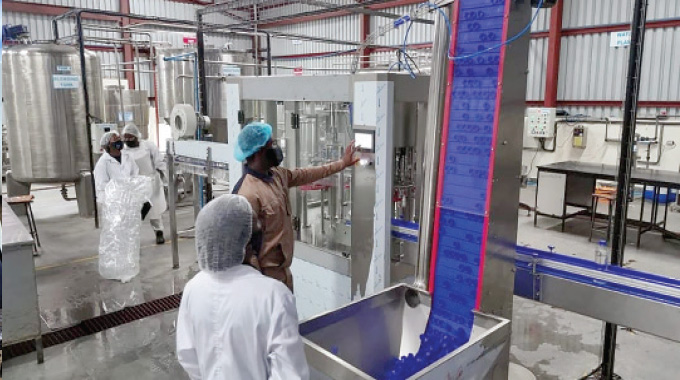
Patrick Chitumba, [email protected]
THE Midlands State University (MSU) is ramping up industrial production from its industrial units, churning out over 300,000 bottles of Nature Burst juice monthly at its food and processing plant, which has undergone a significant transformation, shifting from a small-scale, internally-focused operation to a thriving commercial venture.
The plant, which initially produced still water and Nature Burst drink for MSU’s internal needs, has expanded its capacity following installation of new automated equipment and is part of the broader industrialisation drive.
The university’s Industrial Park is evolving into a thriving innovation hub, driving research, entrepreneurship, and industrial growth by producing goods and services that stimulate economic activity in line with the Second Republic’s re-industrialisation drive.
President Mnangagwa officially commissioned the Industrial Park in 2020, and the facility has since made significant strides in providing innovative solutions to the community and beyond.
Government is keen to see every Zimbabwean reach their full potential through a strong and vibrant innovation ecosystem with universities leading the drive.
The MSU Industrial Park also houses the university’s clothing and textile enterprise and a chemical manufacturing plant.
To ensure products from the park reach the public, MSU has also opened a retail outlet in Gweru and is driving industrialisation through the implementation of an education system that is transforming the tertiary institution from producing job seekers to churning out graduates who create jobs.
MSU executive director of enterprise, Ms Patience Mangwiro, said the strategic move is part of MSU’s broader push to commercialise and industrialise, driving sustainability and revenue growth.
The expansion aligns with the Education 5.0 model, which emphasises innovation, industrialisation, and community engagement and by scaling up production. MSU is not only meeting local demand but also contributing to Zimbabwe’s economic development, she added.
“The facility has undergone significant transformation, evolving from manual production lines to a fully automated system, signalling the university’s shift towards the Education 5.0 model-driven industrialisation,” said Ms Mangwiro.
She added that MSU has four business units, namely the Chemical Manufacturing Unit, Food and Beverages Unit, Clothing and Textiles Unit, and Printing Press and Publications, established by the institution to drive innovation, value addition and commercial viability.
“We have increased our production capacity from when we started. We are now producing 14,000 bottles of Nature Burst per shift per day, bringing the total to 308,000 bottles per month (22 operational days). Initially, we used manual processes, but now we have an automated line,” said Ms Mangwiro.
“We have also acquired pasteurisers to extend product shelf life. We began by servicing the MSU internal market, but demand quickly outstripped supply.”
She said with the Zimbabwe Standards Association (ZSA) certification now in place, the institution can supply wider markets.
“Importantly, we source fruits directly from local farmers, completing the value chain,” she said.
Ms Mangwiro said besides juice, the food and processing plant also produces mineral water and distilled water.
“These products are sold in the MSU internal market, supermarkets (Nyaningwe, Imac), food outlets (Auntie Cutie), to street vendors, and retail shops through van sales in Gweru, Kwekwe and Shurugwi,” she said.
On employment creation, Ms Mangwiro said that the plant is run by 16 employees and five students.
“The plant is a result of the innovation hub and industrial park that were initiated by the Second Republic under Education 5.0,” she said.
MSU Vice Chancellor, Professor Victor Muzvidziwa, weighed in saying that beyond boosting output, the expansion is strengthening linkages with surrounding communities through the utilisation of locally produced fruits, in line with the government’s thrust on inclusive industrial growth.
“Education 5.0 is now making a tangible impact beyond our borders. This is a system anchored on innovation, driving industrialisation. We are commercialising innovations, protecting them through patents, and establishing production units, factories and workshops,” he said.
“This directly supports a critical pillar under NDS2, and we are confident the impact will continue to grow.”
Prof Muzvidziwa explained that the expansion of the MSU beverages plant positions tertiary institutions as key players in the country’s industrialisation agenda, blending innovation, skills development and production to drive sustainable economic growth.
The Industrial Park exemplifies the practical implementation of the Second Republic’s heritage-based education policy, transforming higher learning institutions into catalysts for economic development, community empowerment, and national resilience.