admin
admin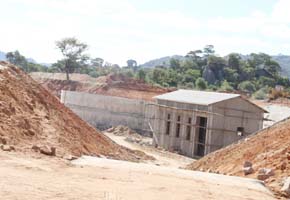
The project, which missed completion deadlines four times last year, is almost complete as most of the major works have been completed.
A visit to the site yesterday by a Chronicle news crew revealed that the pump house has been constructed and most of the pipeline has been laid.
In an interview yesterday, the Minister of Water Resources, Development and Management, Samuel Sipepa Nkomo said only 13 percent of the work was left.
The city is facing an acute water shortage with the five supply dams — Insiza, Umzingwane, Upper Ncema, Lower Ncema and Inyankuni holding about 50,2 percent of their capacity as of 27 March this year.
The figure is 2,73 percent less than what the dams held when council announced a water-shedding schedule in December 2010.
“Although I cannot give an exact date for the commissioning, we are highly optimistic that the June deadline will be met. About 87 percent of the work has been done and the pump houses are almost complete, while most of the piping has been laid,” said Minister Nkomo.
He said pumps and motors that were being imported from China were in Johannesburg, South Africa, awaiting collection.
“Initially, generators will be used to pump water from the dam, through the pipeline, into Umzingwane Dam. However, as a long term measure, a contract was awarded to a local company to put up a power line that will bring electricity from Gwanda Town,” said Minister Nkomo.
Bulawayo was forced to decommission Upper Ncema on 21 March and Umzingwane Dam is likely to follow in a few weeks time.
More than 80 percent of the city’s water supply is held by Insiza Dam but cannot be extracted at the required rate due to pipeline constraints.
Mtshabezi Dam, completed in 1994, has been lying idle as the implementation of the project to pump the water from the dam to Umzingwane Dam from where it would be pumped into the city’s reservoirs has been postponed numerous times over the past 18 years.
Mtshabezi Dam has a capacity of 52,2 million cubic metres.
Once harnessed, it will be the city’s sixth supply dam and the third largest, after Insiza and Inyankuni.
The pipeline has always been touted as the short-term solution to Bulawayo’s water problems.
Bulawayo’s director of engineering services, Eng Simela Dube, is on record saying water rationing could not be lifted in the city before the completion of the pipeline. The National Matabeleland Zambezi Water Project, which was first mooted in 1912, is viewed as the permanent solution.
On 5 December 2010, Bulawayo City Council announced a water shedding schedule but suspended the shedding after the city received rains soon after.
In February, Eng Dube said water shedding was imminent after the city’s five supply dams had a collective inflow of only two percent of their holding capacity during the last rainy season.
The city is said to be operating with a deficit of about four dams. The city was supposed to have an additional supply dam constructed after every 10 years.
The last supply dam to be constructed and used by the city was Insiza in 1976.


 Online Reporter