admin
admin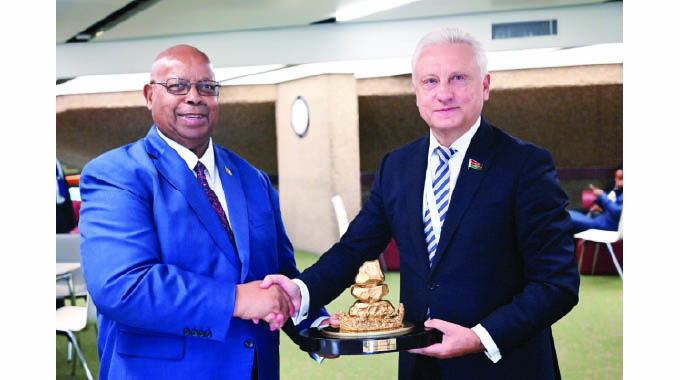
Herald Correspondent
In a demonstration of Government’s commitment to fostering international relations, Speaker of Parliament Advocate Jacob Mudenda engaged in a productive dialogue with Speaker of the Parliament of Iran Dr Mohammad Bagher Ghalibaf.
The meeting explored avenues for enhanced cooperation between the two nations, reflecting the spirit of friendship and non-adversarial diplomacy espoused by President Mnangagwa.
Dr Ghalibaf acknowledged the historical ties between Zimbabwe and Iran, dating back to it’s struggle for independence.
He reaffirmed Iran’s commitment to strengthening these bonds and expressed optimism about the potential for deepened collaboration. The Iranian Speaker emphasised the importance of parliamentary diplomacy in fostering mutual understanding and cooperation.
Adv Mudenda, in turn, expressed condolences for the tragic loss of the President of Iran Ebrahim Raisi.
He reiterated Zimbabwe’s unwavering support for Iran and its people, particularly in the face of challenges posed by Western sanctions.
The two leaders discussed a range of issues, including economic cooperation, regional security, and parliamentary exchanges.
They identified potential areas for collaboration in sectors such as agriculture, mining, education, and technology.
Adv Mudenda underscored the need to diversify economic relations and explore innovative trade mechanisms to mitigate the impact of sanctions.
On the regional front, Adv Mudenda expressed concern over the escalating tensions in the Middle East and called for a peaceful resolution to the Israeli-Palestinian conflict. He reiterated Zimbabwe’s support for the two-state solution of independent Israel and Palestine and condemned the violence perpetrated against civilians.
Dr Ghalibaf called for international efforts to promote dialogue and de-escalation.
In terms of parliamentary relations, the two Speakers agreed on the importance of establishing a formal friendship association to facilitate exchanges and cooperation.
They discussed potential areas for collaboration, including legislative best practices, capacity building and joint parliamentary initiatives.
The meeting concluded with a mutual commitment to strengthen bilateral relations and explore new avenues for cooperation.
Adv Mudenda also met Mr Sergei Rachkov, Chairman of the Standing Committee on International Affairs of the House of Representatives of the National Assembly of Belarus.
The meeting underscored the cordial and fraternal relations that continue to be strengthened between the two sisterly Republics.
Mr Rachkov started by acknowledging the cordial relations at the governmental level between Zimbabwe and Belarus. However, he pointed out a noticeable gap in parliamentary relations, which he deemed essential for the further enhancement of bilateral ties.
He said while Presidents of both countries have engaged in reciprocal visits that have deepened cooperation in various sectors of the economy, it is crucial to establish direct links between their parliaments. To that end, Mr Rachkov proposed the formation of a friendship association between the two parliaments. He suggested that this initiative could be incorporated into an existing agreement proposed with the Southern African Development Community (SADC) region or developed specifically for the two legislatures.
In response, Adv Mudenda expressed appreciation for the proposal to establish a Parliamentary Friendship Association, recognising it as a positive initiative.
He encouraged Mr Rachkov to take the lead by engaging his counterpart, Cde Webster Shamu, the Zimbabwean Chairperson of the Portfolio Committee on Foreign Affairs and International Trade.
Adv Mudenda also expressed gratitude to Belarus for its assistance in modernising Zimbabwe’s agricultural sector, particularly through the supply of tractors and related farming equipment.
He identified potential areas for investment in the mining, medical and in agro-industries, highlighting the importance of diversifying and strengthening economic ties. To further enhance cooperation, Adv Mudenda proposed the promotion of academic exchanges aimed at fostering science, technology and innovation (STI) as pivotal instruments for developing knowledge-based economies driven by artificial intelligence. He emphasised that such initiatives could significantly contribute to smart agriculture, e-governance, smart industries, and greater parliamentary collaboration.
Mr Rachkov acknowledged that the Belarusian executive had already signed several agreements that require ratification by both legislatures to support economic development in both countries. He also pledged to explore avenues for scholarships for Zimbabwean students on the background of Belarus’ achievements in the education sector.


 Online Reporter