admin
admin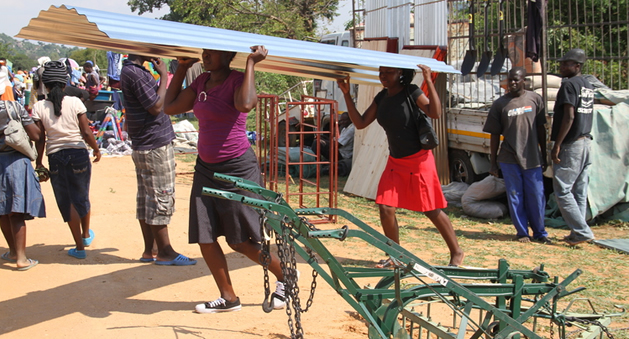
Tichaona Zindoga Senior Features Writer
THE seeming decay of rural shopping centres in Zimbabwe, as seen by travellers on the highways and roads across the country, is something of a tragedy. It is also an indictment on the business ethic and continuity of the black entrepreneur, and most damningly, the dearth of the idea of “growth points” which was supposed to turn big rural centres into development hubs and stem the tide of people going to towns in search of work and better facilities.
Travelling along the Birchenough Bridge-Chivhu highway will provide the familiar pitiful sights of limited life and decrepit shops.
Only recently at Chikuku Shopping Centre in Bikita West, some 60 kilometres from Birchenough Bridge, something huge was happening.
There was life and movement.
There was hustle and bustle.
The shop fronts were awash with people and at an open space behind spread a sea of people at an open market that has the characteristics of the famous Mupedzanhamo flea market in Harare – and more.
One could compare it with the market of Umuike in Chinua Achebe’s “Things Fall Apart”, which is said to have “so many people on it that if you threw up a grain of sand it would not find a way to fall to earth again”.
There seemed to be such Umuikean magic here.
About 500 traders of various sizes and shades bring together the community of scores of surrounding villages selling anything from cellphones and cellphone accessories, clothes, household utensils, radios and other electric gadgets; farm implements and hardware to maize.
Petty traders dealing in cellphone recharge cards, snacks and soft drinks also haunt the market.
The customers, estimated to be close to 2 000, swarm the area and the swathe of human life is breathtaking. Today is Chikuku’s turn, and in the next five days the mobile Mupedzanhamo will descend on other villages around some 300km radius of Bikita Rural District Council.
The show comes to town six days every month.
“The idea of open markets started in 2008 as a way of helping people access goods and also help with council revenue,” explains Mathew Mabhande, a council official who was collecting fees from the traders.
“When people agree on a venue regarding a particular catchment, we assess the venue and put up amenities such as toilets and water as part of our service delivery.
“There are sufficient Blair toilets and potable water at each of the stations,” he explains.
“This initiative has helped Bikita Rural District Council to collect revenues so that we can deliver our mandate of service delivery,” he says adding that council collects between US$600 and US$700 on a typical market day and over US$2 000 per week.
Each stand costs US$5 per day.
“The revenue collection has been the biggest success while we find minor challenges with some people who refuse to pay, whereupon we confiscate their goods until they pay up,” he says.
There are likely not to be many riots in this happy crowd.
Business is brisk.
Rarer, colourful goods are brought to the villages and villagers trade local goods like roundnuts and madora among themselves.
“I can make up to US$300 per day if business is good, especially after harvest time,” says Admire Mwachoma, a Harare resident who has been travelling with the mobile market since 2008.
He sells clothes and cellphones.
“I make around US$500 over two market days and my stock will be sold out,” he says.
Tafadzwa Knowledge Motsi (25) of Manyame Park in Chitungwiza has a stall at Harare’s Mbare Musika where he sells school uniforms, and he knows when to come down to Bikita.
“I come here when there is no business in Mbare. I bring the cheaper uniform sets that cost between US$5 and US$6 because that is the material that the people here afford.
“They cannot fork out US$15,” he explains.
A Masvingo resident, Peterson Sakala (53), conducts his business from the back of his truck.
He sells groceries and some clothes.
The idea of the open market has been a huge boon.
“I have been doing this for the past three years and it has helped me a lot,” he tells The Herald.
“I have been able to send my children to school and as we speak one is at university, one is doing Form 6 and two are in Form 2. I have no other business apart from this. In fact, I wanted to rent a shop but I could not find one.
“This is a relief and on average I make US$100 per day and my stock is finished in five to six days,” he says.
He says the Chikuku centre is most lucrative followed by Chiremwaremwa.
The budding businesses of Bikita need support.
“The Government should provide us with loans so that we expand our business and own formal shops,” he suggested.
On the other hand, he challenged the local authority to provide water at other centres by sinking boreholes.
He noted that Chikuku had only one tap to serve the multitude.
For Cain Musungure, who travelled all the way from Kuwadzana in Harare, the trick lies in accessing funding to buy his own car.
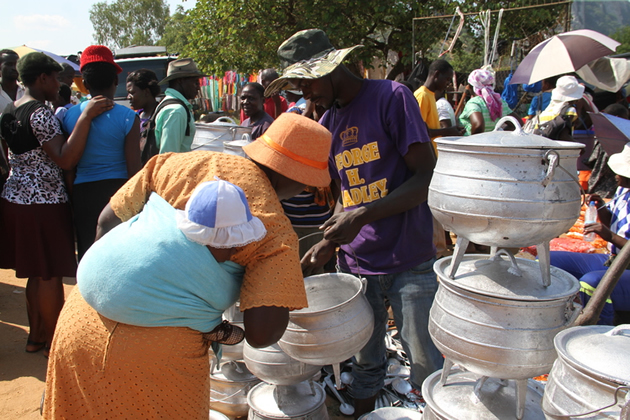
His routine involves buying three-legged cast iron pots from Mbare where he hires a truck to travel close to 400km to Bikita where he will shunt from one market to the other.
This costs him around US$250.
His stock of around 40 pots comprising of large, medium and small pots will yield around US$600.
For all the challenges, he is determined to succeed.
“I used to ply my trade in Mbare where business was not that good when I heard that there was something like this going on here I decided to give it a try,” he explains.
It has paid off, as the pots, which are durable and have always commanded respect in rural areas, are in demand.
Such are the things that villagers have been praying for.
“We now don’t have to go to Harare or Masvingo to buy the things that we want because we can now find them locally,” says one villager, Clementia Chiutsi.
A barman at the shops reveals that market days are profitable to the extent that his stock of Chibuku opaque beer flies from the shelves as he shunts 15 crates instead of the normal six.
The market days may also help alleviate hunger in the drought-prone area, although the maize sold at the market costs what may be called a prohibitive US$7 per 20-litre bucket.
Amid the hustle and bustle, one could also sense the inevitability of new relationships and liaisons being made from this Mupedzanhamo concept, which may yet provide memories in the future.



 Online Reporter