Online Reporter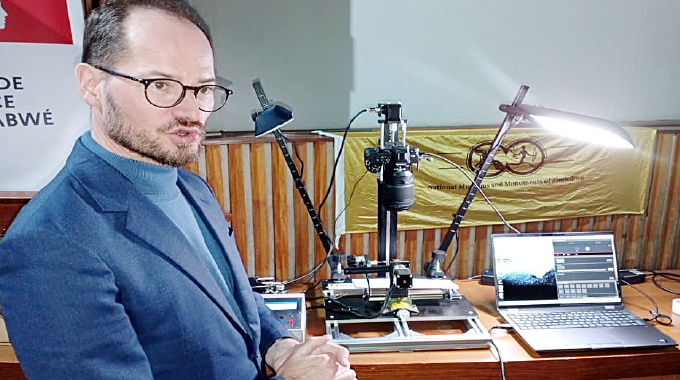
Raymond Jaravaza, [email protected]
THE Natural History Museum of Zimbabwe has received a major boost to its scientific research capacity following the donation of a state-of-the-art 3D imaging system that will enhance insect biodiversity studies and conservation efforts.
The cutting-edge equipment will allow researchers to digitally capture and share high-resolution images of insect specimens, enabling scientists from around the world to access the museum’s vast collection without physically handling or transporting fragile samples.
The technology will revolutionise how researchers interact with the collection, opening new frontiers in the study of insects.
Established in 1911, the Bulawayo-based institution houses one of Africa’s most significant entomological collections, with about five million insect specimens, some dating back to the late 19th century. The collection includes more than 3,200 type specimens — among them 420 holotypes — which are critical for defining species and supporting global scientific research.
Among its prized holdings is a 140-year-old jewel beetle, believed to be the oldest specimen in the collection, gathered during an expedition to Zanzibar in the 1880s. Bulawayo Natural History’s head of the entomology department and curator, Ms Dorothy Chipo Madamba, stumbled across the beetle while conducting a study on edible insects in Zimbabwe.
The donation was handed over by the French ambassador to Zimbabwe, Paul-Bertrand Barets, under a collaborative project funded by the French Government, bringing together the museum, Chinhoyi University of Technology (CUT), and France’s Institute of Research for Development.
Amb Barets said the initiative, titled Co-operation for the Protection of Biodiversity in Zimbabwe, aims to strengthen research, innovation and training in insect biodiversity.
“Focusing on innovation, training and field-based science, the initiative underscores the critical role of insects. Representing approximately 80 percent of all living species and over 80 percent of animals, insects are fundamental to the health of the natural ecosystem. Despite this, insect biodiversity remains significantly understudied,” he said.
Amb Barets described museum collections as “libraries of life” that require continuous modernisation to remain relevant in global scientific research.
The new 3D imaging system will enable digitisation of rare and delicate specimens, enhancing international collaboration while preserving the integrity of the collection.
“Museum collections are vital for understanding biodiversity, yet require continuous enrichment and modernisation. A major milestone of the project is the donation of a state-of-the-art 3D imaging system,” he said.
“This technology will enable the digitisation of valuable insect specimens, including rare and fragile types, making them accessible to researchers worldwide through online platforms. Digitisation enhances international collaboration while reducing the need to handle or transport delicate specimens.”
Experts said the development comes at a critical time when biodiversity is increasingly under threat from climate change and human activities.
Senior lecturer at CUT, Professor Robert Musundire, said while insects hold immense ecological and economic value, their global decline remains poorly documented.
“While insects represent a significant economic and ecological value, the global decline in their populations remains a phenomenon that is poorly documented and largely overlooked.
“The donation of a 3D imaging system will build a network of experts dedicated to ensuring knowledge transfer to those involved in issues relating to insect decline,” he said.
Prof Musundire said the integration of modern technologies such as 3D imaging is expected to position the country as a key player in global research while safeguarding its rich natural heritage for future generations.