

 Online Reporter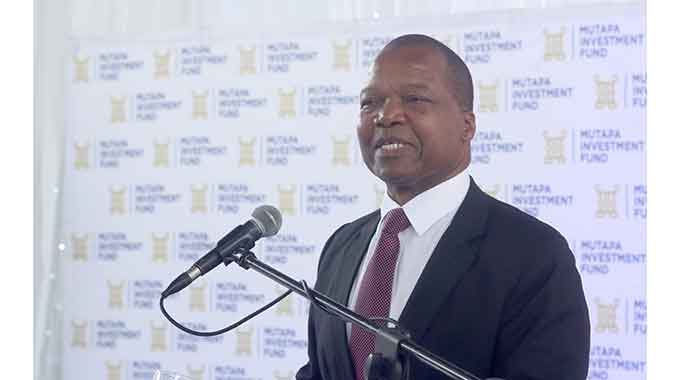
Business Reporter
MUTAPA Investment Fund, Zimbabwe’s sovereign wealth fund, is working to upgrade its subsidiary, the National Oil Company of Zimbabwe fuel handling capacity from 3 billion to 5 billion litres per year, the fund’s chief executive Dr John Mangudya has said.
He revealed this at the inaugural public lecture series organised by Zimpapers in partnership with the Harare Institute of Technology (HIT) and Mutapa in Harare on Friday.
The lecture was sponsored by Zesa Holdings, NetOne, AFC Insurance, AFC Leasing, CABS, POSB, TelOne, Air Zimbabwe, FBC Holdings, BDO, Petrotrade, Willowvale Motor Industries, Homelink, Printing and Minting Company of Zimbabwe and the Export Credit Guarantee Corporation of Zimbabwe.
Expanding NOIC’s handling capacity will help Zimbabwe meet rising fuel demand, reduce import costs, strengthen Zimbabwe’s strategic reserves and establish the country as a regional energy hub.
Zimbabwe’s fuel consumption has experienced a significant upward trend over the last three years, driven by robust demand in key economic sectors such as mining and transportation.
Increased activity in mining (including lithium and platinum) and agriculture has directly boosted fuel demand.
Diesel consumption, in particular, reached 1,12 billion litres in 2024, marking a steady increase from 1,07 billion in 2023 and 1,04 billion in 2022.
Fuel consumption (including petrol and diesel) increased by nearly 30 percent in the 11 months to November 2024 compared to the previous year.
Dr Mangudya said the capacity extension for NOIC was part of Mutapa’s broader restructuring plans for the Fund’s US$16 billion asset portfolio that spans key segments of Zimbabwe’s economy.
“At NOIC, we are working with them to increase capacity. The idea here is to increase capacity to 5 billion litres per year, which is about 400 million litres per month.
“It’s happening. It used to do 1,8 billion litres and now it has a capacity of three billion litres; we want to move from three billion to five billion litres,” Dr Mangudya told the oversubscribed gathering.
NOIC has upgraded the Feruka oil pipeline to 3 billion litres per year in partnership with CPMZ of Mozambique.
Expanding the capacity further will lower fuel transportation costs and reduce reliance on expensive road transport. Dr Mangudya said the initiative would remove many fuel tankers from the country’s roads.
Already, more than three-quarters of fuel imports into Zimbabwe use the NOIC pipeline.
The initiatives at NOIC are part of overarching efforts to modernise infrastructure and ensure the security of fuel supply.
They also feed into Zimbabwe’s vision of becoming a regional fuel hub by capitalising on its strategic geographical location and utilising existing pipeline infrastructure to facilitate cheaper, faster and more efficient fuel distribution to landlocked neighbours like Zambia, Botswana and Malawi.
Dr Mangudya said NOIC owns a “monopoly capital”, the Feruka oil pipeline, which connects Harare to Beira Port in Mozambique.
It is only a part of Mutapa’s grand transformation plan to pursue opportunities, informed by the fund’s mandate, objectives and diagnostic assessment conducted by the fund and its SWOT analysis.
Mutapa thus devised a transformation strategy, dubbed FIRE, which stands for Fix, Invigorate, Reinforce, Extract.
“We came up with an acronym for our strategy, FIRE, which means we need to fix, we need to invigorate, which is reviving, we need to reinforce, which is strengthening and we need to extract value from our companies,” Dr Mangudya said.
“And we also went further to say, you know what? Now that we have this FIRE strategy, we also looked at the Boston Consulting Group (BCG) metrics. So, we looked at the Boston Consulting Group metrics for business and also our FIRE strategy.
“The two of them, we combined them and came up with that very simple, illustrative diagram, whereby, we say we have got stars within the group, we have got cash cows within the group, we have got question marks within the group, and we have got dogs within the group.
“That is the categorisation under the BCG Matrix. So, we used those same metrics to categorise our entities. And we said, who are the question marks?
“The likes of Telecel, a question mark. (Grain milling firm) Silo is a question mark. (Meat processor) CSC was a question mark by the time we started,” the ex-central bank governor said.
He said in the dogs category, made up of struggling but strategically key entities, comprised entities such as the National Railways of Zimbabwe (NRZ) and ZUPCO.
“Dr Mangudya said Mutapa cannot afford to allow the country’s struggling, but strategically key economic enablers to collapse.
“We need to keep them. We need to feed (revive) them. How do you feed them? This is where the stars and the cash cows come. The question marks and the dogs need robust fixing, and then reviving strategies to grow them and unlock value.
“On the other side, the cash cows, you need to strengthen them to expand their operations and provide support to those dogs and question marks. So, you get money from this. You leverage the balance sheet,” he said.
Dr Mangudya said the Government established Mutapa to coordinate the restructuring and profitable operation of key commercial State assets for the benefit of all Zimbabweans.
He said, following decades of poor financial performance by the State enterprises, the Government realised that it would be difficult to turn them around while operating in silos.
Mutapa is Zimbabwe’s sovereign wealth fund, rebranded in September 2023 from the previous Sovereign Wealth Fund of Zimbabwe. It manages a portfolio of over 30 State-owned enterprises (SOEs) and strategic assets to generate wealth, improve public infrastructure and foster economic growth, with a focus on sectors like mining, energy, and finance.



