

 Chronicle Editor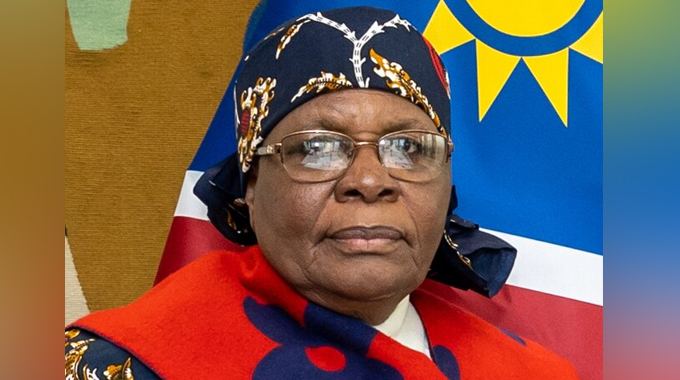
Ranga Mataire, Zimpapers Politics Hub
NAMIBIANS are voting today for a new President and parliamentary representatives following the death of President Hage Geingob on February 4, 2024. President Geingob was replaced on an interim basis by his deputy, Mr Nangolo Mbumba.
The Electoral System
The Namibian constitution stipulates that a President is directly chosen by voters and he or she has to garner more than 50 percent of the votes to be declared the winner.
The President is elected using the two-round system with a run-off being held if no candidate managed to get more than 50 percent of the votes. Since its independence in 1990, Namibia has never gone to a second round.
The National Assembly of Namibia consists of 104 members with 96 elected members and eight (non-voting) members appointed by the President. The 96 elected members are elected by closed list proportional representation from 14 multi-member constituencies based on the regions. Seats are allocated using the largest remainder method.
Main Political Parties and Candidates
Political parties in Namibia are all required to be registered with the Namibian Electoral Commission, which according to Section 135 (2) (a) of the Electoral Act 5 of 2014, are required to meet certain criteria with the principal object to participate in and promote elections as stipulated under the Act.
Swapo — Netumbo Nandi-Ndaitwah
She is the current Vice-President of Namibia and also the vice-president of her party. She is a veteran of the country’s liberation struggle after becoming a member of Swapo in the 1960s. She once served as Swapo’s representative in central and eastern Africa. She studied international relations in England and at independence she returned to Namibia where she held various portfolios in government including serving as Minister of International Relations, Women Affairs and Child Care.
She is most favoured to win as she is viewed by most voters as having political integrity. She has never been linked to any misdemeanours since her joining the public service.
IPC — Panduleni Itula

He is a former member of Swapo who in 2019 ran as an independent candidate and secured 29 percent of the presidential vote — the best challenge against Swapo. He is participating in the election under the Independent Patriots for Change (IPC), a new political party that he founded and claims to champion grassroots participatory democracy.
A former party youth leader of Swapo during the fight for independence, Mr Itula, is a dentist by profession after attaining the qualification in England where he practiced for over three decades before returning to Namibia in 2013.
PDM — Mchenry Venaani

He is currently the leader of the country’s largest opposition party in parliament, the Popular Democratic Movement (PDM), which holds 16 out of 96 elected seats.
He studied law and became the country’s youngest member of parliament in 2003. Pundits however predict a slump in votes for the PDM and is likely to be replaced by the IPC as the official opposition in the National Assembly. Despite a strong showing in the 2019 National Assembly elections, Mr Venaani came a distant third in the presidential race with only five percent of votes. The party has an infamous history of being a protégé of the apartheid regime. Set up as the Democratic
Turnhalle Alliance (DTA) in 1977 during the Turnhalle Constitutional Conference aimed at granting self-governance under South African rule, the DTA received financial support from the apartheid government to oppose Swapo. Its dalliance with the apartheid regime cast a dark legacy and had to rebrand to PDM in 2017 with Mr Venaani as its leader.
LPM — Bernadus Swartbooi

He is the leader of the Landless People’s Movement (LPM), a political entity that campaigns for land redistribution and what he calls restorative justice. Mr Swartbooi founded LPM in 2017 after losing his job as deputy minister of Land Reform. He left Swapo to form his own political party and managed to garner four seats in parliament in the last elections and won a mere three percent in the presidential contest.
AR — Job Amupanda
He is former Swapo youth leader who fell out with the ruling party and founded his own political movement called the Affirmative Repositioning in 2014. Like the LPM, the party advocates for an equitable land reform and redistribution of land currently owned by foreign nationals. Mr Amupanda once served as mayor of
Windhoek, the capital city in 2021. He is also an associate professor of political science at the University of Namibia.
Extraordinary Professor at the University of Pretoria and the University of the Free State in Bloemfontein, Henry Melber, who is also a German-Namibian political scientist, yesterday told Zimpapers Politics Hub that the governing Swapo party was likely to retain its absolute majority.
“Swapo has declared as a goal, to regain the two-thirds majority. This is overly ambitious and unlikely with the more intense competition unfolding. But it is rather probable that it will retain an absolute majority and does not decline as much as the ANC. In the absence of any reliable polls and surveys, it is, however, difficult to make any secure guess. If the majority is maintained, it has to be considered as dinosaurs’ success,” said Prof Melber.
On the Swapo’s Nandi-Ndaitwah chances of winning the presidency, Prof Melber said the veteran politician faces stiff competition from Mr Itula of IPC who in the last elections snatched 29 percent of the votes from the re-elected President Geingobe.
“It remains to be seen if with his new party IPC (Independent Patriots for Change) has consolidated voter support. It also remains to be seen if Nandi-Ndaitwah- as a woman is accepted by all Swapo supporters. For the first time, there is the albeit unlikely possibility that no candidate reaches the 50 per cent plus one vote required in the first round. This would then need a second round, which then would be Nandi-Ndaitwah versus Itula. If all other candidates and parties would rally behind
Itula, the question would be if he could have a chance to be elected. Very speculative and unlikely but possible.”
Prof Melber said Swapo performs comparatively better among most former liberation movements which are presently some kind of outlier since election campaigns are peaceful and no politically motivated violence has been reported.
“All this counts in favour of Swapo and governance since independence,” Prof Melber added.
It remains to be seen how Swapo under a first female presidential candidate will fair in this election, which she is pitted against her former party colleagues who left to form their own parties.


 Online Reporter