admin
admin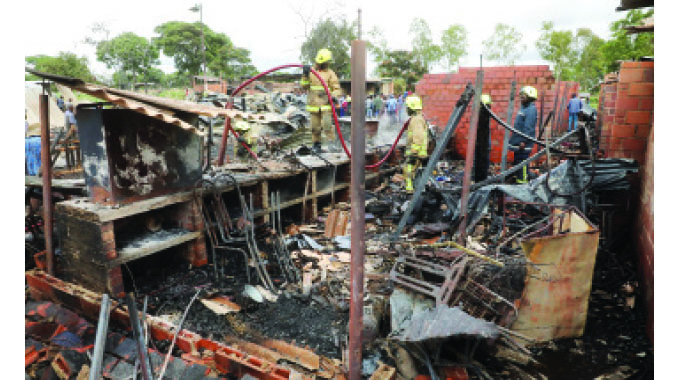
Prosper Ndlovu
EARLY Wednesday morning on January 18, 2023, what was once a thriving co-operative furniture enterprise run by the Mpopoma Outspan Association in Bulawayo was gutted by fire, reducing the entire business to rubble — leaving nearly 400 entrepreneurs and their dependants stranded.
Faced with the devastating loss of goods and equipment worth millions of dollars, sudden cut in income, destroyed work space and without working capital, it quickly dawned that this massive business had no form of insurance cover.
The association’s leaders could only desperately appeal for rescue interventions from the Government and potential funders to be able to stand on their feet again.
Factory chairperson, Mr Khozanayi Mlambo, made a frank admission on the piercing reality of not having insurance cover when the calamity struck. In what showcases the market perception challenge regarding insurance, he remarked: “Insurance is important but for us as SMEs, it’s something that has not been at the top of our priority list.”
Following the incident, Government, and business leaders have been calling upon all micro-small to medium enterprises (MSMEs) in the country to embrace insurance to cushion themselves from potential hazards while safeguarding future business sustainability.
Like the rest of Sub-Saharan Africa, the widening level of informality in the country’s economy, coupled with adverse localised macro-economic constraints and global headwinds, continue to pose serious threats to the viability of formal contributory models of social protection schemes, which tend to exclude informal workers.
With a majority of the population residing in rural areas where they derive livelihoods from informal means like farming and artisanal mining while those based in urban centres are mainly employed in the informal sector, research studies have shown that expanding pension and insurance cover to these groups is a big challenge for most service providers.
And yet without basic social protection, this clearly means a majority of the population is seriously exposed to various risks and would easily succumb or be harshly crippled in the event of unforeseen misfortunes such as accidents, illness, weather or pandemic-related losses, as well as death or fire.
According to the National Financial Inclusion Strategy (NFIS:II) document launched by the Government late last year, only four percent of MSMEs who are the dominant economic force, had business insurance cover, while less than 30 percent of the adult population in Zimbabwe has insurance cover.
“About 72 percent of the population does not have any form of insurance. Uptake of formal insurance by MSMEs (which is largely personal insurance), remained low at 24 percent, up from five percent in 2012. Formal insurance was largely driven by funeral cover (76 percent), and medical cover (36 percent),” reads part of the report.
Zimbabwe’s insurance penetration rate remains among the lowest in the region at 1,9 percent, according to the Insurance and Pension Commission (Ipec), and this is a serious cause for concern as it has adverse implications on the sector and the economy at large, says Mr Robson Mutangadura, Ipec’s director on actuarial services.
“The 1,9 percent insurance penetration is quite low and what it means is that there are relatively few people in Zimbabwe who are covered from an insurance point of view, which has a significant implication both to the sector and the country’s development,” he told journalists during a recent virtual mentorship programme.
“As you are aware, insurance involves a transfer of risk. This low insurance penetration risk shows that very few people are transferring risk to the risk carriers and what this means is that the general population is exposed to a significant amount of risk.
“Should your car be involved in an accident today without insurance cover, it means tomorrow you will be someone without a car. Should your house catch fire today, it means you will be homeless. So, it’s actually a challenge on its own.”
From a national development perspective, Mr Mutangadura said insurance is a critical conduit for mobilising resources for driving economic development while securing personal future benefits.
“So, in between the time you pay your premium and the time you get your benefit, the resources or investment from that premium can then be used to develop the economy,” he said.
However, for Mrs Priscilla Moyo* (56), who works for a local private company, the appetite for insurance savings has been dampened by historic currency instability and policy changes in the past years.
“I am close to retirement now and all the savings I made in the past were eroded by inflation in 2008. I now only subscribe for funeral cover and can only hope that my children will look after me when I stop working,” she said.
While acknowledging the adverse impact of legacy losses due to historic hyperinflation forces and subsequent monetary policy changes in 2009 and 2019, Ipec Commissioner, Dr Grace Muradzikwa, has said the need for embracing and scaling up insurance and pension cover is indispensable.
She went on to explain the policy measures being taken by the Government and the Commission to address legacy issues through a compensation model for the losses suffered in the past so as to restore market confidence.
Following the Justice Smith Commission findings and recommendations, Zimbabwe has kick-started a process to compensate losses for the 2009 pensions and insurance savings value conversion while modalities for compensating 2019 losses are also in progress.
MSMEs operators on one hand blame the conservative contributory structure of insurance and pension packages, stringent requirements and limited knowledge for limiting uptake of social protection schemes. The tendency to favour established businesses that are formalised and compliant with a number of formal provisions is in itself a barrier to financial inclusion, including insurance, Bulawayo Vendors and Traders Association executive director, Mr Michael Ndiweni, has said.
“Some SMEs may not be fully compliant and that has a bearing on the structure of financial inclusion. There is limited knowledge on insurance packages and those that are tailor-made for SMEs, some of them have prohibitive premiums and requirements such as collateral,” he noted.
The prevailing structural economic changes have not only strained the insurance sector but also trimmed down the number of active pension schemes in Zimbabwe to 504 from 981 as of December 2022, according to Ipec.
Director of pensions at the Commission, Mr Cuthbert Munjoma, has attributed the trend to changes in the labour market over the years, which has seen some major companies closing shop, as well as migration of several workers to other countries, which has paralysed some schemes.
With about 90 percent of the private sector in Africa made up of the informal sector, the International Finance Corporation (IFC), a division of the World Bank Group, has called for swift extension of pension coverage to all workers as a top priority if there is to be more comprehensive social protection and participation across the labour force.
To remain relevant, players in the sector have been urged to review their product offering and strive to meet changing customer needs. A collective stakeholder approach, as well as embracing innovation will be critical in trying to expand insurance provision to other untapped markets.
“Considering how our economy has informalised, I think it’s high time we devise ways to provide insurance to those markets,” said Mr Mutangadura.
The need to improve social protection has been further buttressed by a study on “Pension Funds in Sub-Saharan Africa” published in August 2022 by the United Nations University, which states that Africa’s quest for sustainable and equitable development would not be complete without adequate social protection of the masses through enhanced basic insurance cover and pension.
Lamenting the low pension coverage and participation rates in the continent where fewer than 10 percent have contributory pension, it notes that guaranteeing a basic income to the elderly will always remain a challenge. This scenario amplifies societal exposure to shocks, both local and global, the effects of which are greater for the older population.
For instance, the UN states that older informal workers without any social protection were affected more during the Covid-19 pandemic while the few who were covered received low levels of pension benefit when compared to prevailing cost structures.
Because of these dynamics, experts say existing social protection schemes do not fully promote risk-sharing and redistribution, which increases calls for comprehensively reforming the insurance and pensions sector to ensure universal coverage, which will promote attainment of the United Nations 2030 Agenda for Sustainable Development Goals (SDGs).
“There is a need for stakeholders in Zimbabwe to seriously come up with policy interventions, including massive awareness campaigns towards resetting the pensions and insurance sector as the engine for harnessing funding for sustainable economic development,” said analyst, Miss Nothando Ncube.
From a regional development perspective, she said a sound pensions and insurance sector is also critical in the context of widening domestic resource mobilisation, especially for Africa, which has largely depended on donor financing that often comes with strings attached and adverse long-term impacts.
As Zimbabwe pursues its National Development Strategy (NDS1), the desire to foster inclusive participation by citizens in mainstream economic activities is imperative in building momentum towards attainment of an upper middle-income economy vision by 2030 of which revitalising the pensions and insurance sector must be part of.
The broader framework of this ambitious vision is closely tied to the regional and global ideals of transforming Africa’s development, as enunciated in the Africa Agenda 2063 and the United Nations SDGs, which are anchored on uplifting the masses out of poverty through improved economic development and enhanced access to key services.



 Online Reporter