Online Reporter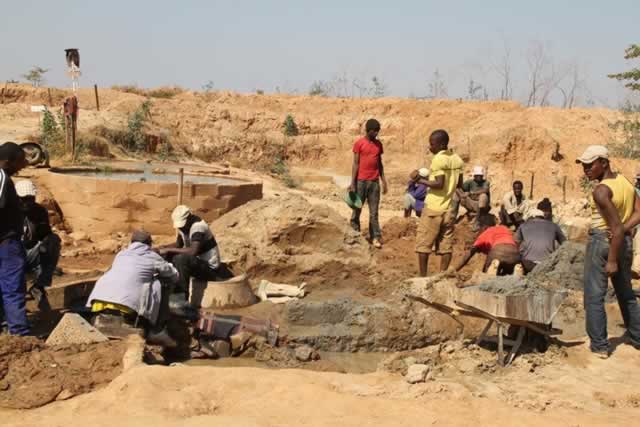
Patrick Chitumba, [email protected]
Mining-induced displacements (MIDs) have emerged as a significant challenge in Zimbabwe, particularly within resource-rich regions such as the Midlands Province.
The expansion of mining operations — open cast or underground, often results in the relocation of communities, triggering complex socio-economic, environmental and governance concerns.
Notable cases of successful displacements across Zimbabwe as a result of mining activities include the displacement of 4 221 families in Marange (2009), the relocation of 926 people by Murowa Diamonds (2004), and ongoing challenges in Mutoko involving Zimu Mining.
Last year, Eureka Gold Mine relocated 15 families affected by its operations from Mazhambe Village to Bome Farm in Guruve, Mashonaland Central Province.
The resettlement of the families was necessitated by the mine’s ongoing expansion programme.
Concerns have been raised about potential future displacements in Hwange (due to coal mining) and Murewa and Uzumba (due to greenfield mining projects).
These examples highlight the pressing need for transparent processes, fair compensation, and sustained community engagement.
It has to be emphasised that while mining contributes to national economic recovery, it should not undermine the rights of communities that have historically occupied mineral-rich land.
A “win-win” approach has often been proposed — where both mining companies and communities can benefit equitably.
When mines set up operations, the placement of infrastructure —particularly roads and water storage facilities — can expand the radius of impact far beyond the immediate mine site.
For instance, road access to mines can cut through rural settlements, leading to social fragmentation, while water reservoirs used for mining operations may necessitate the displacement of entire communities due to flooding risk or environmental regulations.
Therefore, the geographical footprint of mining is often wider than assumed.
Another important contribution is the call for harmonisation between mining laws and land governance legislation.
Of late, it has been noted that misalignment between the Mines and Minerals Act and land-use policies often leads to legal and practical challenges during mining expansion.
Without coherent legislation, both communities and investors are left vulnerable to conflicts, delays and resource misuse.
MIDs must be recognised in its full spectrum — not only as a physical issue but also as a socio-cultural and psychological phenomenon.
Assessment frameworks and planning tools must be broadened accordingly to address the hidden costs of mental and cultural disruption.
Recently, a local non-governmental organisation, Centre for Conflict Management and Transformation (CCMT) held a workshop in Gweru to discuss MIDs with mining companies, local authorities and Zimbabwe Mining Federation officials.
The workshop was a process to further draw on the existing Guidelines and Recommendations on the Compensation of Communities Displaced by Growth Point Expansion developed and adopted in the Midlands Province previously produced by CCMT.
They are being widely used by local authorities and have facilitated the constructive resolution of eight cases of displacements since 2019.
These documents will serve as baseline reference materials to ensure consistency, continuity and alignment with ongoing national efforts.
Once a draft of the consolidated Best Practice Handbook on MIDs has been produced, the guidelines will be shared with all key stakeholders — including mining companies, relevant Government ministries and departments, traditional leadership, and civil society organisations (CSOs).
The outcome of this process will be a final version of the MID Best Practice Handbook that is widely endorsed and ready for use in policy, planning, and implementation.
CCMT has, since 2013, worked to address Development Induced Displacements (DIDs) through conflict-sensitive and collaborative approaches involving local authorities, private sector actors, and affected communities.
Ms Rejoice Dzingai, from the Midlands Province Ministry of Mines and Mining Development noted that Zimbabwe has exceeded its US$12 billion mining economy target, with figures reaching US$20 billion as of 2024.
However, this economic growth has raised critical questions about the social costs associated with mining expansion, particularly in relation to the rights and well-being of displaced communities.
“The workshop was timely and vital in helping the country strike a balance between mining-led development and safeguarding human dignity and livelihoods,” she said.
Director of Provincial Co-ordination in the Midlands Province Mr Kudakwashe Machako, said the discovery of mineral resources across the country has contributed significantly to the achievement of national priorities through job creation, economic growth and poverty alleviation.
“These positive outcomes are undoubtedly attributable to the policies the Government has put in place, particularly through the National Development Strategy 1, underpinned by the goals of Vision 2030, which have been crafted to help the nation attain an upper-middle-income economy by 2030 under the leadership of President Mnangagwa,” he said.
Mr Machako explained that mining activities within communities often expand, resulting in conflict related to displacements. If not handled procedurally and properly, these conflicts can disrupt the lives of local communities.
“While mining developments undoubtedly offer clear opportunities, they also bring with them a range of social, economic and environmental consequences that can impact local communities for generations,” he said.
Mr Machako noted that devolution provides opportunities for localised planning but requires stronger mechanisms to mitigate the unintended impacts of mining projects, such as the loss of livelihoods, environmental degradation and social fragmentation.
According to the director of Green Shango Environmental Trust Mr Daniel Sithole, mining has been positioned as a critical driver of national development, contributing significantly to export revenue and job creation.
However, he said it has to be agreed that these benefits must be weighed against the disruption caused to communities.
Importantly, Chief Bunina Chisadza from Lower Gweru said the concept of displacement goes beyond the traditional physical understanding.
He said displacement can also manifest as air and noise pollution, dust emissions, vibration caused by blasting, and contamination of downstream river systems.
“These indirect impacts can severely affect people’s well-being, their livestock, and their access to clean water, even when they are not moved physically from their homes. Cultural disturbance and mental trauma resulting from these disruptions were highlighted as equally important but often overlooked aspects of mining-induced displacement,” he said.
Chief Chisadza noted that for example, grave exhumations — often an emotionally sensitive aspect of displacement — should be handled with cultural sensitivity.
Environmental Management Agency Provincial manager Mr Benson Bhasera, offered a grassroots and often-overlooked perspective on displacement linked to artisanal and small-scale mining (ASM) operations.
Unlike large-scale mining entities that operate under formal frameworks, small-scale miners frequently operate in legal grey areas or with limited regulatory oversight — yet their impact on communities, the environment and land use is equally significant.
“Indigenous miners or artisanal miners operating on a small scale, too can be responsible for displacements — both direct and indirect. These displacements often go unnoticed in policy discussions because they do not follow formal Environmental and Social Impact Assessment (Esia) procedures and frequently occur without consent or compensation,” he said.
Mr Bhasera said most conflicts arise from a lack of clear land-use planning, where artisanal miners end up pegging claims in areas already occupied by communal farmers or close to homesteads and cultural sites.
Shurugwi District Development Co-ordinator Mr Romeo Shangwa, said because many small-scale mining operations lack formalised engagement mechanisms, communities often face disruption with no legal or institutional redress.
These, he said, include loss of grazing land, destruction of fields, noise pollution, and water contamination—all of which lead to forms of displacement without physical relocation.
CCMT’s executive director Mr Xavier Mudangwe explained that this dialogue marked the first of four thematic engagements focused on different types of development-induced displacements—mining, urbanisation, agriculture, and infrastructure development.
The intention, he said, is to start with mining because of the sector’s scale, long-term impacts, and complexity.
“Displacements are not only physical but also include economic, social, cultural, and environmental displacements. CCMT’s approach, based on sustained dialogue and conflict-sensitive engagement, has yielded results in areas like Mberengwa, where the organisation facilitated successful resolution between communities and mining companies,” he said.
Mr Mudangwe said the upcoming Best Practice Handbook will be a tool to guide mining companies, government ministries, and affected communities on how to manage displacement in a way that promotes inclusivity, sustainability, and shared benefit.
“The success of the handbook would depend on how well it reflects the realities on the ground and how committed stakeholders are to its implementation. The handbook is envisioned not as a prescriptive document, but as a guiding framework to promote responsible, transparent, and community-sensitive mining practices,” he said.