Chronicle Editor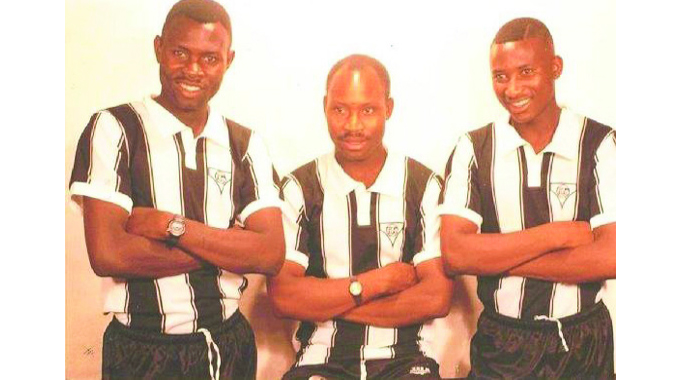
Chronicle Sport, in association with Zimpapers Knowledge Centre
A NUMBER of talented siblings have graced Zimbabwean football over the years, but none can claim a place in the upper echelons of the local game like the Ndlovu brothers — Madinda, Peter and the late Adam.
The oldest Madinda was born on May 2, 1965, in Binga, while Adam was born on June 26, 1970, in Bulawayo and Peter was born on February 25, 1973, in Bulawayo.
The three were blessed with incredible ability and complemented each other beautifully each time they ran onto the pitch of any stadia around the country donning the black and white-striped jerseys of their beloved Highlanders football club.
The trio entertained football fans countrywide with their fancy footwork combined with speed and amazing goal-scoring abilities, which established their legacy in the local game.
Their collective game was never anything other than absolutely sensational and defenders quaked in their boots when playing against Highlanders, because they didn’t know how to deal with the Ndlovu brothers.
However, Highlanders never got to field all three brothers at the same time because by the time the youngest Peter broke into the Bosso first team towards the end of the 1988 season, the oldest Madinda was making forays into the then West Germany league.
So, only Adam got to play with both his brothers at club level at different times, while Peter only got to combine with Adam for Bosso up to 1991 when he then moved to England.
Only at the senior national team level was the three Ndlovu brothers’ firepower unleashed at the same time, but Madinda’s colourful career was coming to an end.
What the brothers all have in common is that they managed to break into the senior national team by their 20th birthday.
While Madinda paved way for his younger siblings to make a name for themselves and carve legendary status at Highlanders FC and the senior national team, it is the youngest Peter, who can claim bragging rights over his older brothers in the battle of the Ndlovus.
Their story starts in the dusty streets of Bulawayo’s oldest suburb Makokoba where they grew up playing with homemade plastic balls, with other boys in the neighbourhood.
Talented children back then were easily identified by the city council’s community officers that were in charge of the various youth centres dotted around the city.
The Ndlovu brothers stayed in a flat just a stone’s throw from one such venue, the Thabiso Youth Centre, in Makokoba, which gave children a platform to exploit their talent in sport, drama, music and dance.
The youth centre had teams and coaches for different sports and it was here that teams from around the city scouted for talent for their junior sides.
Interestingly back then junior leagues were probably much more competitive than the Super League. There were teams that only had junior teams that competed in the various age-group leagues from Under-14s to the Under-18s, so competition was stiff.
Although they were all first spotted in the streets of Makokoba and then absorbed into the youth centre teams before being snapped up by the Highlanders juniors’ academy, Peter emerged as the most famous of the Ndlovu brothers.
Peter went on to have the most successful football career, of which 14 years were spent in England. Peter went to Lotshe Primary School in Makokoba before enrolling at Mzilikazi High, schools that both had a strong football culture, and quickly established himself in their first teams.
Peter tormented defenders with his dribbling skills and rare flash of speed that left opponents stunned, as he banged in goals using both feet with ease. However, very few people know that he tormented defenders running on nine toes after the little toe on his left foot was amputated, according to his older brother Madinda.
“His little toe was amputated when he was a young boy. As youngsters, you go through lots of adventures and he was unfortunately cut by a broken bottle and the wound wouldn’t heal so, it was decided that the toe be cut off,” Madinda said.
Like other kids growing up in Bulawayo then, Peter’s dream was to play for Highlanders like his brothers and his dream was watered by celebrated junior development coach Ali Baba Dube, who took him under his wing in the Bosso juniors when he was at Mzilikazi High School.
Dube’s strictness helped mould Peter into the star player that he went on to be. His striking partner at Highlanders, Gift Lunga Snr, said he was honoured to have partnered with a talented guy like Nsukuzonke and described him as an “eighth wonder of the world” during his playing days at Bosso.
“I remember one Chibuku Trophy Under-16 final in Harare, where we played against Redwing from Mutare as curtain raisers to a Dynamos versus Caps United match at the National Sports Stadium. “At half-time, we were down 0-1 and Dube was boiling in the dressing room.
In the second-half, Peter scored six goals and we eventually won the final 10-1, and that’s the day I realised that Peter was in a world of his own,” said Lunga.
Lunga was also part of the Bosso Under-19 squad that toured Aberdeen, Scotland, and Wales in 1987 for tournaments that featured teams from 14 countries.
Highlanders won those tournaments and Peter was voted Player of the Tournament in both events. Peter and Makheyi Nyathi were initially set to remain in the United Kingdom and join the Manchester United Academy after their impressive performance at the tournaments, but things somehow changed and they flew back home with the rest of the team.
Peter later returned to England for trials with Coventry City together with his brother Adam, whom Dube rates as the most talented of the three Ndlovu brothers.
“Coventry wanted one player and ended up settling for Peter because of his age. He was two years younger than Adam and I think they felt they could get more value in a younger player, but I am still convinced that Adam was the best among those boys. Yes, all were talented, but Adam was ahead,” said Dube.
Before leaving for Coventry, Peter had become a star player in the Highlanders line-up, after graduating into the first team at the recommendation of Dube.
“The late Barry Daka was initially hesitant to take him, saying supporters will attack them if they fielded him because of his small body frame, but I assured him that the boy wouldn’t disappoint.
His debut in 1988 must have been against Black Aces in Harare and he came in as a substitute and scored, and the rest is history,” Dube said.
Peter was still a learner at Mzilikazi High when he made his debut for Bosso in 1988 and helped his school scoop the inaugural Copa-CocaCola Schools Football competition the following year.
The fearsome Mzilikazi High team featured, among others, Peter’s best friend Benjamin Nkonjera and Makheyi Nyathi, who all went on to make a mark at Highlanders and in the national team.
Peter made many man-of-the-match performances for Highlanders during the few seasons that he was with them, before being snapped up by English League side Coventry City in June 1991.
He made history by becoming the first African player to play in the new English Premier League (EPL) on August 19, 1992 when he made his debut for Coventry City in their win over Tottenham Hotspurs at White Hart Lane, after coming on as a substitute for John Williams in the 70th minute.
Since his pioneering role as the first African to debut in the EPL, 29 years ago, more talented African players have gone on to illuminate the EPL, among them are five-time African player of the year Samuel Eto’o, former World Player of the Year and now Liberian President George Weah, Didier Drogba, Anthony Yeboah, Jay Jay Okocha, Michael Essien, Yaya Toure, Celestine Babayaro and Emmanuel Adebayor.
Peter was signed for Coventry by Terry Butcher in June 1991 and his first season for the Sky Blues in English football happened to be the last for the old English league system.
He scored 17 goals in his first EPL season for Coventry and 11 goals in the following season.
His hat-trick against Liverpool in the 1994/95 season stands out as one of his most outstanding performances in a Coventry shirt, as he became the first visiting player to score a hattrick against the Reds at Anfield in 30 years. Peter played 154 games for Coventry and scored 34 goals between 1992 and 1997 before moving to Birmingham City in July 1997.
He was loaned to Huddersfield Town in 2000 and then released to join Sheffield United in February 2001.
He left English football in 2004 and was signed by South African side Mamelodi Sundowns, who were still in the process of rebuilding after being bought by current CAF president Patrice Motsepe.
After five years with the “Brazilians”, Peter joined Thanda Royal Zulu, but was released after they were relegated from the South African Premier Soccer League and retired from playing.
He was taken out of retirement by Northern Region Division One side Highfield United in Harare and then loaned to police side Black Mambas in 2011.
He became assistant coach of the Zimbabwe senior national team after finally hanging up his boots. Tragedy struck Peter when he was involved in a car crash near the Victoria Falls Airport on December 16, 2012, which left his brother Adam dead after the BMW X5 Peter was driving burst a tyre, careened off the road and crashed into a tree.
Peter suffered internal injuries, head injuries, broken ribs and a broken leg, while a female friend in the same car was also killed. Peter faced trial for culpable homicide in March 2013 and was acquitted the following month, with the court citing lack of evidence.
After he recovered from his injuries, Peter briefly stayed as the Zimbabwe Under-23 coach and Warriors assistant coach before Motsepe invited him to take up the role of Mamelodi Sundowns manager in July 2013, a job which he still holds.
Peter was the cornerstone of the Warriors from the Dream Team coached by the late Reinhard Fabisch in the early 1990s right up to the time of his retirement.
He always put his country first and hardly missed any call-up. To demonstrate his commitment and patriotism to the Warriors’ cause, Peter paid for his own travels to play for the Warriors and assisted his teammates.
He made about 100 Warriors caps, and sealed Warriors legendary status when he captained them to their first Africa Cup of Nations appearance in Tunisia in 2004. Peter arguably stands as Zimbabwe’s greatest player of all time.
Although he could be the GOAT of Zimbabwean football, Madinda was idolised by many generations.
He was a special talent and already had 17 Warriors caps and 12 junior national team caps at the age of 20.
He was gifted with speed and started playing for Highlanders at the age of 12 after being spotted by another club legend Lawrence Phiri.
Madinda graduated into the first team in 1980 when he replaced Doubt Sithole, who had moved to the United States of America to further his studies. He immediately endeared himself to the Highlanders’ fans at the Barbourfields Stadium with his speed, down the right-wing and goal-scoring prowess. Because of his speed, which gave defenders nightmares, the Bosso faithful gave him the nickname Khathazile, meaning the troublesome one, and he lived up to that name during his entire stay at the club.
In August 1985, Madinda was invited for trials at English First Division side Queens Park Rangers and Oxford United, but nothing materialised. He came close to signing for Sheffield Wednesday in 1986, but he was left shattered when the English club chose an Italian player over him.
However, in April 1989, Madinda, the late Willard Khumalo and Tito Paketh made the grade at West German First Division side Emsdetien 05 on a one-year deal.
Their move came after Rahman Gumbo and Mercedes Sibanda had been signed by Danish First Division side Rainders.
The move to West Germany cost Madinda his senior merchandising job at Zimbabwe Sugar Refineries, as he was fired for extending his stay overseas.
He had been given 30 days leave by his employers when he left for West Germany and in October 1989, his employers got approval from the Ministry of Labour, Manpower, Planning and Social Welfare to dismiss the Zimbabwe international.
The three returned home from West Germany in May 1990, but Madinda and Khumalo went back for another stint until August 1991.
Madinda returned to Highlanders, but notified the club of his intention to retire in December 1991, citing a nagging ankle injury and pressing work commitments.
He, however, returned to the playing field and helped Bosso to the league title in 1993. Away from football Madinda served as public relations manager for the Matabeleland Chapter of the Affirmative Action Group (AAG) at the turn of the millennium and played a key role in calling for AAG to dump its “militant tactics” and pursue dialogue as the best way forward in its indigenous drive.
In one of the AAG’s drives, Madinda and his administration blocked the auctioning of 23 houses belonging to their members due to unserviced debts.
Madinda had assumed an active role in the AAG by virtue of managing his business affairs as well as that of the MAP Ndlovu Brothers, which he jointly owned with his two brothers.
Phiri, who managed him at Highlanders, said he played a key role in getting Madinda into the Bosso juniors, coached by Ali Baba Dube.
Phiri said: “I used to be a youth club leader at Bulawayo City Council in charge of Thabiso Youth Centre in Makokoba while still playing alongside the late Barry Daka. There was this crop of very good young players, who included Madinda and Netsai Moyo, that I directed to Ali Baba Dube and join Highlanders. “They used to be in my Thabiso Youth Centre team. At the same time, Alexander Maseko’s brother was in Mzilikazi and he brought in the likes of Mercedes Sibanda and Willard Khumalo. That’s how they grew up to make that formidable juniors’ group popularly known as Liverpool.
“They were trailblazing and my influence on him was in the junior stage. The ‘Liverpool’ group was made up of Under-16s and Under18s, and we could only watch the boys at training and sometimes when they curtain-raised some of our matches because of the pressure we were under at Highlanders then.”
Phiri said fear of losing the talented “Liverpool” set-up, forced them to promote the players early and Madinda was loaned to Merlin to get some game time, but he returned after a season to fill the void left by Sithole, who had moved to the US.
Madinda was promoted into the reserve side alongside Sibanda, Khumalo and goalkeeper Peter Nkomo. Phiri described Madinda as “an excellent footballer and a very strong-willed person”.
“His character was very strong, and (he) always gave everything he had. His hard stance attitude did very well for him as he didn’t fear anyone even from his team. He exerted his authority and called a spade a spade without sugar coating.
“Character-wise, Madinda didn’t have that boyhood naughtiness most footballers had. He was firm in what he did and didn’t fall for peer pressure like Willard and Mercedes.
But these guys made up for their naughtiness with good performances on the field. They were hard to manage off the field, but were good performers and a wonderful lot,” said Phiri.
He said Madinda attracted attention all the time, hence the strong interest from overseas clubs and breaking into the national team at a young age.
“When he left for West Germany with Willard, they were our best players and we told them to go capacitate themselves with coaching courses.
Now he’s a successful coach because of the investment he made when he was in Germany.” Former national team coach Gibson Homela said the former Highlanders speedy winger was a member of his senior national squad between 1982 and 1986.
“Madinda was one of my national team strikers, but I can’t remember the exact years. I was with the national team from 1982 to 1986. I know that he shared the dressing room with Joseph Machingura, Stanley Ndunduma, Joel Shambo and Stix Mutizwa, among others. Then it was a star-studded team, but Madinda stood out. What I realised was that he was a good and disciplined player,” Homela said. Madinda ventured into coaching after hanging up his boots and has had several stints with Highlanders where he is credited for promoting juniors into the senior team, as he believes a lot in youngsters.
He is highly regarded in Botswana where he won three league titles. He has never been shy to quit when things are not going his way.
Unfortunately, Madinda suffered a stroke while conducting a morning training session for his club Gaborone United in September 2019, forcing him to relinquish the post and return home.
The middle bother Adam was the most prolific goal scorer among the Ndlovus and was especially good at shielding the ball in a hold-up play.
He was very good at making intelligent runs that opened up the most compact of defences. In 1991, Adam claimed the top goal scorer with 30 goals; six ahead of his joint runners-up Claudius Zviripayi of Dynamos and Maronga Nyangela of Black Rhinos. He missed signing for Coventry City in 1991 after they indicated that they could not sign both brothers and settled for Peter.
In 1992, Adam was invited for trials by Manchester United and even featured in a couple of Manchester United friendlies alongside the likes of United legends Ryan Giggs and Paul Scholes.
At that time, Manchester United Manager Sir Alex Ferguson was looking for a forward to provide the X-factor for the team and given a choice between the tried and tested Eric Cantona, who had made his name at Leeds, and Ndlovu, the Scotsman settled for Cantona, who went on to become a Manchester United legend.
Adam was eventually signed by SC Kriens of Switzerland in 1994 and stayed with the club for three years before joining SR Delemont in 1997.
He was voted player of the year and also won the golden boot with 15 goals from 14 matches in his first season at SR Delemont.
Adam was snapped up by FC Zurich before returning home to rejoin his boyhood club Bosso for half a season in 2001, forming a deadly combination with Stewart Murisa.
He then moved to South Africa in 2002 and joined Moroka Swallows where he scored seven goals in 23 games. He also played for Dynamos and Free State Stars across the Limpopo.
Adam played in Zimbabwe’s debut appearance at the Africa Cup of Nations and scored one goal against Algeria. In total Adam netted 34 goals for the national team in 79 appearances.
He also had a unique goal celebration depicting a machine gun each time he scored his trademark thunderbolts that always took most goalkeepers by surprise.
He is also best remembered for his starring role for the national Under-23 side in the 1995 All-Africa Games, which they unfortunately lost to Egypt in the finals.
He formed a deadly combination with Vitalis Takawira in the tournament. His coach as a Highlanders junior Ali Baba Dube ranks, him as the best among the Ndlovu brothers in terms of technique.
“I am still convinced that Adam was the best among those boys (Ndlovu brothers). Yes, all were talented, but Adam was ahead,” said Dube.
Adam lived under the shadow of his young brother Peter and although they were both massively talented, they had contrasting styles of play.
While Adam was forceful and lethal, Peter was an upgraded version of their older brother Madinda. Peter was young, fast, slicky and lethal too. Besides being a lethal striker that used his body and height to terrorise defenders, Adam remained humble on and off the field.
He easily interacted with everyone involved in football despite his achievements. He modestly took on a job as assistant coach at Chicken Inn and became head coach 12 months later in December 2011, leading Chicken Inn to a third-place finish behind Dynamos and Bosso in the 2012 season.
Adam died tragically on December 16, 2012, at the age of 42 close to the Victoria Falls Airport on their way to a friendly match pitting Highlanders Legends and the Victoria Falls Social Soccer League Select.
He was buried at Lady Stanley Cemetery in Bulawayo at a highly emotional funeral attended by football greats, civic and political leaders from the region.



 Online Reporter