Online Reporter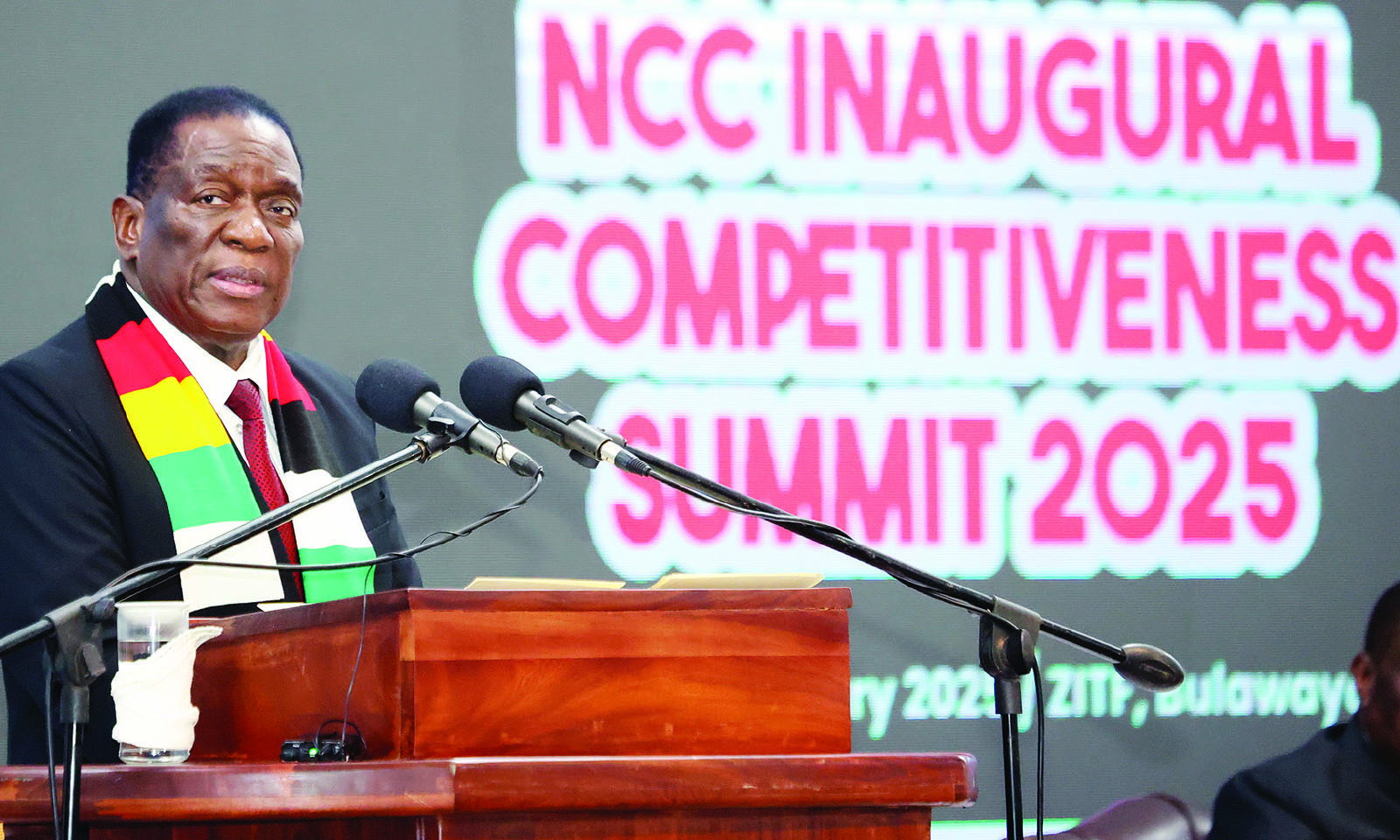
Zvamaida Murwira in BULAWAYO
President Mnangagwa says National Development Strategy 2 (NDS2), the successor to NDS1, will prioritise value addition and industrialisation, particularly in the manufacturing sector, which is poised to rise from the current US$4 billion to over US$10 billion through a strategic focus on value chains in different sectors.
The Head of State and Government said this in Bulawayo yesterday while officially launching the inaugural annual Competitiveness Summit, organised by the National Competitiveness Commission.
Held under the theme, “Building sustainability towards enhanced productivity and competitiveness in Zimbabwe”, the summit seeks to foster dialogue among stakeholders to improve national competitiveness.
“As you are aware, the first edition of the National Development Strategy 1 is coming to an end in 2025,” said the President.
“Efforts are underway to develop the successor programme, the National Development Strategy 2 (NDS2).
“This is set to be anchored on fiscal discipline, macro-economic stability as well as robust trade and investment, as critical drivers for improving productivity and competitiveness.”
President Mnangagwa said NDS2 will prioritise value addition and industrialisation, particularly in the manufacturing sector.
“The aim is to increase the sector’s value from the current US$4 billion to over US$10 billion, through a strategic focus on value chains in the different sectors,” he said.
President Mnangagwa said the Government was aware of challenges affecting businesses and measures would be put in place to address them.
“On its part, the Second Republic is alive to issues affecting businesses and is scaling up measures that create a supportive business operating environment, which encourages innovation and investment.
“My Government’s thrust is premised on the need to promote value addition and beneficiation of raw materials and minerals, that support the creation of vibrant industrial value chains, which are critical in the transformation of our economy,” said President Mnangagwa.
Government, he added, was ready to support the National Competitiveness Commission so that it focuses on competitive strategy, which is key in guiding national policy formulation.
“It is pleasing to note that the Ministry of Industry and Commerce, through the National Competitiveness Commission will focus on developing a National Competitiveness Strategy this year which will be instrumental in guiding national policy formulation.
“My Government stands ready to lend you as much support as possible to successfully acquit yourselves on this very noble endeavour,” said President Mnangagwa.
The inaugural competitive summit, he said, had come at an opportune moment for the Government.
He then took the opportunity to urge the commission to leverage the invaluable networks it has.
President Mnangagwa said the Zimbabwe Industrial Reconstruction and Growth Plan has been developed as the transitional plan to address the challenges bedevilling both the industrial and commercial sectors.
“Specific sectors and value chains such as the soya bean and dairy value chains have been identified as having the national comparative advantage and maximum potential to contribute towards manufacturing value-added growth,” he said.
Value addition and beneficiation are poised to enhance the competitiveness of the country’s manufacturing sector at a time when the African Continental Free Trade Area agreement is now operational, said President Mnangagwa.
“I urge stakeholders to tap into the new market opportunities presented by these emerging conditions of trade. Hence the need to ensure that our country’s goods and services are competitive, cannot be overemphasised. All sectors, therefore, have a duty and responsibility to embrace the competitiveness agenda and take it to another level.
“On its part, my Government remains committed to working with all stakeholders, including the private sector, development partners and academia, in addressing impediments
affecting the country’s global competitiveness,” said President Mnangagwa.
Earlier, Vice President Dr Constantino Chiwenga said the theme of the summit aligned well with President Mnangagwa’s steadfastness to achieve inclusive and equitable economic growth as outlined in the NDS1.
“This trajectory will continue to inform and guide us into NDS2. It is gratifying that President Mnangagwa has consistently championed the improvement of Zimbabwe’s global competitiveness.
“Under his leadership, the country has embarked on a transformative journey focusing on boosting productivity, enhancing the ease of doing business and fostering an ecosystem that attracts both domestic and foreign investment,” said VP Chiwenga.
Industry and Commerce Minister, Mangaliso Ndlovu, said one of the objectives of the summit is to improve the ease of doing business and end bureaucracy.
He added that competitiveness is the cornerstone of any country’s development.
“It is the key driver of the country’s economic growth,” said Minister Ndlovu.
The summit was meant to provide a dialogue platform for all stakeholders to reflect strategies to enhance competitiveness in the country and come up with resolutions for presentation to Government.
It drew participants from Government ministries, agencies, business leaders and academics among others.
Speakers from different countries addressed the summit where they presented on best practices on how to achieve competitiveness.