Online Reporter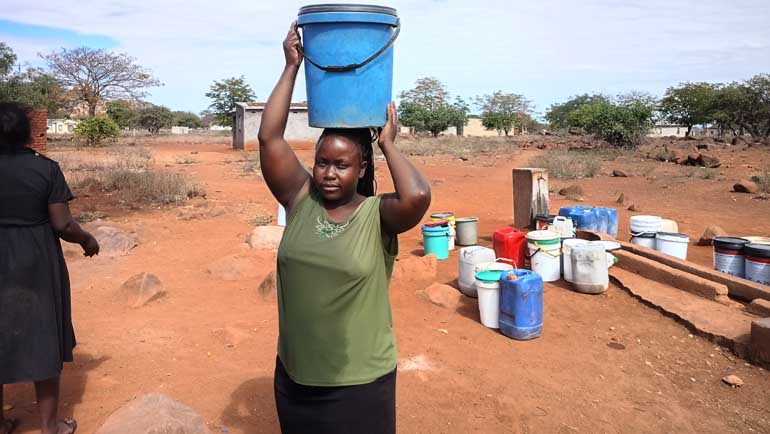
Lovemore Kadzura
Post Reporter
LONG before the first rooster crows over Nenhowe, the village is already awake.
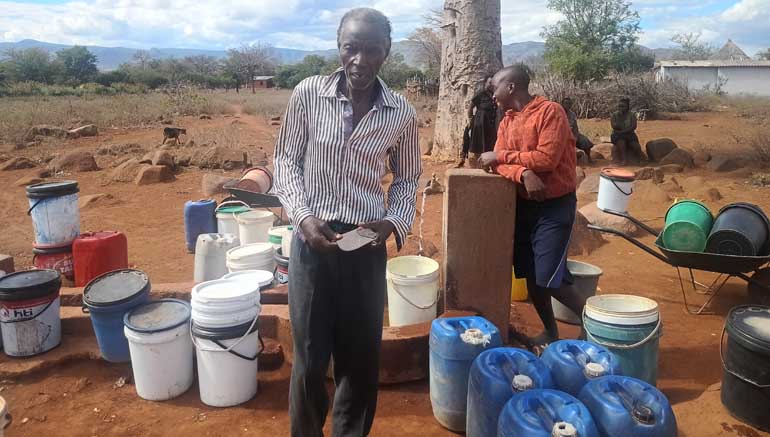
In the blue-black chill of dawn, the clank of buckets and the shuffle of worn plastic sandals mark the start of a daily pilgrimage.
For more than 350 villagers in Ward Five, Chimanimani District, the day does not begin with sunrise. It begins with a queue.
At the heart of Nenhowe stands a single borehole, its rusted handle polished smooth by thousands of desperate hands.
It is the village’s only artery of clean water—and it is failing.
By mid-morning, the borehole coughs, spits, and falls silent, leaving a line of women, men, and children staring into its hollow throat.
What was once a lifeline has become a symbol of scarcity.
Families ration water for cooking, cleaning, and livestock, while children often miss school to wait in line.
The borehole’s decline has turned daily survival into a test of endurance, exposing the fragility of rural infrastructure in the face of growing demand.
Community leaders warn that without urgent intervention, Nenhowe risks deeper hardship.
For villagers, the borehole is more than a machine—it is the pulse of their existence. And each dry morning, that pulse grows weaker.
“If it water does not come back today, we walk to Odzi,” said Mrs Munosiyeni Sithole, balancing a 20-litre container on her head like a crown she never chose.
Odzi River is three kilometres away. Its water is brown, shared with cattle, and laced with the fear of disease. But when the borehole dries, choice dies with it.
The crisis seeps into everything. Girls miss school to fetch water, their textbooks gathering dust while their hands blister. Gardens wither. Maize stalks stand like skeletons in the fields. And at the clinic, nurses brace for the worst. In Nenhowe, water is not a right. It is a rumour.
And every morning, the village lines up, hoping the rumour becomes real before the sun, and the sickness, comes.
For more than 350 villagers, the day begins in a slow-moving line at the community’s only functional borehole. The borehole, installed a few years ago by a development partner, was never meant to carry a whole village.
“We wake up as early as 4am to join the queue. Sometimes you wait for hours only to find that the borehole has stopped functioning. Then we are forced to go to Odzi River,” said Mrs Sithole, shifting a bucket from one hand to the other.
Rainfall in the area is stingy, the water table has dropped, and other community boreholes are now decorative relics. Private homestead deep wells dried up long ago.
“As women we are the most affected. We use water daily for cooking, washing and other household chores. We appeal for urgent intervention before the outbreak of diseases. If this is not addressed urgently, our health will be at risk due to the outbreak of water-borne diseases. Women are the hardest hit. We are the ones expected to provide water for the families,” she said.
Her neighbour, Mrs Jane Madhaure knows the mathematics of misery too well.
“This borehole is very far from where I live. We spend time travelling and queuing. It is midday now, but I came here around 7am. We need more deep boreholes that are reliable in the dry season. This area receives very little rain and the water table is so low,” she said.
Village head, Mr Tobias Nenhowe, said the Maths no longer adds up.
Dry spells have become frequent, the population has grown, and the lone borehole is gasping.
“It was not designed to serve such a large number of people. It was meant to support existing ones which are now dysfunctional,” he explained.
The problems do not end at numbers. The borehole has one storage tank, far too small for the community’s needs. Come winter, when clouds smother the sun, the solar panels will struggle to power the pump. And humans are not the only ones queuing.
“We also share the same water with our livestock — cattle, goats and chickens — and the borehole gets strained. Our gardens are drying up, and this is a threat to food and nutrition security,” said Mr Nenhowe.
Chimanimani Rural District Council Ward Five representative, Councillor Rueben Mujee, acknowledged the pressure.
“The borehole is now overwhelmed because the number of people has increased. I am taking the issue to council so that a solution is provided,” he said, adding that his council works hand-in-hand with the Rural Infrastructure Development Agency (RIDA) to drill boreholes and maintain dysfunctional ones.
There is also talk of a Village Business Unit (VBU) in the area, anchored by a solar-powered borehole to supply villagers. For now, though, promises do not fill buckets.
The community is appealing to Government authorities and development partners to drill additional boreholes and improve access to clean and safe water.
Access to clean water is recognised as a basic human right.
In Nenhowe, it remains a basic daily gamble.
As the dry season approaches, villagers fear the situation will only worsen.
Until a lasting solution is found, hundreds of families will continue to depend on a single borehole — and when it runs dry, on the uncertain, muddy waters of the Odzi River.
For the Nenhowe villagers, the search for water is more than an inconvenience.
It is a struggle for survival, played out every morning at 4am, one bucket at a time.