

 Online Reporter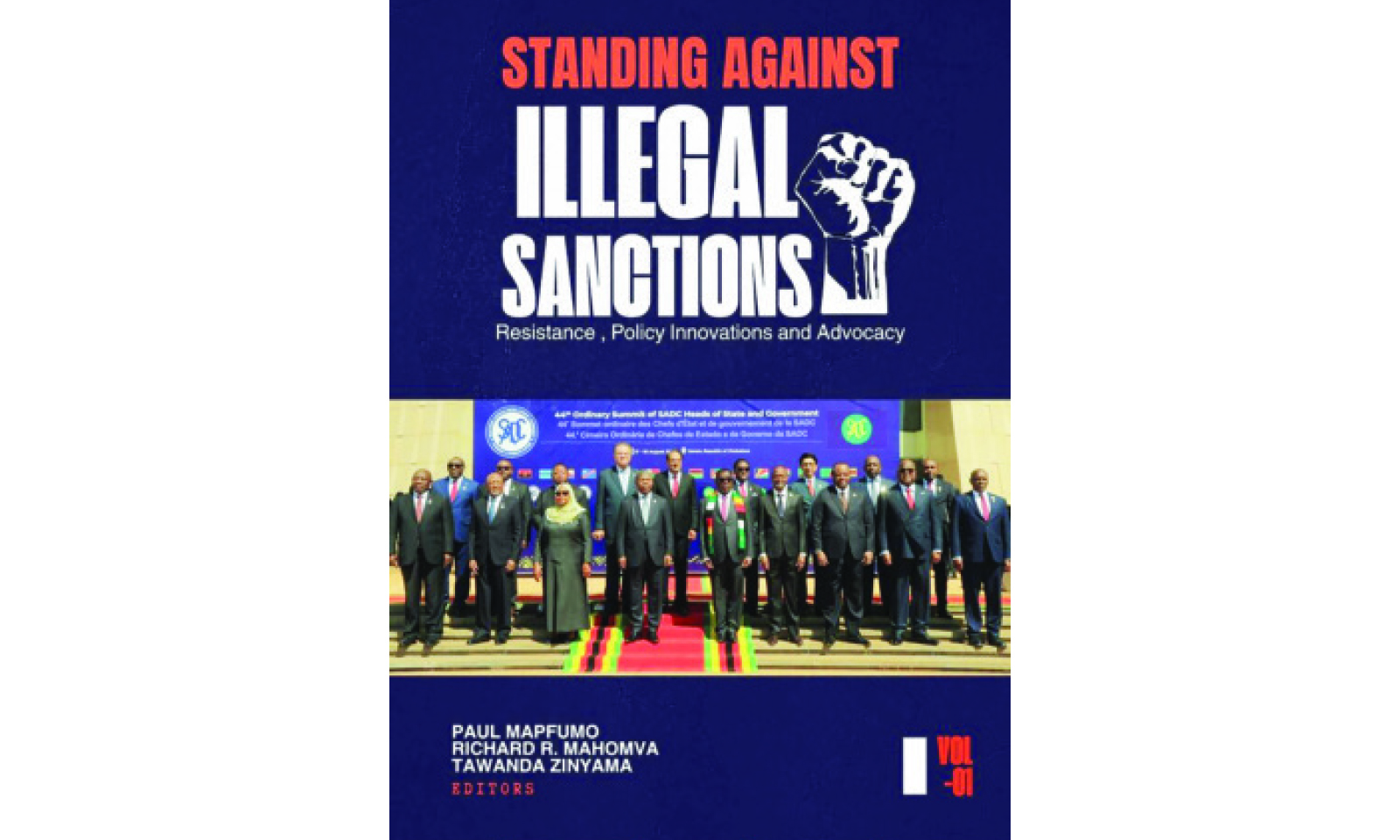
Wallace Ruzvidzo
Book Review
THE book “Standing Against Illegal Sanctions: Resistance, Policy Innovations and Advocacy” (2025), edited by Paul Mapfumo, Richard Mahomva and Tawanda Zinyama, is essential reading for anyone interested in how Government’s policy changes are rallying diverse social advocacy groups to push for the unconditional removal of illegal sanctions imposed on Zimbabwe, along with a historical overview of their evolution since the colonial period.
For over two decades, Zimbabwe has been reeling from the albatross of the United States imposed sanctions.
The embargoes have ensured that Zimbabwe has no access to direct lines of credit, thereby hindering its growth prospects.
The post-2000 Fast Track Land Reform Programme, which sought to address land imbalances, was the basis for their imposition.
The sanctions have changed over time but typically involve financial restrictions, asset freezes, travel bans on certain individuals and entities, and limitations on international financial assistance.
Published by Institute of African Knowledge, the book is an eye-opener and informative read, not only to literary critics and writers, but those keen on knowing Zimbabwe’s past, present and future predicaments.
In the chapter titled, “Engagement and Re-engagement in the Face of Continued Sanctions” Kumbirai Ngwaru notes: “Sanctions are a very common tool in international diplomacy though their effectiveness is highly contested.
“They are used to pressure governments perceived to be violating international normative principles without resorting to outright warfare. They have been criticised for being ineffectual, and more likely to punish the innocent than the intended targets.
“They are also seen as economic warfare by Western governments wishing to assert their control over the domestic affairs and political choices of mostly former colonies and other smaller states.”
Sanctions have affected the ordinary Zimbabwean. Since their imposition, the country has not realised its full potential, yet the US maintains that the coercive measures are targeted.
The US’ position has received amplification from the country’s private media, which has unfortunately short-changed the ordinary Zimbabwean reader.
In the book, Wellington Gadzikwa and Gibson Nyikadzino note: “The private media in Zimbabwe have been at the centre of buttressing the Western perspective on these sanctions, thereby denying citizens the correct record on the causes and real impact of the illegal sanctions on the economy.
“This has denied citizens the opportunity to make informed decisions on the issue of sanctions to Zimbabwe’s political-economic democratisation. Instead, they have embarked on an agenda-setting path by collaborating with the punishing countries.”
Thomas (2003) observes that land conflict is a prominent news topic that the media frequently exaggerates through misrepresentations and omissions.
In their chapter, Gadzikwa and Nyikadzino argue that the misrepresentations around the Fast Track Land Reform Programme paved the way for the imposition of ZIDERA by the US, while the European Union imposed bans on Zimbabwean exports.
Last September, a comprehensive Bill was introduced in the US House of Representatives, which proposes the repeal of the nearly 25-year-old sanctions regime imposed on Zimbabwe, marking a potentially seismic shift in Washington’s policy towards Harare.
The proposed law, called the Department of State Policy Provisions Act, includes a provision to repeal ZIDERA, which has served as the basis for US sanctions against Zimbabwe.
For almost 25 years, ZIDERA has enabled the US to oppose loans, debt relief, or financial assistance to Zimbabwe from institutions such as the International Monetary Fund and the World Bank, effectively locking the country out of the critical global financial system.
While the proposed repeal will dismantle these restrictions, the Bill embraces the agreement already reached between the Government and the former farmers and is tied to the country’s land reform legacy.
It stipulates that Washington will not support any fresh IMF or World Bank funding for Zimbabwe unless the Government commits to fully compensate white former commercial farmers in line with the Global Compensation Deed.
Over US$20 million has already been paid to the farmers, many of whom confirmed so to the delegates at a side event in Abidjan, Côte d’Ivoire, during the African Development Bank annual meetings held towards the end of May this year.
Some of them said they were surprised to see part of the money due to them reflecting in their accounts.
Reads the Bill in part: “In general — The Zimbabwe Democracy and Economic Recovery Act of 2001 (ZIDERA Act), as amended, Public Law 107–99 (115 Statute 962) is hereby repealed.”
“Condition on further funding for Zimbabwe: The United States shall not support any new or expanded funding from the International Monetary Fund or the International Bank for Reconstruction and Development (commonly known as the World Bank) for the Government of Zimbabwe unless the Government of Zimbabwe shall commit, within 12 months of the approval of such new or expanded funding, to remit all outstanding arrears owed under the Global Compensation Deed, inflation adjusted to the date of enactment, and compensation shall not be in the form of Zimbabwe issued securities.
“Failure to comply with this provision shall result in an immediate cessation of all United States support for any further funding from these institutions.”
The Bill, introduced by Mr Brian Mast (Republican), is a wide-ranging authorisation and policy blueprint for the US State Department covering the full range of laws dealing with foreign policy.
There is not much to write home about this because the land reform programme, which was the basis of ZIDERA remains a condition.
This brings Mahomva and Shava’s argument in the book that colonialism remains unfinished business in Zimbabwe and Africa at large, and imperialism is incessantly mutating under the auspices of global political-economy integration, into perspective.
They cite Boron (2005) who amplifies the point: “Today’s imperialism is not the same as the one that existed thirty years ago. It has changed, and in some ways the change has been very important, but it has not changed into its opposite, as neo-liberal mystification suggests, giving rise to a ‘global’ economy in which we are all interdependent’.
“It still exists, and it still oppresses people and nations and creates pain, destruction and death. In spite of the changes, it still keeps its identity and structure, and it still plays the same historical role in the logic of the global accumulation of capital.
“Its mutations, its volatile and dangerous combinations of persistence and innovation, require the construction of a new framework that will allow us to capture its present nature.”
The book also concedes that under President Mnangagwa’s leadership, Zimbabwe has been on a diplomatic offensive under the auspices of the engagement and re-engagement foreign policy.
Since the coming in of the New Dispensation, President Mnangagwa has demonstrated that the country’s foreign policy is far from the previous regime.
In the 12th chapter, Paul Mapfumo and Tawanda Zinyama argue that in President Mnangagwa’s socio-economic-politico calculations, mending fences provides much needed economic aid and offers trade and investment opportunities.
Mapfumo and Zinyama affirm: “Fundamentally, as a pragmatist, President Mnangagwa realises that for his government to be accepted by the West, he has to go on a charm offensive and demonstrate that his regime is not a case of ‘same script, different cast’ or continuation of Mugabe era policies”.
Interestingly, the book also unpacks how Zimbabwe has garnered support from various countries in calling for the unequivocal removal of sanctions.
In 2019, the Southern African Development Community (SADC) designated October 25 a day the region joins Zimbabwe in calling for the removal of sanctions.
Yolanda Munyama and Emmanuel Tsara carefully articulate how under the Second Republic, Zimbabwe has used various international fora to lobby for the removal of the sanctions, and this has worked, with Zimbabwe receiving support from many countries.
“Standing Against Illegal Sanctions: Resistance, Policy Innovations and Advocacy” provides a perfect lesson for those who want to know the history of the legal embargoes and their implications.
The authors break down the various ways sanctions continue to affect Zimbabwe and the region, how they have evolved, and how the country has been gaining sympathies from other countries.
The book also serves as a provocateur to those who debate issues to do with the 25-year-old sanctions.
- For an immersive reading experience, visit the Typocrafters (DigiHub) retail shop at Herald House, corner George Silundika Avenue and Sam Nujoma Street in Harare.



