admin
admin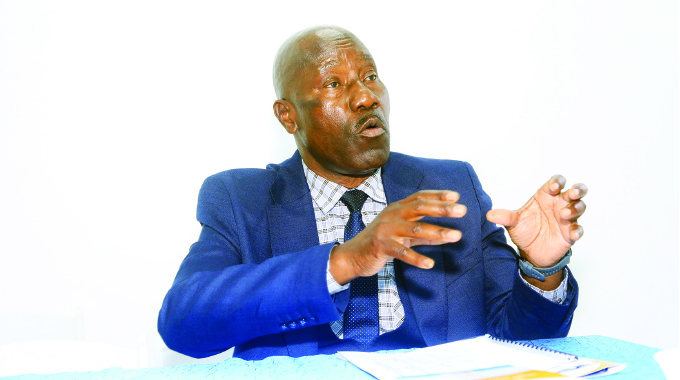
Joseph Madzimure
The revolutionary Zanu PF party recently appointed a new principal for Chitepo School of Ideology following the reassignment of the founding principal, Cde Munyaradzi Machacha to the Commissariat Department as secretary in the Politburo.
The new tsar at the Chitepo School of Ideology is Cde Ishmael Mada. Very little is known about Cde Mada who takes over the reins at the school.
Zimpapers Politics Hub’s Joseph Madzimure (JM) sat down with Cde Mada, (IM) to get to know more about the man and his vision for the school.
JM: Congratulations on being appointed principal of Herbert Chitepo School of Ideology?
IM: Thank you, Madzimure.
JM: Chitepo School of Ideology is an institution meant to stimulate national consciousness and prioritise national interest over anything else. What mechanisms are you going to put in place to fulfil the school’s mandate?
IM: Indeed, it is a daunting task, but where there is a will, there is a way. I have a vision to take the school forward, and I will share with you my vision, which has been broken down into short-, medium- and long-term.
In the short-term, we want to catch the young generation by introducing heritage clubs for learners in secondary school and at tertiary institutions.
This is a continuous programme for the schools. We will be working together with the Ministry of Primary and Secondary Education to establish these heritage clubs.
We believe working with the Ministry of Education will make it easier for the institution to spread its tentacles to the majority of the population.
The majority of our population is the youth, therefore we intend to work with the Ministry of Education to catch them young and bring them on board to be patriotic citizens.
In the short-term, we will also continue with the five-day basic orientation course.
This one is meant for all citizens, including you. We call it “Chiramba wasara in Chibuja”. Under this one, we want to restore Zimbabwean identity through an accurate historical perspective and ideological orientation.
We seek to ground our people to identify themselves as Zimbabweans first. Quite a number of our citizens have lost their identity.
This is what we want to restore; our Zimbabwean identity, and then be grounded on ideological orientation. We envisage that we will achieve cohesion in the nation.
In the mid-term, we have a 90-day cadre development course that we are planning, and this one will be targeting leaders in politics, the Government, and other sectors.
JM: What is the objective of the 90-day cadre development course?
IM: The objective of this one is to create a servant leader with integrity, one who is patriotic, loyal, honest, persistent, consistent, and perseveres in the educational course.
JM: When do you intend to commence this programme?
IM: Our plan is to commence this one in the first quarter of 2025.
In the long-term, we intend to develop the School of Ideology into a university that will offer a diploma and a degree in Heritage and Strategic Studies.
JM: Who is your target in this programme?
IM: We are targeting scholars, academia, tertiary institution learners, and those who are in high school.
As a school, we will affiliate with the institutions of higher learning, and our target is to have this one running by the first quarter of next year.
Still in the long-term, we intend to establish provincial Schools of Ideology.
We envisage to have one per province for all our 10 provinces, and the objective being to decentralise so that we enhance our outreach programme.
We are mandated to reach out to every citizen; so, decentralising will enable us to reach out to our people out there.
Our plan is that it should be up and running by the first quarter of 2027.
JM: Earlier on, you mentioned the establishment of heritage clubs. What are they?
IM: Under Education 5.0, there is now a subject that teaches heritage courses. This is basically a history lesson. Now as a school, we are proposing that at each learning institution, we will have clubs where issues are discussed with learners, and they go on tours of our liberation struggle sites in and outside the country. These tours will be coordinated through these clubs.
JM: Do you have age limits in your enrolment?
IM: It’s open for everyone. We do not have age limits. We want to reach out to every citizen.
JM: There is a notion that the Chitepo School of Ideology is specifically for Zanu PF members. How do you respond to this?
IM: No, that is not correct. This a national institution whose mandate is to decolonise the mind. We want to position every citizen to be a true Zimbabwean, who is aware of his or her history.
JM: How are you going to tap into the Diaspora community to enrol at the school?
IM: As a school, we have modules that are conducted online. Those in the Diaspora can access our modules so that we can reach out to them. They can interact with our resource persons whenever they need clarification, and we are available.
JM: Is there any payment required for one to enrol at the school?
IM: For the basic orientation, we are not charging anything. It is the institutions that organise themselves. What you only need to do is to engage with our administration. You come up with dates that are comfortable with you, and then we offer teaching. After completion, we will issue you with a certificate of attendance.
In the medium and long term, we will be levying a fee so the school can sustain itself. For the basic orientation course, which is conducted over five days, you do not pay.
JM: Do you also offer training to Youth Service in Zimbabwe graduates?
IM: Those are within our basket. We will continuously engage them.
JM: Lastly, your stakeholders want to know who Cde Mada is?
IM: I am a Zimbabwean citizen, born some 67 years ago in Bikita District, Masvingo, where I did my primary and secondary education.
The spirit to liberate my country which engulfed the entire nation during that period led me to be part of those that trekked outside the country’s borders to go and fight in the liberation struggle.
I joined the struggle in 1976 in Mozambique under Zimbabwe African National Liberation Army (ZANLA), and I did military training at Chimoio, Mozambique.
I was present when Chimoio was attacked by the Rhodesian forces on November 23, 1977.
I am one of the survivors. Recently I shared with colleagues when one of our commanders at Chimoio passed through my office; on occasions he accompanies students or learners going to Chimoio.
So, I just shared with him that, “you do not need to take me back there. I do not want to go there.” So, in 1977, I found myself at the war front.
I operated in Mutoko District to be specific, from 1977 until ceasefire.
This was Detachment A of Takawira Sector, Tete Province, where my provincial field commander was the late Air Chief Marshal Perrance Shiri.
JM: Thank you for sharing your vision for the school and a bit about yourself.
IM: My pleasure


 Online Reporter