dyton mupawaenda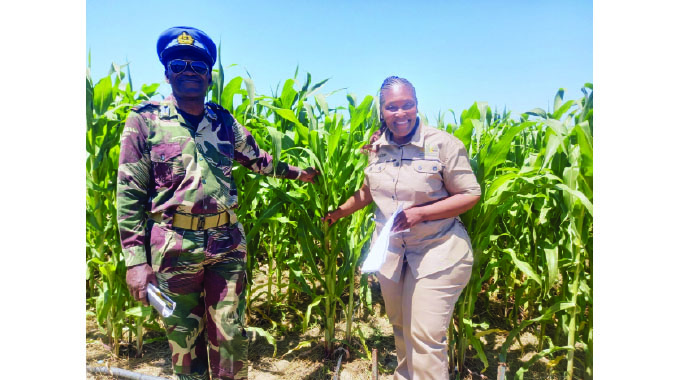
Patrick Chitumba-Midlands Bureau Chief
IN 2011, Ms Kudzai Katiyo benefited from the land redistribution programme as an owner of only three cattle.
Twelve years later, she is a proud owner of 130 heifers, makes her own feed formulation, runs a butchery and is an employer of 18 people, thereby contributing to the National Development Strategy 1 in line with Vision 2030 of an upper middle income society.
Ms Katiyo is the owner of Fig Tree 8 Farm, popularly known as WeUmambo Centre of Excellence, which is located in Somabula outside the City of Gweru.
Yesterday she was hosting participants from the Zimbabwe National Defence University Course Number 12/23, who were on a domestic study tour.
University Vice Chancellor, Air Vice Marshal Dr Michael Tedzani Moyo, led participants from the ZDF and allied participants from countries such as Nigeria, South Africa, and Zambia, among others, when they were taken on a tour of the farm by Ms Katiyo and her team.
The participants were left mesmerised by the works being done at the farm, which they said was a clear indication that President Mnangagwa’s philosophy, “Nyika inovakwa nevene vayo/ Ilizwe lakhiwa ngabanikazi balo”, is being implemented from the grass roots level.
Ms Katiyo, who also identifies herself as WeUmambo (of the royal priesthood) and talks authoritatively about livestock feed formulation, cross-breeding of cattle, disc harrows, or irrigation for pastures, is into livestock production concentrating on cattle ranching and cattle fattening.
Now, there are 130 cattle under cattle ranching and 30 at any given time under cattle fattening. There are cattle pens for ranching and fattening.
The purpose of cattle fattening is to increase the weight of the cattle over 90 days and to raise the quality of the beef.
Higher grade of beef generates more profit. Ms Katiyo has over 200 rabbits, goats, sheep and road runners.
She also has tractors, a borehole and has built herself a head-turning house at the farm, and competes well with some found in urban areas.
In an interview after touring the farm, Air Vice Marshal Moyo said the National Defence Course is broken into four terms that are Foundational Theory and Zimbabwe Domestic Studies, International Security Studies, National Security Studies and National Defence Building.
“Term one, in which we are, is when we have the domestic study tour which is designed to enable the participants to appreciate the endowment of our rich country Zimbabwe, and for this year, we requested to visit a farm and that is why we are here,” he said.
“There is an old adage that says ‘seeing is learning’, because our programme on national security covers all sectors from the infrastructure, economy, healthy, agriculture, mining and tourism and because we are on a tour farming is part of what we have decided as the theme of this year’s tour and we found this farm along the way.”
Air Vice Marshal Moyo said the Fig Tree 8 Farm tour was aimed at making the participants appreciate the importance of farming and the centrality of working hard to get what one wants as has been done by Ms Katiyo over the years.
“We wanted the participants to feel the need to work hard, starting from the bottom up and not like someone who has just won a lottery without working hard.
“This tour is a motivation to all; the work that has been done here speaks to NDS 1 and Vision 2030.
“We learnt plenty here, we learnt that it’s not about one having lots of money or big names, but perseverance, determination and hard work for one to achieve anything like what we have witnessed here,” said Air Vice Marshal Moyo.
Ms Katiyo told the visitors that as a beneficiary of the successful land redistribution, she moved onto the farm when it was just open land without any developments.
“A year later, I lost my husband in 2012. He was the breadwinner, so as a mother, I needed to brace up and be there for my two children and extended family,” she said.
Ms Katiyo said they had started with three cattle before building their way up to over 100 cattle.
“By 2015 my herd was growing and I had six employees. In 2017, I registered my company WeUmambo Holdings and today I have renamed this farm to WeUmambo Centre of Excellence because we are talking about development.
“We are talking about NDS1 and Vision 2030. We practice smart agriculture, we practice Pfumvudza/ Intwasa and we are into seed formulation, hay baling, cattle fattening and cattle ranching,” said Ms Katiyo.
She said from the cattle fattening programme, they do value addition and sell meat at their butchery in Gweru and in schools, hotels and other markets.
“The visit by (Air Vice Marshal) Dr Moyo and his team is a welcome development for us and we are going to work hard in line with the ‘Nyika inovakwa nevene vayo’ philosophy,” said Ms Katiyo.
One of the participants from the course, Group Captain Benedict Tongha from the Nigerian Air Force, said the visit to the farm brought to him some level of nostalgia as someone who grew up on the farm in his country.
“We have been exposed to the farm and how they have used the resources to improve food security for themselves and the country at large,” he said.
“They have been able to use the resources to enhance national food security which is commendable.
“Seeing this high level of production brought back old memories and by and large, having a smart farming system is the way to go. They have been able to mitigate against such challenges and kudos to the farm and for a lady spearheading this, they will go far.”
Group Captain Tongha said production and productivity at the farm shows that Africans can fix their own problems without support from outsiders.
“This is evident to the fact that as Africans we don’t need to wait for outsiders to bring us solutions. The solutions should be inside out and we must bring out what makes us Africans now, like working the land productively like what is happening here,” he said.
Colonel Stevens Mfana from the South African Defence Forces commended Ms Katiyo and her team for their hard work.
“This tour was an eye opener and I leant that we can do anything we want if we are determined like what is happening at this farm,” he said.
ZNDU was established through Presidential Proclamation 2 of 2017 with its pilot programmes enrolling students from Government institutions only.
However, it later opened its doors to the public in February 2021, and offers competitive academic study options in addition to serving as a national defence and security think-tank.
In tandem with the Ministry of Higher and Tertiary Education, Science Innovation and Technology Development’s new policy thrust on Education 5.0, the ZNDU nurtures research, teaching, community service, innovation and industrialisation to enhance national development.


 Online Reporter