dyton mupawaenda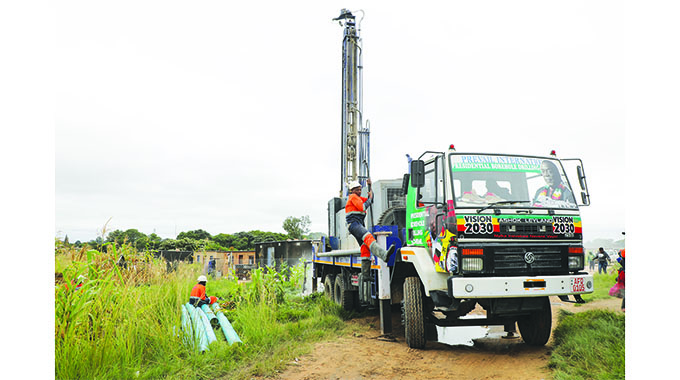
Precious Manomano-Herald Reporter
Villagers in Muzarabani have hailed the Government for bringing water for household and village gardens as that alleviates water challenges and helps to improve nutrition and household incomes.
Under the Presidential Borehole Scheme, families can now access clean water from solar powered boreholes and start community gardens that will ameliorate the majority of them as they grow horticultural products.
In every village there will be a community garden and a borehole, this is targeted in all 35 000 villages that are in rural areas.
The initiative is to support the vision of President Mnangagwa to bring water to people and leave no one and no place behind.
In an interview Muzarabani villagers indicated that this programme will eradicate water problems since the majority were travelling long distances in search of water.
Mr Gift Mubinyi said the programme is greatly appreciated as it gives an opportunity for villages to engage in life saving projects such as horticulture and gardening.
“The programme is greatly appreciated because it gives us the opportunity to acquire crops which do not do well in their region. Our area does not receive enough rainfall so with boreholes we can also grow maize to sustain our families. This programme is a welcome development which will enable us to diversify,’’ he said.
Mrs Joyce Mativenga said the programme will ensure that people will cut distances to get water.
“We are grateful to our Government because we used to walk long distances to get clean water. It was not easy but now we are proud of the efforts made to ensure that the majority get clean water. This will go a long way in alleviating the plight of people in rural areas.”
Mr Martin Chiguma said Government’s commitment is greatly appreciated, adding that this will ensure that communities lead decent lives.
“Water is life. We are glad that we can now introduce different projects that will sustain our families. Nothing meaningful can be done when people do not access clean water ,’’he said.
A total of 527 villages countrywide now have access to clean and safe potable water as the Government continues to make strides under the Rural Development 8.0 initiative.
Meanwhile,Zimbabwe National Water Authority (ZINWA) had successfully drilled 527 boreholes which are benefitting an equivalent number of villages.
The boreholes were drilled and equipped under the ongoing Presidential Rural Development Programme, which is being implemented by the Ministry of Lands, Agriculture, Fisheries, Water and Rural Development, through the Zimbabwe National Water Authority, Agricultural and Rural Development Authority (ARDA) and AFC.
The aim of the programme is to help uplift the standards of living for rural communities by among other things, reducing the distances traveled in search for water; a development that reduces the burden on women and girls who are largely responsible for fetching water in most households.
Apart from providing drinking water to households, the boreholes will also provide water for livestock and dip-tanks.
Of the 527 boreholes fitted with bush pumps, 69 are in Matabeleland North, 41 in Mashonaland East, 73 in Manicaland, 45 in Mashonaland Central, 32 in Mashonaland West, 44 in the Midlands, 81 in Masvingo and 27 in Matabeleland South.
The Presidential Rural Development Programme is part of the Rural Development 8.0 drive whose other components include the Pfumvudza, Presidential Cotton Scheme, Presidential Blitz Tick Grease Scheme, Presidential Goat Scheme, the Vision 30 Accelerator Model and the Presidential Poultry Scheme.
Under the Presidential Rural Development Programme, water is availed in all villages and schools as a constitutional right and as an economic enabler and this is meant to build resilience for rural communities.
The programme will also see ZINWA establishing a village business unit (VBU) in each of the country’s 35 000 villages. The VBUs, which will be registered as formal companies and with community members being both shareholders and employees will have a solar powered borehole, water storage tanks, fish ponds, a one-hectare drip irrigated horticulture project and communal water points as its components.
ARDA helps in the development of the VBUs’ business case and also provides them with agronomy services while AFC provides them with funding. The Agricultural Marketing Authority identifies markets for the VUBs for the uptake of their produce hence their activities are market driven.



 Online Reporter