Online Reporter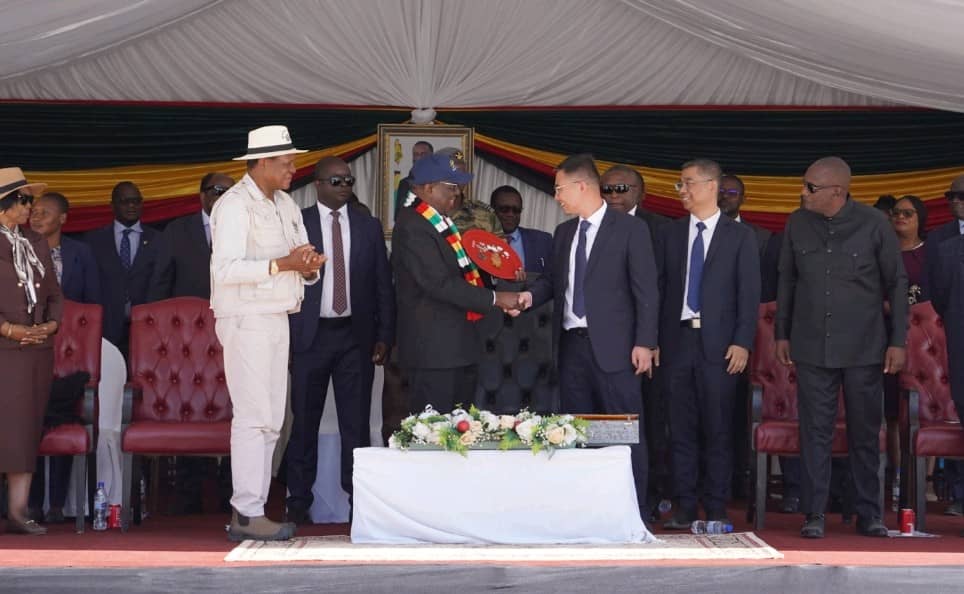
Patrick Chitumba Midlands Bureau Chief
The partnership between the Government and Packagers Hub and Famsun is poised to propel economic growth for the country in line with Vision 2030 following the construction of the state of the art Artificial Intelligence powered seven silos at the Grain Marketing Board depot in Kwekwe.
The silos were commissioned by President Mnangagwa recently making another milestone in infrastructure development as the country glides towards achieving an upper middle income economy by 2030.
During the commissioning ceremony, President Mnangagwa engaged in discussions with Mr Kian Wang, a senior executive of Famsun commending Packagers Hub and Famsun.
The 56 000-tonne facility, featuring seven state-of-the-art silos, is now functional after it received its first grain delivery on Sunday.
The Kwekwe silos are part of a nationwide infrastructure drive by the Second Republic to bolster the country’s strategic grain reserves. The project includes the construction of 14 modern silo complexes in key agricultural zones such as Beitbridge, Gwanda, Lupane, Gokwe, Masvingo, and Timber Mills in Mutare.
Each silo complex, including Kwekwe, has a storage capacity of 8 000 tonnes, contributing to a targeted national silo capacity of 1,5 million tonnes, up from the current 750 000 tonnes. This expansion is critical to cushioning the country against droughts, stabilising food prices, and reducing post-harvest losses.
Kwekwe District is a key grain-producing region, home to high-yielding farms such as the First Family’s Precabe Farm, which recently achieved an impressive 11,3 tonnes per hectare yield, surpassing past records. Other major producers include DCK Investments run by Mr. Douglas Kwande.
Until now, farmers in the region were forced to transport grain to silos in Chegutu, a costly journey that could exceed US$600 per 30-tonne trip. The new silos drastically reduce transportation costs and make storage more accessible.
“On May 5, President Mnangagwa inaugurated the Kwekwe Smart Grain Silo of the Grain Marketing Board (GMB), marking the completion of the first intelligent grain storage facility under the national grain storage network project,” reads part of the statement released by Packagers Hub and Famsun.
The government partners noted that the milestone signifies Zimbabwe’s entry into a new phase of modernized grain storage infrastructure and represents a critical step in the government’s strategy to enhance nationwide grain storage distribution, reduce post-harvest losses, and strengthen food security.
“Jointly constructed by Packagers Hub and Famsun, the National Grain Storage Network Project is a cornerstone of Zimbabwe’s “Vision 2030″ agricultural transformation agenda. Upon full operationalization of all 14 planned silos nationwide, the country’s total grain storage capacity will expand from 650 000 metric tons to approximately 1.5 million tonnes, ” reads part of the statement.
As the inaugural project of Zimbabwe’s modern grain silo upgrade initiative, Packagers Hub and Famsun noted that the the Kwekwe facility integrates IoT sensing technology, automated environmental control systems, and digital management platforms to monitor real-time critical parameters such as temperature, humidity, and grain moisture levels.
“Equipped with continuous drying systems, automatic ventilation units, and eco-friendly dust removal technology, it ensures end-to-end transparent management from grain intake to dispatch through automated loading/unloading systems, digital tracking, and intelligent inventory management,” said the statement.
Moving forward, Packagers Hub and Famsun plans to deepen collaboration with the Zimbabwean government and Southern African Development Community (SADC) member states, focusing on technological innovation and integrated agricultural supply-chain solutions to advance food sovereignty and sustainable agricultural practices across the region.
“The launch of the Kwekwe Smart Silo not only underscores Packagers Hub and Famsun’s technical expertise and mission-driven approach but also injects fresh momentum into the modernisation of agriculture for SADC nations and the broader African continent,” said the statement